general
Tinubu Is Praying for Nigeria While Nigerians Are Being Kidnapped
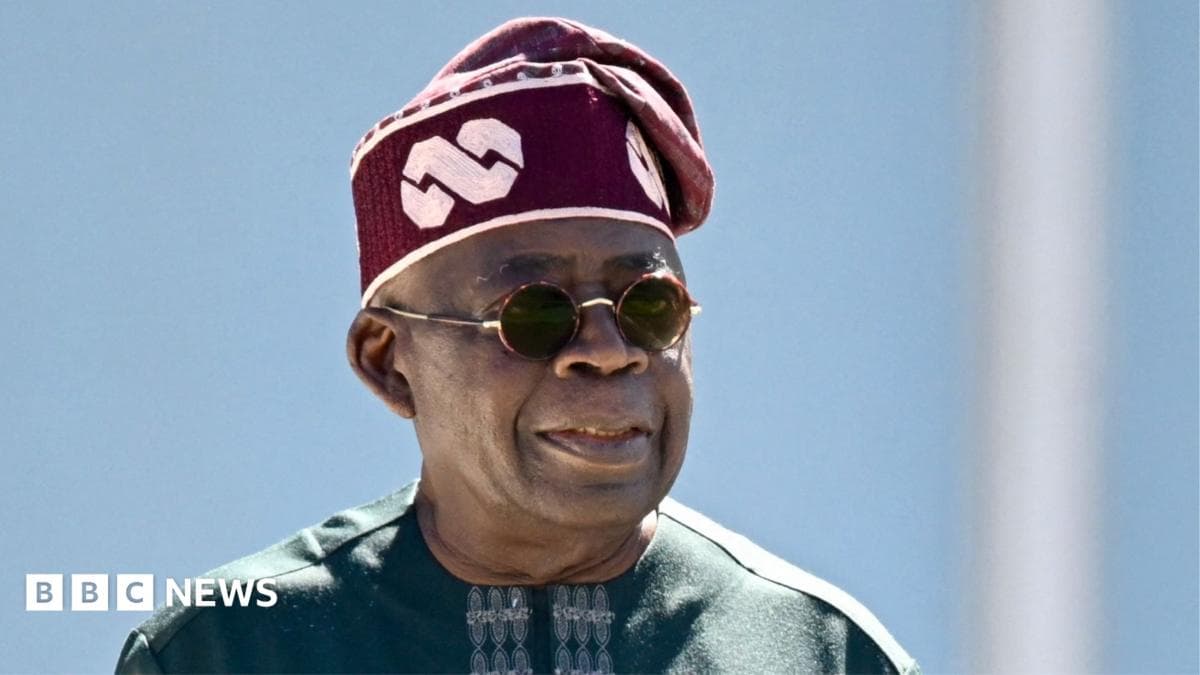
Ask a Nigerian mother in the northwest what her president is doing this week, and she will not say he is governing. She will say he is away. Bola Tinubu, at 74, is travelling to Mecca to perform Umrah, the lesser pilgrimage, and his office says he will pray for the peace, unity, and stability of a country that is bleeding out in full view of the world.
We are not against prayer. Most of us pray. But when a head of state uses a holy journey to ask God for the security that his government has failed to deliver, we are entitled to ask who is supposed to be doing the work. The answer, after nearly three years of this administration, should make every Nigerian uncomfortable.
Let us be precise about what we are being asked to accept.
Nigeria's next presidential election is scheduled for 16 January. Tinubu is seeking a second term. His main challengers are former Vice-President Atiku Abubakar and former Anambra State Governor Peter Obi. And the country's security crisis is now the central issue of the campaign. This is not a hypothetical problem. Nigeria faces an Islamist insurgency in the northeast, armed bandit gangs who loot villages and kidnap people for ransom across the northwest and north central regions, violent clashes over land and cattle in the Middle Belt, and separatist unrest in the southeast. Each of these has its own victims, and each has its own grave. The bandits do not care whether their captives are Christian or Muslim, northern or southern. They care about the ransom.
Consider what a kidnapping means in practice. A farmer is taken from his field. His family sells cattle, land, and whatever gold they own to pay. Some of them are never seen again. Consider what a school means in a district where armed men can ride in on motorbikes and take the children. Parents now debate whether to send their daughters to class at all. That is not a security problem for a statistics report. It is a generation being told that the state cannot protect them.
And now we are told that the president's trip is spiritual. His media aide, Olusegun Dada, has rejected speculation that the real reason is medical checks. The timing invites that speculation. A video went viral last weekend appearing to show the First Lady placing something into the president's mouth at the launch of the APC's re-election campaign. Millions of Nigerians have watched it. There has been no official explanation. Not a press briefing. Not a medical statement. Not a clear answer to a question that the Nigerian people have every right to ask.
Let us be clear about the principle. The health of a president is not a private matter when he is seeking to govern 220 million people. Nigeria's constitution provides mechanisms for handling a president who is incapacitated, including a formal written declaration to the National Assembly. Those mechanisms exist precisely because we have seen what happens when a leader disappears behind a curtain and his inner circle speaks for him. Silence in that situation is not dignity. It is a choice, and it is a choice made at the expense of the people who gave the president his mandate.
Why does this matter beyond one man's health? Because Nigeria has been here before. Power in our country too often rests on a small circle of loyalists, political godfathers, and security chiefs, while the citizen is told to trust, wait, and be patient. Patience has been the national slogan for decades. Meanwhile the naira has lost much of its value, inflation has eaten into wages, and the cost of basic food has climbed past what most families can bear. Nigerians are not asking for miracles. They are asking for a government that does its job.
The religious dimension deserves honesty too. More than 90 percent of Nigerians say religion is very important in their lives, according to Pew Research Center data, and the country is roughly evenly divided between Christians and Muslims. That is a source of pride and a source of enormous responsibility. Politicians who weaponize faith, who perform piety for cameras while the state abandons its citizens to armed groups, are exploiting the sincerest feelings of their own people. Prayer is personal. Governance is public. Confusing the two is how a country gets left in the dark.
So what should happen?
First, the presidency must disclose the truth about the president's health in writing, with a clear medical statement and a clear account of who is exercising executive authority during any absence. Transparency is not optional when the office is on the line. Second, the National Assembly should use its oversight powers to demand regular security briefings in public session, with figures on kidnappings, displacement, and police and military deployment by state. Third, INEC must be fortified and insulated from political pressure so that the 16 January vote is credible, observed, and accepted by losers as well as winners.
We do not have to look far for examples of what works. Botswana has built its reputation on institutions that outlast individual leaders, a judiciary that rules against the government, and a civil service that answers to the law rather than to a patron. Mauritius has used strong public institutions and open markets to grow into one of Africa's most prosperous economies. Senegal showed in 2024 that a sitting government that tried to delay an election could be forced back to the ballot box by its courts and its citizens, and that power could be handed over peacefully to the opposition. Ghana has repeatedly transferred power through the ballot. These are not perfect countries. They are proof that Africans can build states where the rule of law is real and leaders can be replaced without bloodshed.
Nigeria has the people, the talent, and the resources to join them. What it lacks is a political class willing to put institutions above its own survival. Civil society, business associations, and the press must hold every candidate to specific commitments on security, on electoral integrity, and on the economy. Markets function when property rights are protected and contracts are enforced. Investment follows security. A farmer who can plant without fear of being kidnapped is an economic policy in himself.
So here is our demand, and it is not complicated.
We demand that President Tinubu answer the health questions openly, now, before a single vote is cast. We demand that the government explain, in public, how it intends to stop the bandits, the jihadists, and the land-driven killings that have turned whole communities into graveyards. We demand that the 16 January election be free, fair, and accountable to the people who cast their ballots. And we demand that every candidate who asks for our trust name the specific policies they will use to earn it.
Pray if you wish. We will pray too. But do not ask Nigerians to pray for a government that will not answer their questions, protect their children, or show them the face of the man who claims to lead them. Nigeria does not need a leader who seeks blessings from heaven while ignoring the cries from the ground. Nigeria needs a leader who gets up, faces the country, and does the work.
Based on reporting by BBC