spotlight
Kagame's Army Is Invading Congo While Africa Looks Away
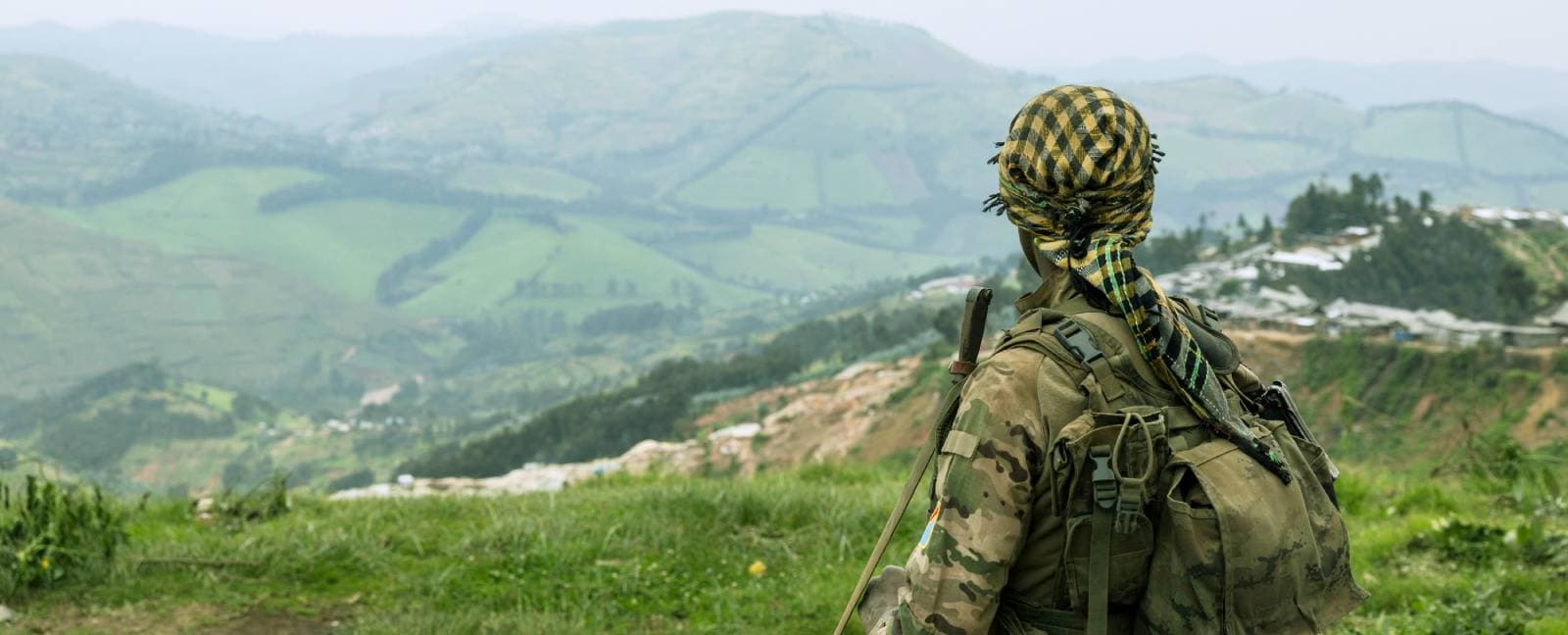
Let us say the thing that everyone in the room knows and few will say out loud. More than 1.1 million Congolese have been driven from their homes since M23's offensive began in December 2024. Some 7,000 people, most of them civilians, are believed dead. Mothers are burying children in towns whose names will never appear in a diplomatic communiqué. And the force that has taken Goma, Bukavu, and vast stretches of North and South Kivu is not a homegrown rebellion. It is the Rwandan Defence Force, fighting a war of aggression across a sovereign border, wearing M23 as a mask.
We have heard the word "rebel" so often that it has lost its meaning. A rebellion is a people rising against its own state. What is happening in eastern Congo is a neighbor marching across the frontier with tanks, artillery, drones, and tens of thousands of troops, then putting a local face on the occupation. Strip away the euphemisms and the pattern is familiar.
Consider the evidence, which is extensive and documented. The UN Group of Experts on the DRC, in its reports including S/2025/446, has detailed the deployment of RDF combat units inside Congolese territory, operating as the core of M23's fighting capacity. Independent open-source investigators have tracked the movements, the artillery positions, and the weapons systems: Bayraktar TB2 drones operating from Kamembe, FPV drones, and Israeli-supplied GPS-guided mortars that have rained down on towns full of civilians. Satellite imagery of the Kanombe military cemetery near Kigali shows more than 1,171 new graves dug since 2021. Think about that number. A government that claims it has no soldiers in Congo is quietly burying them at home, because admitting the dead would mean admitting the war.
The estimates of Rwandan troop strength run from 14,000 to 18,000 soldiers, equivalent to roughly 40 to 50 percent of Rwanda's entire army. Fourteen thousand young men sent to kill, occupy, and loot a neighboring country. Forty percent of a nation's army is not a rebel movement. It is an invasion force. If the world calls Russia an invader for backing Donetsk and Luhansk with its own units and weapons, then the same logic applies to Kigali. Rwanda is the invader. Period.
M23 itself has grown from roughly 3,000 fighters to more than 30,000, and the UN experts have documented the forced recruitment of Congolese civilians and captured prisoners of war. Men are press-ganged from villages, handed rifles, and sent to the front. This is slavery in military uniform, and it is the ugliest part of a conflict already soaked in blood. Those who refuse are beaten or killed. Those who run become refugees. Those who stay become soldiers in someone else's war.
And then there is Kigali's reputation. Rwanda hosts international conferences, markets itself as a clean, orderly destination, and sells gorilla tourism to visitors who are never told that the government's soldiers are massacring Congolese civilians a few hundred kilometers away. Sportswashing is the polite term. We should call it what it is: a government buying applause while its army burns villages. Every visitor who posts a photo from the Virunga foothills is, unwittingly, helping to launder the reputation of a war machine. We will keep naming this hypocrisy every time it surfaces, because silence is how it survives.
The wider context makes this worse. Congo's own state is far from blameless. The Tshisekedi government's disputed electoral victories in 2019 and 2024 and its push to amend the constitution for a third term have hollowed out public trust. The national army, with about 150,000 personnel on paper, is undisciplined, underpaid, and riddled with parallel chains of command. Kinshasa has leaned on Wazalendo militias and Eastern European mercenaries, and some police and army units have reportedly defected to M23. Those are real failures, and we will not excuse them. But a weak state being invaded is not a justification for the invasion. A house with bad locks does not give the burglar the right to move in.
Here is the part that should embarrass every African capital. The Second Congo War ended not because the world lectured the belligerents, but because Africans sat down together. The Inter-Congolese Dialogue, mediated by Ketumile Masire of Botswana with South African backing under Thabo Mbeki, produced the Sun City Accords in 2002. Those accords brought armed groups, the unarmed opposition, civil society, and influential professional bodies into one room. Roughly 40 percent of the signatories came from civil society. The result was a new constitution in 2005, a national election in 2006, and a National Assembly that conducted 43 independent investigations and sanctioned ministers during its early years. Article 32 of those accords recognized that the manipulation of nationality was a root cause of Congo's wars, and it demanded real political will to resolve it. That was the diagnosis then. It is the diagnosis now. Thabo Mbeki himself has said the core issues have not changed.
So why is the continent still stuck? Because the current mediators are fragmented. The AU's panel of former presidents, which includes Uhuru Kenyatta, Olusegun Obasanjo, Kgalema Motlanthe, Sahle-Work Zewde, and Catherine Samba-Panza under Faure Gnassingbé's coordination, is supposed to fuse the Luanda and Nairobi tracks. It cannot succeed if Rwanda is treated as a party to a "dispute" rather than as an aggressor, and if Kampala's dual role in Ituri and the Kivus is left ambiguous. Peace negotiated with an invader still sitting on the territory it occupies is not peace. It is a surrender with better paperwork.
Here is what must happen, and it is not complicated. The AU Peace and Security Council must name Rwanda's intervention for what it is and demand the immediate, verifiable withdrawal of RDF forces from Congolese soil. The UN Security Council must enforce its arms embargo on non-state groups and sanction every individual and entity, state or otherwise, that supplies, finances, or commands M23 operations. The drones and mortars must be tracked to their origin and the suppliers held accountable. Mineral supply chains, including the coltan and gold that fuel this war, must be traced and audited under OECD due diligence standards so that every smartphone and jewelry box stops financing the guns. And Congo must resolve its citizenship question through law and courts, not through ethnic incitement by Kinshasa or cynical manipulation by Kigali. The Banyamulenge deserve clear, equal citizenship, and so does every other Congolese.
Africa already has proof that the better path works. Botswana built one of the continent's most stable democracies on disciplined public finances, strong institutions, and a mining sector managed with transparency. Mauritius shows what rule of law and open markets can deliver to a small nation. Senegal, in 2024, proved that a court and a citizenry can stop a president trying to stretch his term, and that peaceful alternation remains possible. Rwanda's economic achievements are real, but a model that is built on a neighbor's looted minerals and an army that kills across borders is not one we should copy. Prosperity that rests on another people's blood is not development. It is plunder with a press office.
So here is our demand. Enough of the euphemisms. Enough of "both sides." Congolese civilians have been displaced, enslaved, and buried in their thousands while the world debates vocabulary. We demand that the AU call this invasion by its name. We demand that the UN Security Council move from statements to sanctions. We demand that Kigali withdraw its soldiers and open its graves to independent investigators. We demand that Kinshasa stop using war as cover for electoral manipulation. And we demand that every African citizen who reads this article refuse to treat Congo's agony as a distant story. Share the reports. Question your government. Ask your ambassador why Congolese lives are worth less than diplomatic comfort. This is our continent. The question is whether we will defend it or keep looking away.
Based on reporting by ACSS