general
Dangote Is Right. Our Leaders Are Why Africa Still Waits.
Nigeria exports crude oil and imports the petrol that its people burn. For decades, a country sitting on some of the largest oil reserves in Africa has paid foreign refiners to turn its own resources into fuel, then paid again to bring that fuel home. Ask a Lagos driver what that means, and he will tell you about the queue at the filling station, the price he cannot afford, and the politician who promised to fix it in the last election.
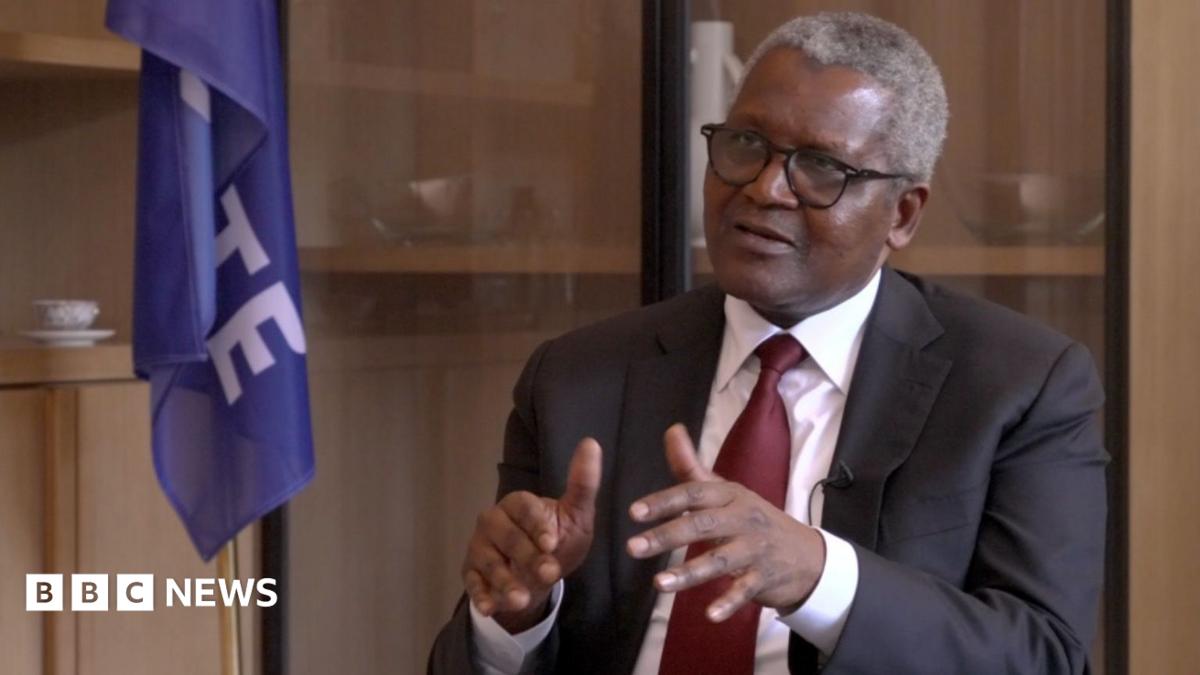
Aliko Dangote, Africa's richest man, has spent years saying what most of us already feel. In a recent interview with the BBC's Nkechi Ogbonna, he told the continent that "nobody can make Africa great but us." He did not say it as a slogan. He said it as a man who built a refinery in Lekki with a capacity of 650,000 barrels a day, a plant meant to end the pattern of exporting raw wealth and importing finished misery. Whatever you think of his business, his point stands. Our future is not in Beijing's loan office, Washington's aid committee, Abu Dhabi's port contracts, or Moscow's mercenary camps. It is in our own hands, and that is exactly why it has been so hard to hold.
Look at what the last thirty years have taught us. Foreign governments and their corporations have every reason to keep Africa as a supplier of raw material and a buyer of finished goods. China builds our roads and then holds our ports as collateral when the debt comes due. Gulf states buy farmland and ports while their citizens get the jobs and the profits flow home. Russia sells us weapons and "security" through Wagner and its successors, and in exchange takes gold, diamonds, and political loyalty from regimes that have stopped answering to their own people. Turkey sells drones and sets up bases. The old European powers still lecture us about democracy, then sign minerals deals with the same dictators they condemned in their speeches. Different flags, same extraction. This is the New Scramble for Africa, and it is not going to end because we ask it nicely.
Now look at the place where this scramble is bleeding us most. In eastern Congo, the UN Group of Experts has documented for years the presence of Rwandan Defence Force units inside DRC territory, operating alongside the M23 movement. The experts' estimates of Rwandan troop strength run into the thousands, including combat units that form the operational core of the campaign, while M23's ranks have swollen by forced conscription of Congolese civilians and captured prisoners. Men are taken from their villages and put on the front line. Boys who should be in school are handed rifles. This is not a local rebellion that got out of hand. It is a war of aggression by a neighbouring state, and the mineral routes that fund it run through the same supply chains that power the phones in our pockets and the electric cars the West wants to buy.
Think about what that means. The Democratic Republic of Congo produces most of the world's cobalt. Its eastern provinces hold tin, tantalum, tungsten, and gold. In January and February 2025, M23 seized Goma and Bukavu, two major cities, and the displacement that followed has left millions of Congolese homeless. Mothers are burying children in camps that the world has agreed to call a "humanitarian crisis" instead of what it is: a crisis created by an invader and sustained by the silence of people who claim to care about human rights. Kigali, meanwhile, markets itself as a clean, orderly model of development, hosts international conferences, and sells gorilla trekking to tourists who never see the graves. When a government invades its neighbour and still runs the victory parade, the hypocrisy is not a footnote. It is the story.
This is where Dangote's line cuts both ways. Yes, Africa must be made great by Africans. But we cannot be made great by an African government that sends its soldiers across a border to loot, and we cannot be made great by African elites who treat state contracts as private property. Every time a minister signs a mining licence in a back room, every time a fuel subsidy vanishes into a cabal's accounts, every time a judge rules on a case with a phone call from the presidency, we hand the continent's future to whoever is willing to pay the bribe. Nobody outside Africa is forcing us to do that. We are doing it to ourselves, and then blaming the foreigners who were only too happy to accept.
The solution is not a mystery, and it is not some grand continental project. It is the boring, unglamorous machinery of freedom. Botswana built one of the most prosperous economies in sub-Saharan Africa on strong property rights, sound fiscal management, and a diamond industry governed by transparent contracts. Mauritius turned itself from a sugar island into a financial and services hub by protecting investors and enforcing its rules. Senegal, for all its challenges, has shown that power can change hands peacefully through the ballot box, and that a democratic transition is worth more than any strongman's promise of stability. Rwanda's economic planning deserves study, but its record of aggression in Congo must be named every time its success is praised. These countries prove that Africa does not need to choose between prosperity and freedom. It needs both, and it needs them to be non-negotiable.
So what do we demand? We demand that every mining, energy, and infrastructure contract be published in full, with beneficial ownership disclosed, so that no official can sell the national patrimony in secret. We demand local-content rules that force foreign investors to build processing capacity at home, the way Dangote's refinery is supposed to do for fuel. We demand independent courts that can rule against a president, a general, or a foreign embassy without fear. We demand that our parliaments, not our security services, decide whether our soldiers fight abroad. And we demand that the African Union stop issuing communiqués about "concern" and start imposing real costs on any member state that invades a neighbour, including suspension, sanctions, and an end to the impunity that makes aggression look profitable. The UN Security Council must stop hiding behind procedure while Congolese civilians die, and its members must apply to Rwanda the same standard they apply to Russia when Russian tanks cross into Ukraine. If it is an invasion in Donetsk, it is an invasion in North Kivu.
Finally, this is for us. Citizens, journalists, business owners, students, and civil society groups must refuse the comfortable lie that corruption is just how things work and invasion is just how regional politics goes. Vote for leaders who can show their contracts. Support the reporters who expose the mineral smugglers. Buy from the local manufacturers who pay taxes and hire workers. Shame the officials who take the money, and the foreign governments that look the other way. Nobody is coming to make Africa great. Dangote is right about that. The question is whether we will accept it as a challenge or keep waiting for someone else to save us, while our children learn the cost of our silence.
Based on reporting by BBC