analysis, rwanda-in-congo, europe
Europe's Rwanda Migrant Deal Legitimizes Africa's Longest War of Aggression
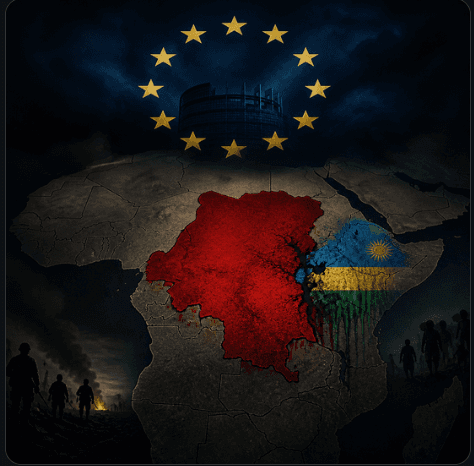
Would Europe pay Russia to take its migrants while Moscow bombs Kyiv? That is exactly what it is doing with Rwanda — a country waging a 30-year war of aggression against the Democratic Republic of Congo that has killed over six million people.
Several European nations — the Netherlands, Germany, Austria, Denmark, and Greece — are negotiating a deal to deport rejected asylum seekers to Rwanda. A pilot program for roughly 100 migrants is already under discussion, with a ministerial meeting scheduled for November 16, 2026 in Vienna. Rwanda has signaled its willingness. The United Kingdom previously attempted a similar deportation scheme with Kigali, but it was struck down by the Supreme Court before a single flight took off — after costing British taxpayers over £700 million. The United States has also deported migrants to Rwanda.
On the surface, European governments frame this as a pragmatic migration policy. But the reality is far more damaging: by entering into a commercial partnership with Kigali, Europe is rewarding and legitimizing a regime that is, at this very moment, orchestrating one of the deadliest conflicts on Earth.
The War Europe Refuses to See
Since 1996, Rwanda has repeatedly invaded its western neighbor, the Democratic Republic of Congo. Under the cover of proxy groups — most recently the M23 militia, which the United Nations has extensively documented as a Rwandan military front — Kigali has occupied vast swaths of eastern Congo, plundered its mineral wealth, and committed atrocities against civilian populations.
The toll is staggering. More than six million people have died as a result of Rwanda's interventions in the DRC since 1996, making it the deadliest conflict since World War II. Father Apollinaire Cibaka Cikongo, a Congolese priest and scholar, has suggested the true toll may exceed 12 million when accounting for the full span of the conflict. Seven million Congolese are currently displaced. In January 2025, M23 forces backed by the Rwandan military launched a devastating assault on Goma. The UN reported nearly 2,900 people killed in the battle — bodies recovered from the streets and hospital morgues. A separate UN investigation documented at least 319 civilians executed by M23 forces during the offensive.
These are not historical footnotes. This is happening now, while European ministers sit across the table from Rwandan officials and negotiate migrant deportation fees.
The Double Standard: Rwanda vs. Russia
The hypocrisy is breathtaking when measured against Europe's response to Russia's war against Ukraine.
When Russia invaded Ukraine in February 2022, Europe responded with unprecedented sanctions: asset freezes on Russian elites, energy embargoes, weapons shipments to Kyiv, diplomatic isolation of Moscow, and a marshaling of the entire Western alliance. The message was clear — a war of aggression against a sovereign neighbor would not be tolerated.
Now ask the question Europe refuses to answer: Would any European government pay Russia to accept its unwanted migrants while Russian forces shell Ukrainian cities? Would Berlin wire money to Moscow for "migration management" while Russian missiles flatten apartment buildings in Kharkiv? The suggestion is absurd. It would be seen, rightly, as financing a war criminal.
Yet this is precisely what Europe proposes to do with Rwanda.
Rwanda's war against the Congo has lasted far longer than Russia's war against Ukraine — 30 years versus four. It has killed far more people — over six million versus an estimated 600,000 combined military casualties. The displacement is worse, the humanitarian crisis deeper, the resource plunder more systematic.
And yet Europe's response to each conflict could not be more different.
For Russia: sanctions, isolation, arms embargoes, International Criminal Court warrants, and moral clarity.
For Rwanda: business deals, migration partnerships, and willful blindness.
What Money Buys
Every euro Europe pays Rwanda under a migrant deportation scheme flows into the coffers of a government that funds and directs the M23. This is not abstract. The UN Group of Experts has documented, in report after report, that Rwanda provides M23 with weapons, troops, logistics, and command-and-control. Rwandan Defense Force officers have been identified on Congolese soil, directing operations.
Europe knows this. The EU has imposed limited asset freezes on some M23 commanders and Rwandan military officials. But these are token gestures — symbolic enough to claim concern, insufficient to impose any real cost. Human Rights Watch has repeatedly criticized the EU for failing to take additional meaningful measures against Rwanda.
A migrant deal turns the relationship from token pressure into active reward. It tells Kigali: your war against Congo will not affect our willingness to do business with you. It tells Congolese civilians: your six million dead are worth less than Europe's migration politics.
The Real Calculus
The uncomfortable truth is that Europe's double standard is not accidental. It is structural.
Russia threatens European security directly. Ukraine is geographically, culturally, and politically proximate to Europe. The war there disrupts European energy markets, creates refugee flows into European cities, and challenges the European security architecture.
Congo is far away. Its minerals — coltan, cobalt, tin, gold — flow into European supply chains regardless of who controls the mines. The victims are Black Africans whose suffering does not feature on European evening news. The war does not disrupt European daily life. And Rwanda, despite being an aggressor state, presents itself as a stable, well-governed partner — a narrative European capitals are only too happy to accept because the alternative would require action.
This is the same logic that enabled European colonizers to carve up Africa at the Berlin Conference of 1884. African lives weighed against European convenience, and found wanting.
A Test of Principle
Europe claims to stand for the rules-based international order. It claims that wars of aggression are unacceptable. It claims that sovereignty matters, that civilians must be protected, that aggressors must face consequences.
The Rwanda migrant deal is a test of whether any of this is true, or whether "rules-based order" is simply a phrase Europe deploys when its own interests are at stake and discards when they are not.
If Europe proceeds with this deal, it will have answered its own question. The rules-based order applies to Europe's neighborhood. In Africa, the rules are whatever is convenient.
Six million Congolese dead deserve better than to be a footnote in Europe's migration spreadsheet.
Based on reporting by REVVMARK