spotlight
Beijing Is Using Egypt's Skies to Rehearse Its Wars
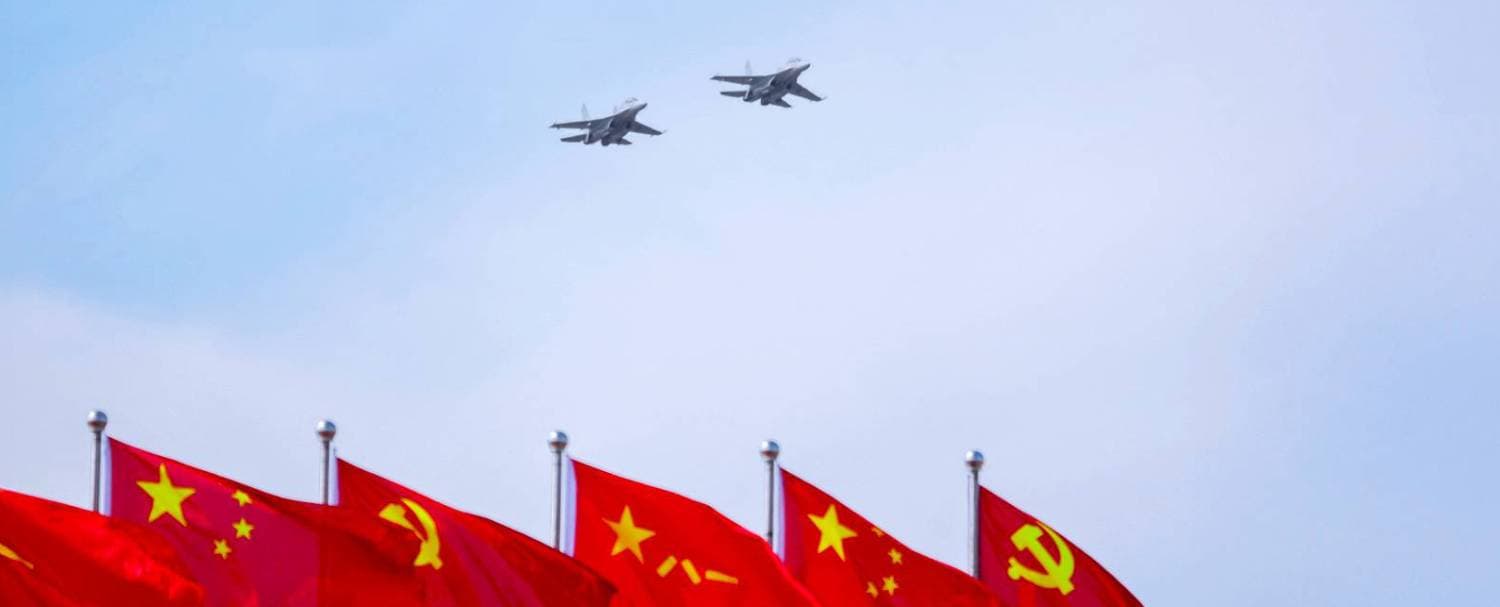
Six Chinese fighter jets crossed more than 6,000 kilometres, two continents and four countries, in roughly nine hours. They were refueled in the air, loaded for combat, and flown into Egypt to train against the best Western fighters the continent can buy. Nobody in Cairo's parliament debated it in public. Nobody at the African Union asked whether our skies should be a rehearsal stage for another great power's ambitions. Who gave permission for this?
The exercise was called Eagles of Civilization 2026. The Chinese package included six J-16 fighters, two YY-20A tankers, two Y-20A strategic transports, a KJ-500 airborne early warning aircraft, two Z-20K helicopters, and a Y-9 aircraft for localized radar jamming and suppression. This was not a friendly flyover. The drills covered beyond-visual-range combat, air superiority, air-to-ground strikes, and suppression of enemy air defenses. The PLA Air Force was practicing the full choreography of modern air war. The lesson for Africa is that the choreography is not designed for us.
The most revealing detail is the opponent. Egypt flew French-built Rafales against the Chinese J-16s, a step up from 2025, when Cairo's MiG-29s sparred with Chinese J-10s. The Rafale duels moved from one-on-one to two-on-two and then to larger formations. For the first time, a Chinese fighter fought a Western fighter outside Asia. Beijing did not simply buy a training partner. It bought a laboratory in which to test its aircraft against Western engineering, and it used an African government's airspace to do it. Meanwhile, the same week, the PLA ran parallel drills with Belarus and with Thailand, where Chinese J-10s sparred against Swedish Gripens. This is a global campaign. Africa is one of its theatres.
Then came the moment that should have made every African capital sit up. Xi Jinping made a state visit to Egypt during the exercise, accompanied by members of the Central Military Commission, men who rarely leave China. When the head of the most powerful military in the world travels with its top generals to watch jets rehearse against Western fighters on African soil, that is not an accident of scheduling. That is strategy, and it is being written partly in our airspace.
This is not new. Between 2000 and 2026, China conducted 24 exercises in Africa, and they have grown steadily larger and more lethal in intent. In 2024, the Peace Unity drill with Mozambique and Tanzania became China's largest African deployment since the 1960s. It included amphibious assaults and the first use of Y-20 strategic transports and Type 071 landing ships on the continent. The exercises also served as a logistics dress rehearsal for a base in Djibouti, opened in 2017, and a 2019 Tanzania drill involved units from the PLA Eastern Theater Command, the same command responsible for Taiwan contingencies. Read that carefully. Tanzanian soil was used to rehearse operations tied to a dispute that has nothing to do with Africa.
Officials in Beijing call this partnership. But notice how little of it strengthens African forces. Analysts following these exercises, including Tewodros Woldearegay, describe a model of "access without basing" that lets China project power across the continent without the political cost of permanent bases. African governments get a few training days and a catalogue of weapons. China gets operational data, logistical experience, and a reliable network of friendly airspace. Meanwhile, analysts such as Lungani Hlongwa warn that the same demonstrations fuel arms sales and that a flood of unverified online claims about the J-16's superiority is itself a marketing tool. We are being sold jets with the same tactics used to sell phones: loud claims, selective data, and no independent verification.
The arms pipeline is already moving. Reports say Algeria was preparing to receive J-10C fighters and KJ-500 aircraft in mid-2026. Namibia, Nigeria, Sudan, Tanzania, Zambia, and Zimbabwe already operate Chinese J-series aircraft or export derivatives. Every new jet is a new maintenance contract, a new dependence on spare parts, a new training pipeline, and a new doctrine. Once the instructors and the software come with the hardware, the buyer is no longer simply purchasing a machine. The buyer is adopting Beijing's standards, and those standards are written in Beijing.
Think about the arithmetic of this dependence. China has built roads, ports, and railways across our continent, and much of that lending has come with terms that tie our governments to Beijing's priorities and make our finances vulnerable to its decisions. Now the same relationship is extending into the air force. Debt for infrastructure, weapons for influence, training for doctrine. Each step looks reasonable on its own. Together, they form a web. Ask any government that has tried to renegotiate a Chinese loan or cancel a contract how much room they had to say no.
Egypt deserves its own scrutiny, because hypocrisy works in every direction. Cairo has spent a decade buying weapons from France, Russia, China, and others, while its own citizens have been jailed for speech, detained without trial, and silenced by a security state that took power through a military intervention in 2013. A government that cannot allow its people to criticize its budget should not be trusted to decide, on their behalf and without their consent, which foreign air forces train in their skies. Sovereignty without accountability is just the rule of the barracks with a diplomatic passport.
So what must change? First, parliaments across Africa must demand full disclosure of every foreign military exercise, every visiting military delegation, every training agreement, and every arms contract before it is signed. No secret annexes. No classified airspace deals presented as fait accompli. If a foreign air force wants to fly over our territory and practice combat, its visit should come before our elected representatives, and the public should know what it costs and what it gives us in return. Second, the African Union's Peace and Security Council should adopt binding transparency standards for foreign military activity on the continent, the same standards it would demand from any European or American power. Third, African nations should practice real nonalignment, which means diversifying suppliers, insisting on competitive tenders, demanding technology transfer and local maintenance, and refusing any package that comes with political strings or exclusive doctrinal requirements.
The success stories show us the path. Botswana has built one of the most stable democracies on the continent by insisting on transparent governance, a strong judiciary, and a civil service that answers to the public. Mauritius has grown into a prosperous, open economy because its institutions protect property rights and reward competition rather than connections. Senegal proved in 2024 that a population organized around the ballot box can change the government without bloodshed, and that the institutions can hold. These countries are not perfect, but they all share one lesson. When citizens have the information, the institutions, and the right to say no, foreign powers have to negotiate honestly. Africa does not need a patron. It needs a constitution it respects and a public that is watching.
And the citizen has power too. Ask your MP where the Chinese jets are landing and who pays for the fuel. Ask your finance minister whether the loan that built your highway comes with a clause that gives Beijing leverage over your budget. Ask your editors why state media repeats Chinese marketing claims without checking them. Demand that every arms deal be published, every debt contract be audited, and every foreign military visit be debated in the open.
Eagles of Civilization 2026 was a rehearsal. The question for Africa is whether we will keep being the stage, or whether we will finally demand a seat in the room where the script is written. The skies above Egypt belong to Egyptians, and the skies above the rest of the continent belong to us. It is time we stopped letting other people's wars be practiced on our soil.
Based on reporting by ACSS