security
Russia Vetoed the Last UN Watchdog in Western Sahara
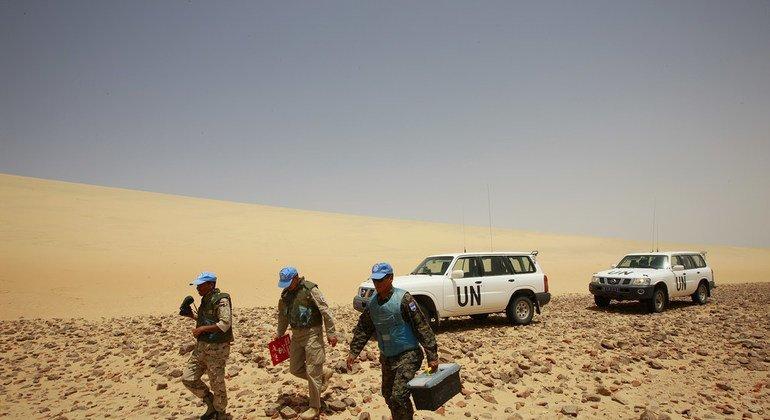
Thirty-five years. Twenty peacekeepers dead. And at midnight on Saturday, the blue-helmeted presence that was supposed to guarantee the Sahrawi people a vote on their own future simply stopped existing.
The UN Security Council could not agree on what came next. A draft resolution from the United States was vetoed by Russia. A rival Russian text, proposing a one-year extension to 31 October 2027, failed to win the nine votes it needed. So the Mission for the Referendum in Western Sahara, MINURSO, wound down. Its headquarters in Laayoune and its nine team sites will now be dismantled, and a small team under the UN Department of Operational Support will sell or scrap the equipment. The people who were supposed to be counted, and the people who were supposed to be watched, are left to the parties that have been arguing over them for half a century.
We should be honest about what that means. This is not a peace process. It is a lock with the keyholders leaving the room.
Russia's ambassador called his veto "a life-saving veto, so to speak." Ask the Sahrawi families who have waited since 1975 whether they feel saved. Ask the mothers in the Tindouf camps in Algeria, who have raised children in tents for nearly five decades, what a life-saving veto looks like from where they sit. Moscow has presented itself as the defender of the weak and the neutral arbiter of the strong. In this Council chamber, on this file, it chose the status quo and called it mercy.
Consider the record. MINURSO was created by Security Council resolution 690 in 1991, in line with settlement proposals that Morocco and the Frente POLISARIO accepted in 1988. Those proposals promised a referendum in which the people of Western Sahara would choose between independence and integration with Morocco. That referendum has never taken place. Not in 1992, not in the decades of promises that followed, not in the years when the mission was counting voters who never got to vote. The ceasefire that MINURSO was built to monitor collapsed in 2020, and the Secretary-General's own statement now warns of "the risk of hostilities escalating." When a referendum is never held and a ceasefire is allowed to rot, the people who pay are not diplomats. They are herders, students, prisoners, and families.
Here is the uncomfortable truth that no party to this conflict wants said out loud. MINURSO's mandate never included monitoring human rights in the territory. For decades, independent journalists have struggled to reach Western Sahara. Human rights organizations have documented arrests and prosecutions of Sahrawi activists in Moroccan-administered areas, and restrictions on those who speak against the status quo. Meanwhile, the Polisario-run camps near Tindouf have their own problems: a population whose exact size has been disputed for years, limited ability to move or speak freely, and a leadership that has never faced a competitive election. Every party in this dispute claims to fight for the people. Almost none of them will let the people speak freely.
That is why the absence of a monitor should terrify us. Without UN personnel on the ground, nobody is counting, nobody is documenting, and nobody is asking the uncomfortable questions in Laayoune, in Tindouf, or in Rabat and Algiers. Impunity thrives in silence. The mission's 200 civilian staff and military observers from more than 35 countries were imperfect, and their mandate was too narrow. But they were a witness. Now the witness is leaving.
Let us also name the broader game. Western Sahara sits on one of the most valuable fishing grounds on the African Atlantic coast and on phosphate reserves that the world's farmers depend on. Foreign capitals, from Washington to Moscow to Algiers to Rabat, have each treated this territory as a chess piece in larger contests over the Maghreb, the Sahel, and access to Europe. The Americans want a deal that suits their security calculations. The Russians want leverage they can trade. Algeria wants to keep Morocco contained. Morocco wants international recognition of its 2007 Autonomy Proposal, which would make the territory self-governing under Moroccan sovereignty. Every great power has a file on this conflict. Almost none has a plan for the people in it.
And this is where we must hold our own house to account. Self-determination is not a bargaining chip, and it is not a slogan to be deployed when it suits a patron. A people who have been denied a vote for fifty years have the right to one. Autonomy can be a serious and dignified outcome, but only if the people themselves consent to it through a free and fair process, with independent observers and genuine freedom of expression. Independence can be a serious demand, but it too must be decided by ballots, not by the barrel of a gun or the veto of a foreign ambassador.
So what must happen next?
First, the Security Council must not treat this silence as an acceptable outcome. The Council should reconvene urgently and mandate a credible, independent human rights monitoring presence in Western Sahara, with unrestricted access for journalists and civil society. Human rights are not a foreign imposition on this conflict. They are the minimum condition for any fair vote.
Second, the African Union, which has its own history with this question and its own voice on the Maghreb, should appoint a high-level envoy with a mandate to press all parties toward a negotiated outcome that includes a voter registry open to Sahrawis in the territory and in the camps, supervised by neutral observers. Africa has learned, from painful experience, that elections without fair rules become the instrument of the powerful. We should insist on the opposite.
Third, the parties themselves, Morocco, the Polisario Front, and Algeria, should accept that a durable solution requires strong institutions, not strongmen. Whatever political arrangement emerges must rest on rule of law, an independent judiciary, a free press, and real accountability to the people who live under it. Look at what is possible on this continent. Botswana built one of Africa's most stable democracies on the back of transparent governance and respect for property and elections. Mauritius shows what happens when institutions are allowed to work. And in 2024, Senegal's Constitutional Council refused to let a sitting president postpone elections, and the country moved peacefully to a new government. That is what democratic maturity looks like. It is not a miracle. It is a choice.
Finally, the Sahrawi people themselves should demand, loudly and collectively, that no deal be struck over their heads. Ask your representatives in Rabat, Algiers, Nouakchott, and every African capital where you have a voice: where is the referendum? Where are the observers? Where are the journalists? Who is counting the dead, and who is counting the prisoners?
We have been told for half a century that this conflict is too complicated to resolve. That is the most convenient lie of all. What is complicated is the arithmetic of great-power interests. What is simple is the question at the heart of this file: will the people of Western Sahara be allowed to choose their own future, freely, under the eyes of independent witnesses? The UN says it "stands ready." Ready is not enough. Africa must stop waiting for permission to demand the vote. Demand it now.
Based on reporting by UN-NEWS