general
Abiy Is Turning Ethiopia's Cabinet Into Soldiers While Tigray Burns
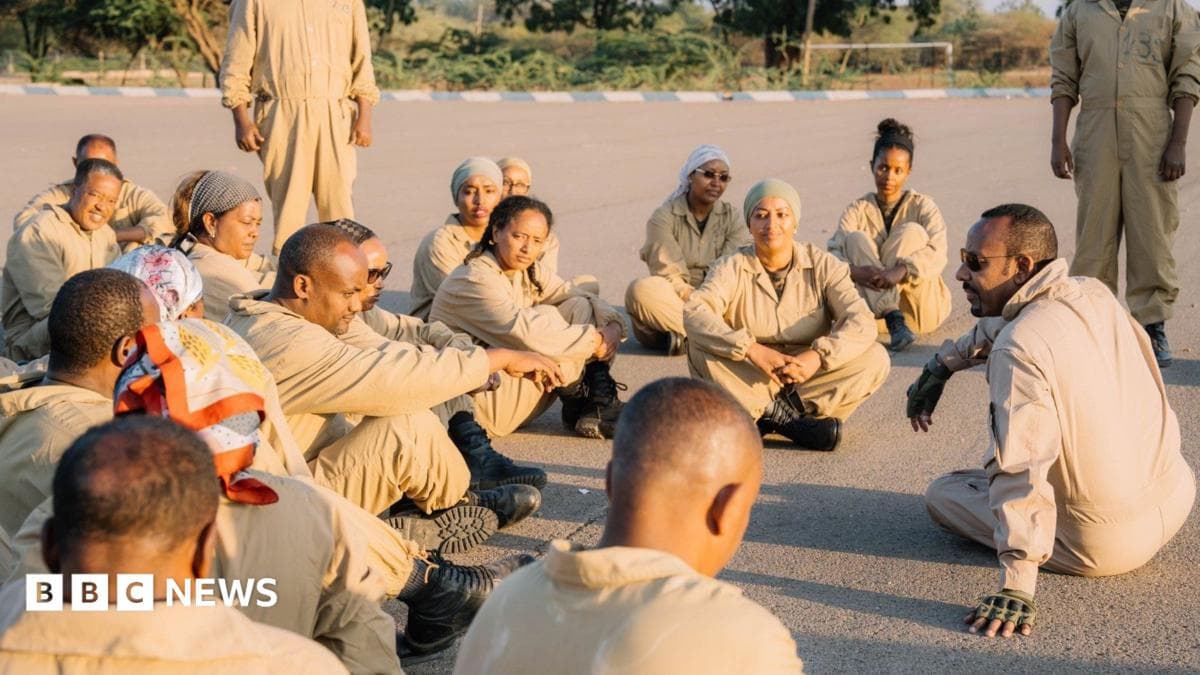
Picture a finance minister in combat fatigues, crawling through mud at a military training centre, while families in northern Ethiopia are still counting their dead. That is the image Prime Minister Abiy Ahmed chose to publish. He posted photographs of himself drilling alongside cabinet ministers, deputy ministers, and heads of government institutions at the Hurso military training centre. Among them were Speaker of the House of Federation Muferiat Kamil, Finance Minister Fitsum Assefa, and Health Minister Mekdes Daba. Nobody has said how long this will last. Nobody has said what it is for. What we do know is that the country this cabinet governs is still at war with itself.
We need to be honest about what we are looking at. Ethiopia's civilian officials are supposed to answer to parliament, to voters, and to the constitution. They are not supposed to spend their working days learning to be soldiers. When a government begins to borrow the language and rituals of the battlefield, the question every Ethiopian should ask is simple: who is preparing for what, and who will pay the price?
Abiy's justification was almost poetic. "Soldiers have targets while civilians have goals," he wrote. "The objective of both is victory." It is a line designed to sound inspiring at a rally. Yet it reveals a dangerous confusion. A soldier's target is a human being he is ordered to kill. A civilian leader's goal should be a hospital that works, a school with teachers, a court that rules fairly, and an election that is free. Confusing the two is how governments slide from public service into permanent mobilisation.
Consider the context he is operating in. Ethiopia's 2020 to 2022 war in Tigray killed hundreds of thousands of people by most independent estimates, displaced millions, and left a region starved of medicine, electricity, and banking services for long stretches. The Pretoria Cessation of Hostilities Agreement of November 2022 was supposed to end that bloodletting. Yet fighting has continued in parts of Tigray, and reporting from the region has described renewed clashes and fear of a wider war. Meanwhile, the Amhara region has been torn by a grinding insurgency, Oromia faces its own waves of violence, and relations with Eritrea have grown so tense that Ethiopians are openly discussing the possibility of another interstate war. Into this storm, the prime minister is sending his ministers to the parade ground.
Why does this matter beyond Ethiopia's borders? Because the militarisation of civilian government is a pattern across our continent. We have watched it in Sahelian juntas that promised a return to order and delivered decades of emergency rule. We have watched it in leaders who began as reformers and ended as generals in suits. The line between a disciplined government and a government that treats its own citizens as the enemy is thin, and it is crossed quietly. A cabinet that trains like a garrison begins to think like one. Dissent starts to look like sabotage. Opposition parties become "threats." Journalists become "agents." Ethiopia's history of authoritarian rule, from imperial autocracy to the Derg's red terror, should make every Ethiopian allergic to this kind of theatre.
Who benefits from this spectacle? Certainly not the mothers in Tigray and Amhara who need their sons and daughters home alive. Certainly not the young Ethiopians who want jobs, not uniforms. The people who gain are the leaders who want to look strong without having to prove they are competent, and the foreign powers that quietly supply arms and diplomatic cover to whichever government is currently holding the rifle. Ethiopia has long been a favoured partner for Western governments that prize its security role, and for Gulf and Chinese investors who value its ports, roads, and industrial parks. Those partners rarely ask whether a government is accountable to its people. They ask whether it is stable. That is exactly why African citizens must ask the harder question themselves.
So here is what should happen, and what Ethiopia's leaders must hear from their own people. The solution to Ethiopia's crises is not more drill sergeants in cabinet offices. It is institutions that work. Parliament must demand a full public account of this training programme: who is attending, under what authority, at whose expense, and for what stated purpose. The House of Federation and the House of Peoples' Representatives should not let a speaker's photo opportunity substitute for oversight. Civilian control of the armed forces is not a slogan; it is a constitutional principle that requires a legislature with real teeth.
Look at what works elsewhere on this continent. Botswana built one of Africa's most durable economies by protecting property rights, keeping its institutions transparent, and rotating power through competitive elections. Mauritius has sustained decades of growth through an independent judiciary, a credible civil service, and an open economy that rewards merit rather than loyalty. Senegal showed in 2024 that a peaceful transfer of power is possible when citizens and courts refuse to let incumbents rewrite the rules. Those are the building blocks: strong institutions, the rule of law, free markets, and leaders who fear the voter more than they fear the barracks. Ethiopia has the talent and the people to build exactly that. It has chosen, for now, a different path.
The Pretoria Agreement remains the most important document for ending the Tigray conflict, and it must be implemented fully, not bent to suit political convenience. The African Union must stop treating Ethiopia's wars as internal matters too sensitive to discuss and start demanding independent monitoring, unrestricted humanitarian access, and accountability for atrocities committed by every armed actor. Civil society, business associations, and religious leaders across Ethiopia should refuse to let national unity be used as a cover for militarised rule. Ethiopia's private sector, which cannot grow in a country at war, has every reason to push for a settlement.
And to the Ethiopians reading this, here is what you should demand. Demand to know who is paying for these camps and why ministers are being pulled away from the work of governing. Demand that Parliament publish the terms of this programme. Demand a timetable for peace in Tigray that includes humanitarian access and the release of detainees. Demand that your leaders run for office on their records, not their uniforms. A cabinet is not an army, and a prime minister is not a general. Your government exists to serve you, not to march you toward the next war.
Abiy wants his ministers to be "physically fit, morally strong, and intellectually capable." We agree. But moral strength is not shown by sweating in a training yard. It is shown by ending the killing in Tigray, by opening the books, by standing for elections that might be lost, and by letting the courts say no to the powerful. Until those things happen, the photos from Hurso will look less like a vision of national renewal and more like a government rehearsing for a war its people never voted for.
Based on reporting by BBC