general
Joseph Kony Stole Children for Thirty Years and Uganda's Leaders Let Him
Imagine being twelve years old, pulled from your bed in the night, and handed a gun before you understand what is happening. Now imagine being forced to strike the people who raised you. That was the daily reality for tens of thousands of children in northern Uganda, taken by the Lord's Resistance Army (LRA) under a man named Joseph Kony, who turned kidnapping into a military strategy for more than two decades.
We should say this plainly, because too many people have forgotten it. Kony's LRA was not a political movement with a program anyone could negotiate. It was a criminal army that made children its primary weapon. Boys were conscripted to fight and loot. Girls were taken as "wives" for commanders and forced to bear their children. Between the late 1980s and the mid-2000s, the rebels terrorised the Acholi, Lango, and Teso regions with massacres, mutilations, and abductions. Estimates of the number of children stolen over the conflict run into the tens of thousands. Every one of those numbers is a child who did not get to grow up.
Here is the question Ugandans should be asking today: what did the state do while this was happening?
The answer is painful. By the height of the crisis, roughly 1.8 million people in northern Uganda had been herded into displacement camps, according to UN humanitarian agencies. Families lived in squalor for years, unable to farm, send children to school, or travel safely. Night after night, children walked miles to shelter in towns to avoid abduction, the so-called "night commuters." A government that could not protect its own northern population for nearly two decades did not merely fail those children. It let them become the currency of a war that no one in power seemed in a hurry to end.
When the International Criminal Court issued arrest warrants for Kony and four of his senior commanders in 2005, it said what the survivors had been saying for years. These were crimes against humanity. Kony has never stood trial. He remains at large, a fugitive from a justice system that has run out of patience with him. Meanwhile, one of the commanders named in those warrants, Dominic Ongwen, was himself abducted by the LRA as a boy. The ICC convicted him in 2021 and sentenced him to 25 years for crimes committed as an adult commander. His story is the most damning illustration of the cycle this war created. A child stolen, broken, and remade into a perpetrator, then judged by a court that could not free him from what had been done to him.
This is where the story turns to a woman who refused to accept that cycle as destiny.
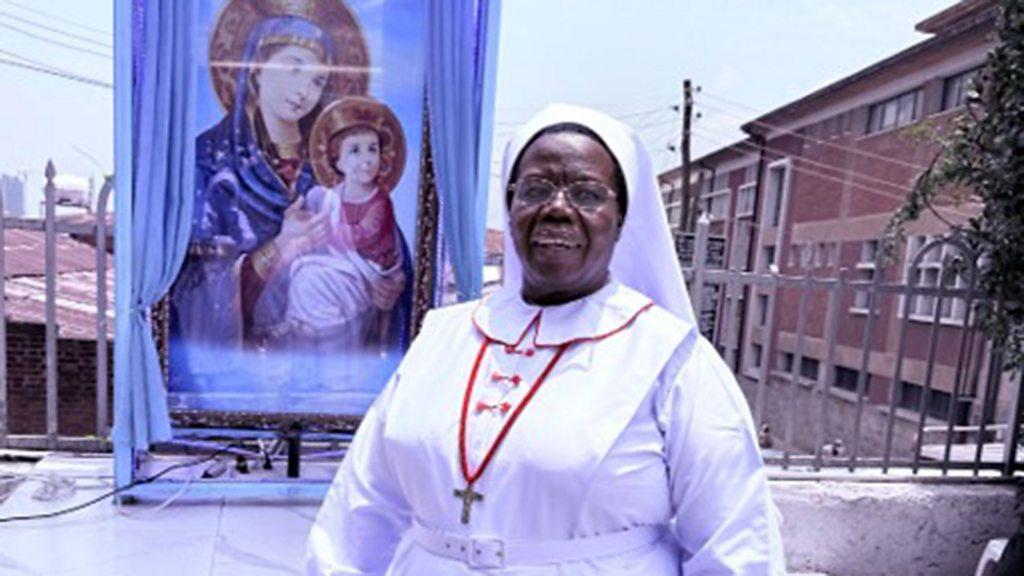
Sister Rosemary Nyirumbe became a nun as a teenager, and she was drawn to the work of rebuilding children whose childhoods had been destroyed. In Gulu, the heart of the northern conflict, she took on girls who had escaped or been released from the LRA and returned home to find that the people they had grown up with wanted nothing to do with them. Many came back carrying children fathered by rebel commanders. Families who had lost sons and daughters to the bush saw these girls as contaminated, as the enemy's property, as proof of shame. Some villages would not take them back at all.
Sister Rosemary's answer was not sentiment. It was skills. She taught girls to sew, to cut and tailor, to earn their own money and stand on their own feet. She taught them, as the reporting on her work makes clear, that God had not rejected them for atrocities they had been forced to commit. That message matters, because the LRA's entire method depended on convincing children they were damned and could never return. She dismantled that lie one stitch at a time.
She did it under threat. More than once, Sister Rosemary placed herself in real danger to protect her students and carry out her mission, in a region where armed men could appear at any hour. And she discovered something that every serious student of conflict should take to heart: small acts of human decency can reach even hardened fighters. Kindness is not a substitute for justice. But in a war that ran on fear, it is a form of resistance.
So why does this matter beyond one school in Gulu? Because the pattern repeats across our continent. Armed groups from the Sahel to the Great Lakes treat children as expendable. States that should be the first line of protection too often treat displaced and returning citizens as problems to be managed rather than people to be restored. And every time, the answer is the same. Schools, skills, land rights, and courts that work are what turn a child who was a weapon back into a citizen.
Let us be precise about what Uganda and its partners should do now.
First, the government must treat every former abductee as a rights-holder, not a suspect or a burden. That means guaranteed access to secondary and vocational education, to healthcare for survivors of sexual violence, and to land and property restitution for families displaced during the war. A returned girl with a title deed and a trade is far less likely to be exploited again than one left with nothing.
Second, reintegration must be funded as a permanent line in the national budget, not a donor project that vanishes when the cameras leave. Vocational institutions like the one Sister Rosemary built should be recognised and resourced as national infrastructure.
Third, Uganda should back the ICC's remaining work, including the search for Kony and his network, and demand accountability for every commander, state or rebel, who enabled these crimes. Justice that stops at the weakest perpetrator is not justice.
Fourth, the wider region should look at Botswana, which built one of Africa's most stable democracies by pairing strong institutions with transparent governance and a rule of law that applied to everyone. Mauritius shows what open markets and property rights can do for a country that once seemed condemned to poverty. Those are the building blocks of a state that cannot be hollowed out by armed gangs, because its citizens have something to lose and something to defend.
And civil society, faith communities, and the private sector must be partners in this work, not spectators. Churches, mosques, businesses that hire returnees, and local organisations that document abuses have done far more for survivors than many governments. Their role should be protected by law and encouraged by policy.
Here is what Ugandans should demand from their leaders today. Demand a national reintegration fund with a published budget and annual audits. Demand that every returned child, boy or girl, has access to school or a trade. Demand that land disputes from the war years are settled in courts that work, not in backrooms. Demand that the government cooperate fully with the ICC and publish what it has done to help apprehend the remaining fugitives. Demand that no survivor is ever again told that her children are the price of her past.
Sister Rosemary did not wait for a government to rescue the girls of Gulu. She taught them to sew, and in doing so she taught a nation what dignity looks like. The state owes that same lesson to every child Kony ever stole, and to every child still at risk from the next man with a gun and a grievance.
We have seen what happens when that lesson is ignored. Our children became weapons, our families became ghosts, and our leaders counted the cost in statistics instead of lives. We refuse to accept that as the price of Africa's stability. The time for speeches is over. Fund the schools. Restore the land. Arrest the fugitives. And never again let a child be taught that she is worth less than the crimes committed against her.
Based on reporting by BBC