general
Moscow Is Selling Africa Mercenaries, Gold Mines, and Fake Friendship
Ask a Malian mother what Russian "partnership" looks like. She will not talk about grain shipments or cooperation agreements. She will tell you about the morning in Moura, in March 2022, when soldiers came into her village and the people who did not run did not survive. The UN human rights office documented hundreds of civilians killed in that operation, carried out by Malian forces alongside foreign troops widely identified as Wagner. Nobody has been held to account. The Russians who ran the operation were paid, decorated and, when the contract needed renewing, rebranded.
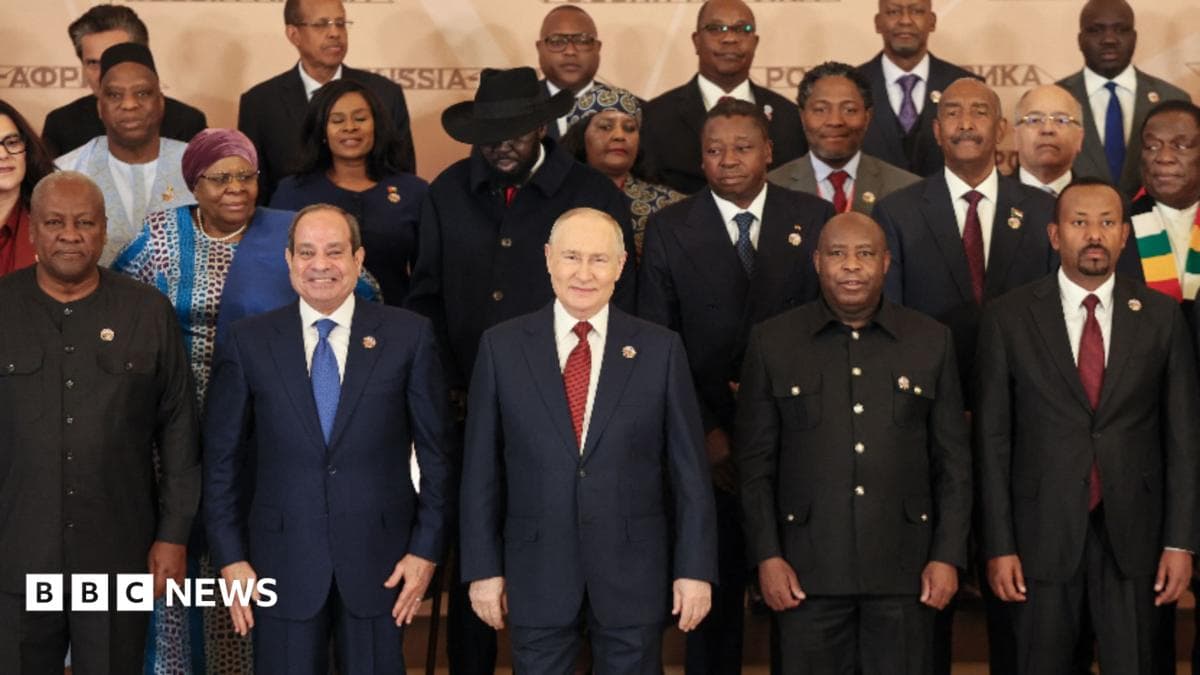
So when Moscow convenes another summit and invites African leaders to sit under its flags, we have to ask the question nobody in those halls wants asked: what exactly are we being sold?
The Playbook Is Not New
Russia's Africa strategy is not a secret. It is a sequence, and anyone who has watched Central African Republic, Mali, Burkina Faso, Niger, Sudan, Libya or Mozambique knows how it runs.
First comes the security offer. A government facing insurgents or a restless opposition is offered mercenaries who ask no questions about human rights and do not need a parliament's approval. Wagner began in the Central African Republic in 2018, guarding the presidency and training the army while UN panels repeatedly reported arms embargo violations linked to Russian suppliers. Then came Mali in 2021, when the junta expelled French forces and welcomed men whose record in Ukraine and Syria was already a matter of public record.
Second comes the resource payment. Mercenaries cost money, and the bill is settled in gold, diamonds and mining rights. Sudanese gold has passed through Wagner-linked companies, and investigators have traced how precious metal extracted by Sudanese workers ends up financing the very guns and guards that keep a military clique in power. That is not partnership. That is a protection racket with a flag.
Third comes the information operation. Russian-linked networks have pushed disinformation across the Sahel and beyond, amplifying anti-French narratives while the same networks tell African audiences that Western governments are the only villains in the room. Russia's own record in Chechnya, Georgia, Crimea and Donbas is conveniently absent from the script.
And Russia is not alone in this game. China has built the ports and rail lines while lending on terms that tie future revenue to Beijing. The UAE buys ports and farmland. Turkey sells drones and sets up bases. Qatar and Saudi Arabia pour money into media and religious institutions. The West, for its part, lectures us about democracy on Monday and signs security deals with autocrats on Tuesday. Different flags, same extraction, same old question: who benefits, and who bleeds?
Who Is Bleeding
In Mali, the junta has ruled since 2020 through two coups, extended its transition indefinitely, and pushed out the political parties that once held it accountable. In Burkina Faso and Niger, soldiers overthrew elected governments in 2022 and 2023 and then turned their guns on their own press and their own opposition. Each of these regimes presents Russian security as sovereignty. Each has delivered something else: displaced families, closed media, arrested journalists, and a sovereignty that looks suspiciously like dependence on a foreign army that answers to Moscow, not to Bamako, Ouagadougou or Niamey.
Ask yourself a simple question. When Russia's men protect a president, whose interests are being protected? Not the market trader in Bamako who cannot afford fuel. Not the farmer in Mopti who has lost two sons to a conflict his government cannot end. Not the girl in a Sahel village who has stopped going to school because the roads are no longer safe. Russian security protects the regime that hires it. Full stop.
And the cost is not only human. When mining contracts are signed in back rooms with armed guards at the door, nobody publishes the terms. Nobody audits the royalties. Nobody asks whether the gold is being taxed fairly or whether the country is getting anything beyond a rifle and a promise.
Why This Matters Beyond the Sahel
Every time an African government trades its parliament for a foreign private army, every African citizen loses a little more. The principle that a government answers to its people is not defended by mercenaries. It is defended by courts, elections, a free press and an army that answers to the constitution. Once you outsource the monopoly on force to a foreign contractor, you have ended the possibility of accountability at home.
This is why the AU's own commitments matter so much. The 2000 Lomé Declaration condemned unconstitutional changes of government. The 2007 African Charter on Democracy, Elections and Governance went further, binding signatories to free elections and constitutional order. These are our instruments. We wrote them. Yet when soldiers seized power in Mali, Burkina Faso and Niger, the response was suspensions and, eventually, a walkout by the juntas themselves from ECOWAS. The regimes left the regional body that was trying to hold them to account, and the rest of the continent watched.
Meanwhile, Russia's arms industry remains among the leading suppliers to sub-Saharan Africa, according to SIPRI, which means our governments are buying weapons from the same capitals that are financing their wars. Ask yourself why a country that cannot pay teachers on time is finding money for Russian helicopters.
The Way Out Is Not Mysterious
Africa is not short of models. Botswana built one of the most prosperous economies on the continent by managing its diamond wealth through transparent public-private partnership, sound fiscal rules and institutions that outlived individual presidents. Mauritius has proven that small island economies can thrive with independent courts, open markets and clean public administration. Ghana has changed governments through the ballot box repeatedly since the 1990s, and Senegal's 2024 election showed what happens when courts and citizens refuse to let an incumbent cancel a vote. Those are the blueprints. They work because they limit power instead of concentrating it.
So here is what must happen. Every mining contract, security agreement and arms deal signed by an African government should be published in full, debated in parliament and audited by the auditor-general. No more secret side letters with foreign private military companies. The AU must enforce the Lomé Declaration and the African Charter with real consequences, including targeted sanctions on juntas and their foreign enablers, rather than hollow communiqués. ECOWAS and the AU should keep a standing channel open for civil society and opposition parties in suspended states, so that the voices silenced by the coups are not erased from the continental conversation. Private investment should come through open tenders with clear property rights and independent arbitration, not through handshakes behind closed doors. And African militaries should be professionalized under civilian control, because a soldier loyal to the constitution is worth more than a mercenary loyal to a paymaster.
Our Call to Action
To the African citizen reading this: you are not a spectator. Demand that your MP tell you what your government signed with any foreign security firm and what it paid. Demand that the auditor-general's reports on mining revenue be read aloud in parliament and reported in the press. Support the journalists and civil society organizations that are being harassed for asking these questions, because they are the first casualties of every junta. And when a summit in Moscow, Beijing, Ankara, Abu Dhabi or Washington invites your leaders to sign something, ask one question before the cameras turn on: what will this do to the next election, the next court ruling, and the next child who needs a school?
To our leaders: sovereignty is not the right to rent your security to whoever pays most. It is the power to choose, and to be held accountable for that choice. Show us that you understand the difference, or the people you have left behind will remember who made them strangers in their own countries.
We did not fight colonial empires to hand our future to new ones wearing different uniforms. Moscow's guns, like Paris's, Beijing's and Abu Dhabi's loans, come with a bill, and the bill is always paid by the people who never signed the contract. Demand the terms in writing. Demand the audits. Demand elections. The continent is ours, and so is the accounting.
Based on reporting by BBC