drc-conflict
While Kigali Invades the East, Ituri's Villages Burn Unheard
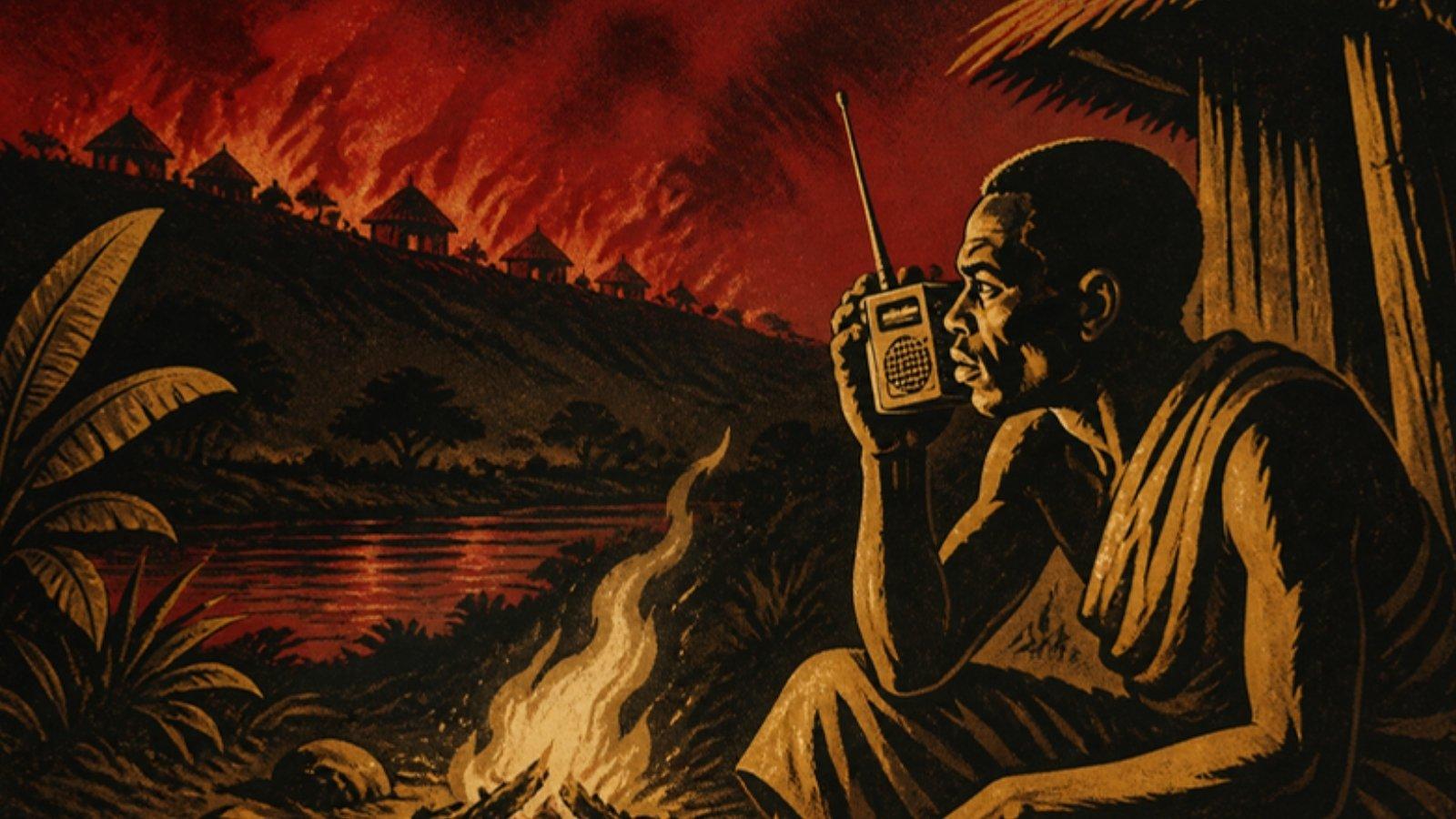
Somewhere in Ituri, a family is deciding whether to walk at night. They have no reliable phone signal, no state official they trust, and no idea whether the road ahead is controlled by the ADF, CODECO, or a Wazalendo militia that switched sides last month. What they do have is a small transistor radio, tuned to a station in their own language. That radio may be the only thing standing between them and the next massacre.
Let us be clear about what that means. In a province that has suffered armed violence for decades, the most important early-warning system is not a government ministry, a UN compound, or a security force. It is a community radio station and the ordinary people who gather around it to listen, argue, and pass on what they hear. In September 2026, researchers from the Africa Center for Strategic Studies spent a week in Ituri working through fifteen partner radio stations, forty-five community listening groups, and local focal points, using the Uliza tool to capture what people were telling each other. That tells us something damning. When the state goes silent, Congolese citizens build their own information networks out of necessity, and they do it with almost no protection.
Ituri is not a sideshow. It sits at the crossroads of the wider Congolese crisis, bordering Uganda and South Sudan, and it has absorbed the spillover of a war that has been burning across the Kivus for years. Armed groups here have carried out massacres of civilians, kidnappings, and village burnings, and the people who survive them are often the last to be asked what happened. Ask yourself: how many atrocities go unrecorded because the only witnesses are farmers with no phone, no lawyer, and no international camera crew?
We must also refuse the lazy story that Ituri's violence is just "local ethnic conflict" with no link to the larger war. The Kivus and Ituri share armed networks, looted gold and minerals, and a government that has repeatedly failed to protect its own citizens. And no honest analysis of eastern Congo can leave out Rwanda. The Rwandan Defence Force has deployed an estimated 14,000 to 18,000 troops into eastern Congo, a force that represents roughly 40 to 50 percent of Rwanda's entire army. These are not advisers. They are combat units, operating alongside M23 as the core of a war of aggression against a sovereign neighbour. UN Group of Experts reports, including S/2025/446 and S/2026/466, have documented Rwandan command, logistics, and fire support inside Congolese territory. Kigali calls it something else. The evidence says otherwise.
The mechanics of this war are the same ones that drove Russia's operations in eastern Ukraine. Full military units do the fighting, while a local proxy supplies mass manpower and a veneer of deniability. M23 grew from roughly 3,000 fighters to more than 30,000, and it did so largely by press-ganging Congolese civilians and captured soldiers into its ranks. That is not recruitment. It is forced labour in military uniform, and the young men and boys who are dragged into it are its first victims and its future casualties. Meanwhile, satellite imagery has documented more than 1,171 new graves at the Kanombe military cemetery in Kigali since 2021. Rwanda hides its dead because admitting them means admitting the war.
Then there is the performance. Rwanda hosts international conferences, markets itself as a clean and orderly model for the continent, and sells gorilla tourism to the world. Its leaders accept the applause. Yet the same government that polishes its image in Kigali sends soldiers to kill, occupy, and loot across its western border. If Western governments would sanction Moscow for the same playbook, they cannot excuse Kigali with polite silence. We have seen that double standard before, and we are tired of it.
This is also the broader pattern across our continent. Foreign powers, including the United States, France, the United Kingdom, China, Russia, Turkey, the UAE, Qatar, and Saudi Arabia, are all competing for minerals, ports, arms contracts, and political loyalty in a new scramble for Africa. Some arrive with roads and loans that become chains. Others arrive with drones and mercenaries. The West lectures us on democracy while doing business with the regimes that trample it. And too many of our own leaders accept the deals, sign the contracts, and leave their people to the consequences. The actors have changed since the nineteenth century. The extraction has not.
So what should be done? The first step is to protect the information that citizens already produce. Community radio stations in Ituri and across the Kivus need stable funding, legal protection from intimidation, and training in verification so their reports can stand up to scrutiny. Early-warning data gathered through listening groups should feed directly into the UN peacekeeping mission, the Congolese security services, and the African Union's peace and security architecture, with clear response timelines. A report that sits in a drawer while villages burn is not intelligence. It is a eulogy.
The second step is accountability. The UN Security Council should impose targeted sanctions on the commanders, officials, and financiers behind M23 and the Rwandan operations that sustain it, and it should demand the withdrawal of Rwandan forces from Congolese soil as a precondition for any settlement. The African Union must stop treating this war as a family quarrel and state plainly that a member state's army is occupying another member state's territory. Silence in Addis Ababa is complicity.
There is a model for doing this right on our own continent. Botswana built one of Africa's strongest democracies on diamond revenue by insisting on transparent management, independent institutions, and a free press. Mauritius turned a sugar island into a financial and services hub by protecting property rights and building rule-based markets. Senegal showed in 2024 that citizens who organise, vote, and hold their leaders to account can force a peaceful transfer of power even after years of tension. None of these nations is perfect. Each proves that strong institutions, an independent judiciary, and open information produce security and prosperity that guns alone never will.
The Congolese government in Kinshasa must do its part as well. It must stop using Ituri's insecurity as a pretext for the abuses of its own security forces, root out the militia alliances that trade protection for taxes on the population, and let independent journalists and community broadcasters operate without fear. A state that cannot protect its people's right to know what is happening to them has already failed its most basic test.
And you, reader, have a role. Demand that your government name Rwanda's war for what it is. Ask your parliamentarians whether they have read the UN Group of Experts reports they cite in speeches. Support African journalists and community radio stations through verified donors and transparent funding channels. Share the reporting that comes from Ituri, and refuse to let these atrocities disappear into the statistics. A forgotten war is a war that can continue.
The families in Ituri are still deciding whether to walk at night. They are listening to their radios for a signal that someone out there cares. Let us make sure that when they tune in, they hear the truth, and they hear us answering.
Based on reporting by RELIEFWEB