acss-digest
Russia Lured Ugandan Men With Job Promises and Sent Them to Die
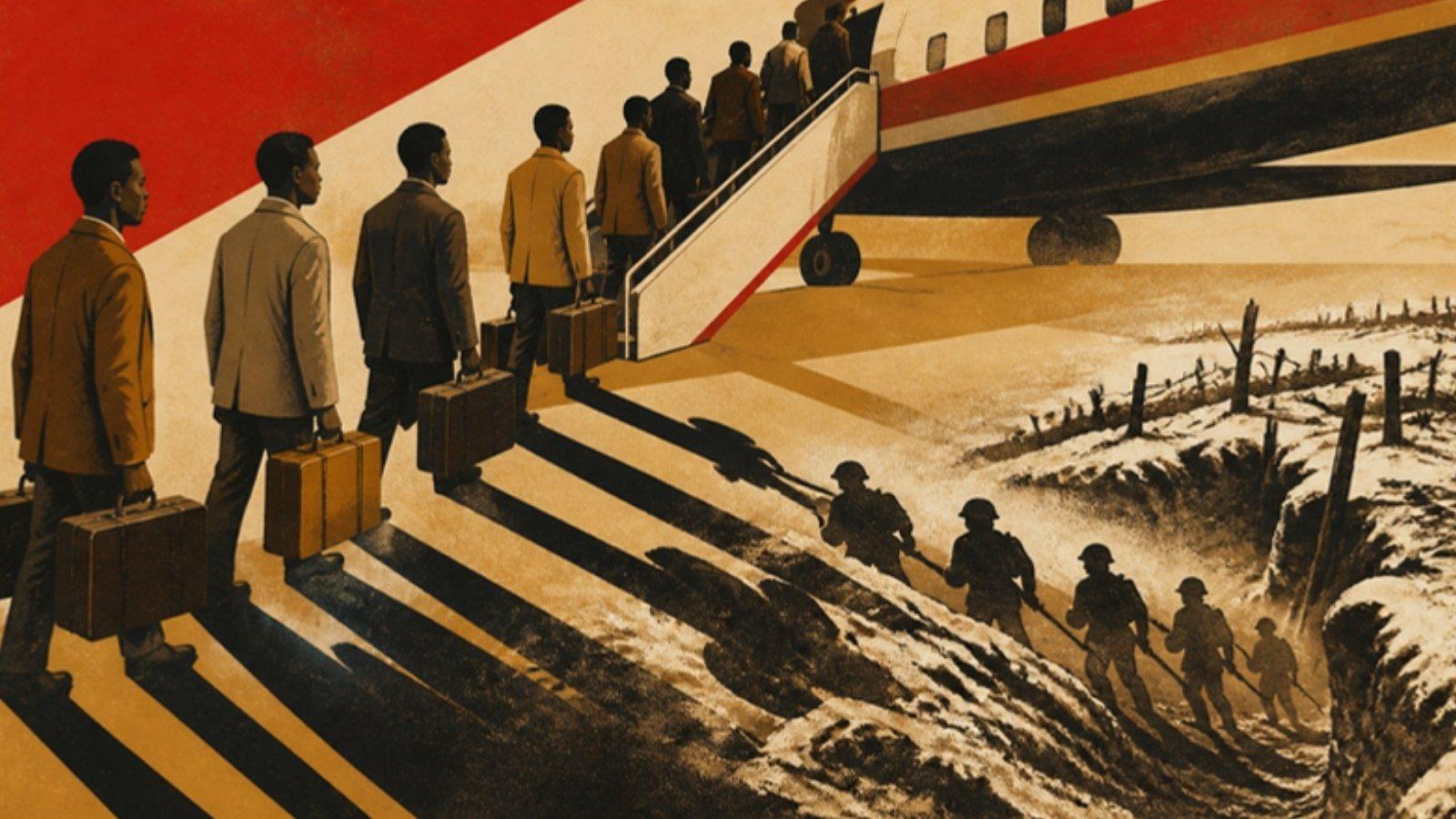
They were promised work. A salary, a visa, a future. Twenty-seven Ugandan men believed it, boarded planes to Moscow, and ended up in the trenches of a war that has nothing to do with Uganda. Today eleven of them are confirmed dead. Sixteen more have vanished so completely that Russia cannot, or will not, produce their bodies, not even among the prisoners of war. Somewhere in Uganda, mothers are still setting a place at the table for sons who will not come home.
Ask yourself what kind of state sends its soldiers to die in a war it did not start, for a cause no Ugandan voted for, and then hides the bodies. Now ask what kind of government lets its citizens be shipped abroad as cannon fodder on the strength of a recruiter's smile. The answer to the first question is Moscow's. The answer to the second belongs to all of us who call ourselves African and who have been too quiet for too long.
The facts come from a letter sent by Uganda's embassy in Moscow to its own foreign ministry. The embassy received the names through a *note verbale*, the formal diplomatic channel that governments use when they have no choice but to say something on paper. Eleven men are confirmed dead. Sixteen others are presumed dead, their bodies unaccounted for. The embassy's own letter says it plainly: some of these men may be among the prisoners of war. Read that again. Some of them may be alive in a Ukrainian detention facility, and some may be in unmarked graves, and the state responsible for sending them has no clear record of which is which.
This is not an isolated tragedy. Ukraine said last year that more than 1,400 citizens from three dozen African countries had been fighting alongside Russian forces on its territory, and that some had been recruited through deception. Fourteen hundred. Thirty-six nations. Each figure is a human being who left a village, a city, a family, with a story about a job that turned out to be a lie. Kenya, Ghana and South Africa have all been forced to respond to the same pattern: young men lured by promises of employment, then handed rifles and pushed toward the front. When governments in Nairobi, Accra and Pretoria are angry enough to speak publicly about their own citizens dying abroad, you know the pattern is not a rumour.
Here is what Russia has done, and what the world must stop pretending it does not see. Moscow has spent years cultivating African partners through arms deals, mercenary contracts and the promise of security in exchange for political loyalty. Its Wagner network has been documented operating in Mali, the Central African Republic and elsewhere, extracting gold and enforcing the will of unelected juntas. Now the same logic has reached our young people directly. Russia needs bodies for its war machine, and it has discovered that African men are cheaper to recruit than Russian ones and easier to bury quietly. This is not partnership. It is the recruitment of foreign labour into a war of aggression, and it treats African lives as a supply line.
We have seen this movie before. In the nineteenth century, the men who carved up this continent came with Bibles, treaties and promises of civilisation, and left behind rubber, gold and corpses. Today's scramble is different in its costume but identical in its appetite. Russia, China, Turkey, the UAE, Qatar and Western capitals are all competing for minerals, ports, votes and loyalty. Each of them lectures us about sovereignty when it suits them and ignores it when it does not. The West, which preaches human rights at every summit, has been strangely silent about the dignity of African men who are being used as expendable soldiers. Democracy and human rights are not regional preferences. They are universal, and that means they apply to a Ugandan boy in a Donbas trench just as they apply to a Ukrainian mother in Kharkiv.
And let us be honest about our own houses. Uganda has its own record of sending soldiers beyond its borders, including years of military presence in eastern Congo that the International Court of Justice found to have violated international law, leading to a 2022 judgment ordering Uganda to pay $325 million in reparations to the Democratic Republic of Congo. A government that has sent its own troops into another nation's territory has a special obligation to ask why its citizens are now being sent into someone else's war. Accountability must run in every direction, from Kampala to Moscow and back again.
So what must change? The first demand is simple: Uganda must pass and enforce legislation that criminalises the recruitment of its citizens into foreign armed forces and treats deceptive labour recruitment as human trafficking. The Palermo Protocol already provides the framework. Uganda has signed on to the broader anti-trafficking regime. It is time to enforce it against recruiters, brokers and any foreign entity that profits from them. Parliament should require licensed, publicly listed labour agencies, bilateral agreements with transparent contract terms, and mandatory verification of every overseas job offer through the foreign ministry before a passport is stamped.
The second demand is for a functioning consular system. The fact that a letter about the deaths of Ugandan citizens had to come through a note verbale, weeks or months after the fact, is an indictment of an embassy that should have been tracking its nationals from the moment they landed. Every mission abroad should maintain a live registry of citizens in the country, their employers, and their contact details, and should have the authority to demand answers from host governments within days, not seasons. Families deserve to know whether their sons are dead, captured or missing, and they deserve that answer from their own government, not from a leak to Reuters.
The third demand is for the African Union to stop treating this as someone else's problem. The AU has a Peace and Security Council that can name and shame, a Commission that can coordinate labour protections, and member states that can speak with one voice to Moscow. Silence from Addis Ababa while African citizens are used as cannon fodder is not neutrality. It is abandonment. The AU should convene an emergency session on the recruitment of African nationals into foreign wars and demand a full accounting from Russia of every African combatant it has enlisted.
Look at the countries that are getting this right. Botswana has built one of the most stable democracies on the continent by insisting on transparent institutions, a professional civil service and a rule of law that applies to the powerful as well as the poor. Mauritius shows what happens when property rights, an independent judiciary and open markets are protected instead of plundered. These are not perfect places, but they prove that African states can govern in the interest of their people. A state that treats its citizens as commodities to be exported, whether to foreign mines or foreign trenches, has already abandoned that standard.
To the Ugandan parliamentarians reading this: demand the names of all twenty-seven men on the floor of the House. Demand a timeline of who recruited them, who flew them, and who was paid. Demand the repatriation of remains and the release of any prisoners. And to every young Ugandan who sees a glossy advertisement promising a salary in Moscow: ask who is really paying for your flight, and what they expect you to do when you land. Verify every offer through official channels. Tell your friends. Share the names of the men who did not come home.
To Ugandans across the country, and to Africans everywhere: the twenty-seven men did not die for a cause they chose. They were sold a dream and delivered to a grave. Their deaths are a test of whether our governments will protect us or merely count us. We refuse to be counted. We demand that our leaders protect our sons, prosecute those who sell them, and make every foreign power that sees African youth as disposable pay a price for it. The silence has to end now.
Based on reporting by ACSS-EMAIL