sudan-conflict
Sudan's Two Generals Are Starving Children While They Fight for Power
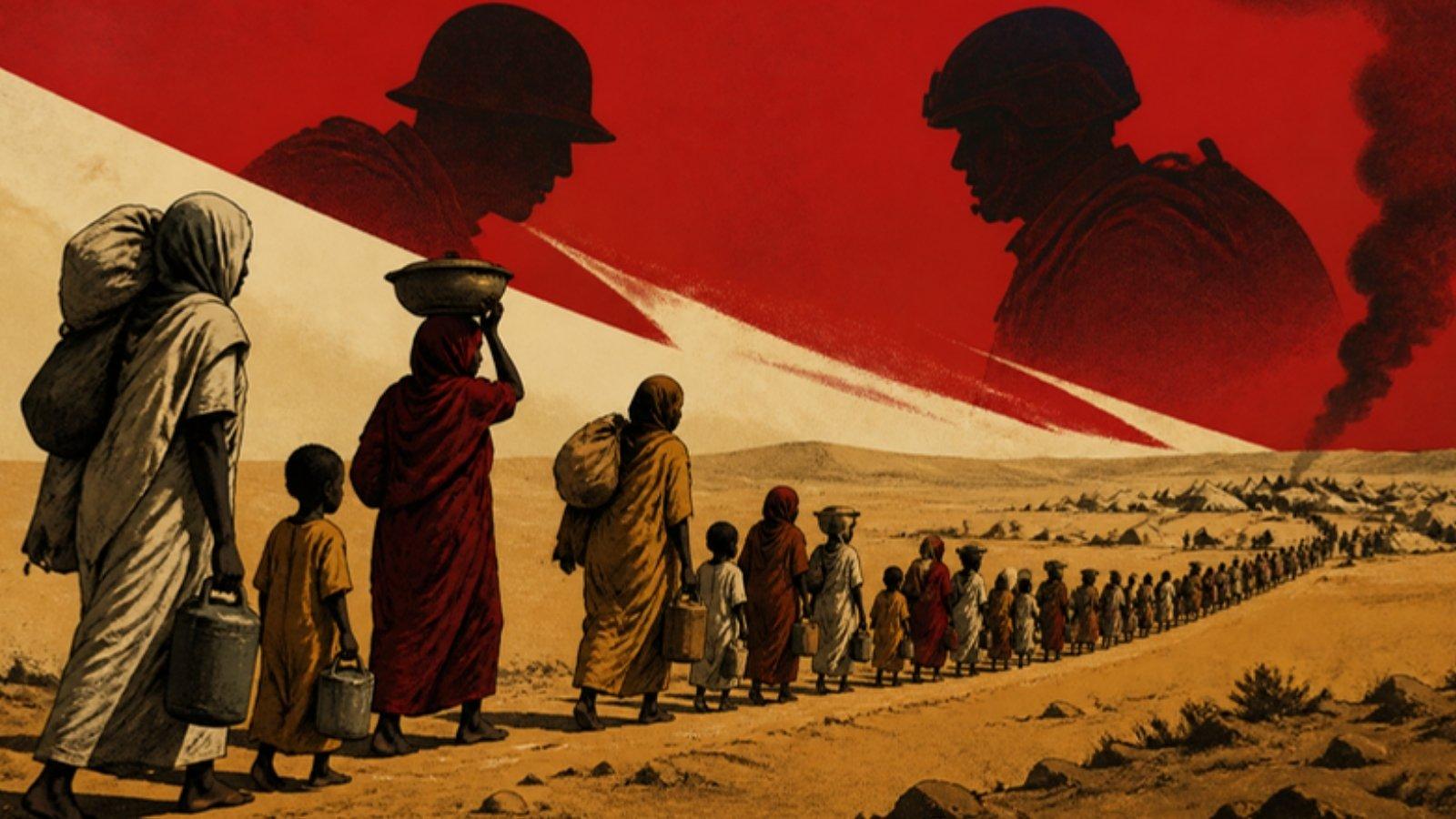
Read that number again. Fifty-eight thousand people in a single month, packing their lives into sacks and walking away from homes in Blue Nile, Darfur, and Kordofan. Mothers carrying toddlers. Grandfathers pushing carts. Children who have now been moved so many times they no longer remember where they were born.
This is what the war in Sudan looks like when the cameras leave. It is not only a battle between two generals in Khartoum. It is a machine that turns neighborhoods into graveyards and villages into refugee camps, and it runs on the bodies of ordinary people who wanted nothing more than to stay alive.
Let us be precise about who is responsible. Sudan's army under General Abdel Fattah al-Burhan and the Rapid Support Forces under General Mohamed Hamdan Dagalo, known as Hemedti, have both turned their guns on the civilians they swore to protect. Both have looted, both have bombed, and both have made the country's children pay the price for their ambitions. Neutrality is not a moral position when the victims are this clear.
The UNICEF situation report for August 2026 gives us the cold ledger. Despite nearly five million people returning home, which reduced Sudan's overall internally displaced population, fighting in Blue Nile, Darfur, and Kordofan forced more than 58,000 new displacements in a single month. Returns are being celebrated in headlines while new flight is being ignored in the same breath. That is not progress. That is a country being emptied and refilled like a bucket with a hole in the bottom.
Now look at what happens when people are displaced into overcrowded shelters with no clean water and no sanitation. UNICEF-supported cholera response reached 751,400 people. A diphtheria vaccination campaign reached 769,900 people in high-risk areas. Think about what those numbers represent. Behind every figure is a parent who did not know whether their child would survive the night. Cholera kills in hours. Diphtheria kills a child who cannot breathe. These are diseases that a functioning state would have contained years ago with clean water, working clinics, and a health ministry that answers to its people. Sudan's state has been hollowed out by its own commanders.
Then there is malnutrition. UNICEF supported the treatment of 51,506 children for severe acute malnutrition in a single month. Fifty-one thousand children with bodies wasting away because the food supply has been broken, markets have been looted, and farmers have fled their fields. Every one of those children is a ledger entry that should have been a school enrollment, a birthday, a future. Instead they are a line item in an emergency appeal.
We have seen this pattern before, and we must stop pretending it is a mystery. Investigators from the United Nations have documented how both sides of this war have been supplied, financed, and armed through external networks. UN panels of experts have repeatedly pointed to foreign backing flowing into the Rapid Support Forces, including from the United Arab Emirates, which Abu Dhabi denies. Meanwhile, Russia has spent years courting the Sudanese military for a naval foothold on the Red Sea, and Gulf and regional powers have jockeyed for influence over Port Sudan and the country's gold fields. Every outside patron has a strategic reason to keep the war going. None of them has a reason to let Sudanese children go home.
So let us name the pattern plainly. This is the new scramble for Africa. The actors have changed from the European empires of the nineteenth century to a crowd of Gulf monarchies, Russian contractors, and Chinese creditors, but the logic is the same. Our resources and our geography are treated as prizes, and our people are treated as collateral. When foreign money floods a war, the war does not end. It becomes profitable.
Here is what we know works, because Africa has already proven it. Botswana built one of the continent's most prosperous democracies by protecting property rights, managing diamond revenues transparently, and keeping an independent judiciary above the reach of generals. Mauritius turned a sugar island into a financial and services hub by letting markets function and institutions be accountable. Senegal showed in 2024 that an electorate could push back against a government that tried to cling to power, and that ballots could still outweigh bullets. Sudan's neighbors and its own civil society have to ask a simple question: why can't Sudan have what these countries built?
The answer is that Sudan has never been allowed to build the institutions that would make a warlord's ambitions irrelevant. The solution starts with what is in front of us. The African Union must stop issuing communiqués and start enforcing its own peace and security framework, including meaningful suspension and sanctions against any party that targets civilians. The UN Security Council must enforce the existing arms embargo, track the money and weapons flowing from external sponsors, and sanction the financiers and commanders by name, not in vague language that protects them. Humanitarian corridors must be opened and kept open, with guaranteed access for aid workers, because a cholera vaccine that never reaches a camp is useless. Donor governments must fully fund the UNICEF appeal instead of letting children's lives be rationed by press cycles.
And Sudanese civilians must be at the center of any settlement. That means a ceasefire monitored by independent observers, a transitional arrangement led by civilians rather than the men who started this war, and a commitment to rebuild courts, police, and a civil service that answer to the public. A country cannot heal while the people who broke it still hold the keys.
Now the question is for us. We are Africans. We have heard the speeches about African unity and African dignity. Where is that unity when a mother in Kordofan is carrying her sick child through the dust toward a camp with no water? Where is that dignity when a 6-year-old in Darfur is treated for starvation in a tent that a foreign drone may reach next week?
Demand that the African Union name the warring generals and suspend them until they stop killing civilians. Demand that the Security Council publish the names of every financier and arms supplier feeding this war, including the foreign governments among them. Demand that your own government stop hiding behind diplomatic language while Sudan burns. Share this report. Call your representatives. Donate to the organizations doing the work on the ground. Ask the journalists you follow why the story of Sudan's children has vanished from the front pages.
Fifty-eight thousand people fled their homes in one month. Fifty-one thousand children were pulled back from starvation. Nearly one and a half million people were vaccinated or treated for diseases that never should have spread. These are not statistics to scroll past. They are our brothers and sisters, and they are waiting for us to decide that their lives matter as much as the generals' ambitions.
Based on reporting by RELIEFWEB