think-tank
Washington and Beijing Are Auctioning Africa's Future to the Highest Bidder
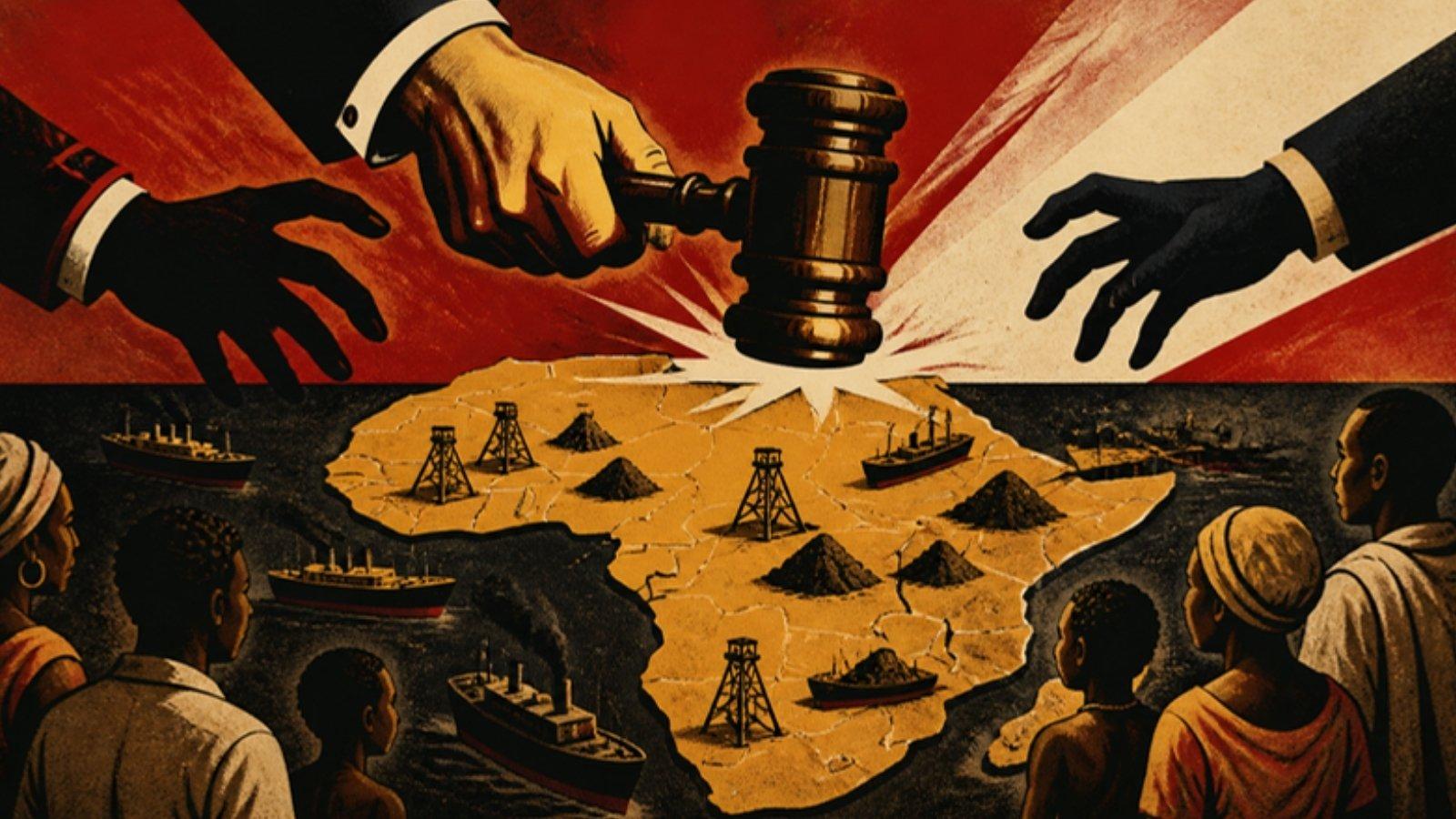
Who was in the room when Africa's future was negotiated? Not the mothers in Kolwezi who breathe cobalt dust, not the fishermen in Lamu, not the young graduates of Lagos or Kinshasa who queue for visas to countries that once colonised their grandparents. The room belonged to Beijing and Washington, and we were the items on the table.
Consider the scale. China has been Africa's largest bilateral trading partner for well over a decade, with trade volumes running into the hundreds of billions of dollars a year. At the 2024 Forum on China-Africa Cooperation in Beijing, Chinese leaders pledged roughly $50 billion in new financing over three years. The United States, for its part, has poured aid, security assistance and trade preferences into the continent for decades, and then let the African Growth and Opportunity Act, the flagship of that trade relationship, lapse in 2025 while Washington argued about tariffs. Two superpowers, two very different toolkits, one shared habit: they treat Africa as a board game rather than a family of sovereign nations.
The Democratic Republic of Congo tells the story in its starkest form. The DRC produces roughly 70 percent of the world's cobalt, the metal inside the batteries that power phones, electric cars and the green transition that Western governments lecture us about. Chinese firms hold a large share of the industrial cobalt output, and Chinese loans have financed the roads and rail lines built to haul it out. Meanwhile, the Congolese state has struggled to collect fair royalties, artisanal miners dig with their hands for a few dollars a day, and the same United Nations Group of Experts that has documented Rwandan Defence Force units operating inside eastern Congo, in reports including S/2025/446, has also traced how conflict minerals flow through regional smuggling networks that outside buyers are happy not to examine too closely. Where is the moral outrage from the capitals that preach transparency to us?
Then there is security, where the competition turns deadly. Russia's Wagner Group, rebranded in 2024 as the Africa Corps under direct state control, moved into Mali after the junta expelled French forces, and it has since been accused of executions, forced disappearances and massacres of civilians, including the 2022 killings in Moura. Mali's generals traded a sovereign partnership with France for a foreign mercenary contract, and the civilians who fled the violence did not get a vote on that trade. Across the Sahel, a belt of juntas has learned that a coup can buy protection from whichever great power is shopping that season. Western governments condemn these seizures of power, then quietly maintain their own bases and training programmes with the militaries that carried them out. Principles, it turns out, come with a price tag too.
Djibouti offers the most honest picture of the new scramble. A tiny country of under a million people hosts a US base at Camp Lemonnier, a Chinese naval logistics facility, French forces, and bases of other states besides. Djibouti's government collects the rent. Its citizens, many of whom live in poverty, see little of the profit. That is not a partnership of equals. That is a landlord with four tenants and no tenant rights.
Let us be precise about what this is, because vagueness is cowardice. Economic dependence through debt, extraction contracts signed behind closed doors and security arrangements that bypass parliaments are the old mechanisms of colonial control, updated with new logos. The 19th-century scramble was carried out by European empires with rifles and treaties. The 21st-century version uses infrastructure loans, arms sales, mining licences and development grants, and it is conducted by a wider set of players, including Turkey, the UAE, Qatar, Saudi Arabia and Russia, all competing for ports, resources and influence. Different actors, same extractive logic. Our governments sign, our citizens pay, and the foreign contracts stay sealed.
But here is the part that should make every African angry, and it is the part our leaders prefer we do not discuss. The greatest damage is rarely done by outsiders alone. It is done by African presidents who accept undisclosed loans, African ministers who sign mining deals without public tender, and African generals who seize power and then go shopping for protection. Foreign powers are opportunists. Our own elites are the ones who open the door.
So what works? Look at the countries that have refused to be pawns. Botswana built one of the most successful economies on the continent by managing its diamond wealth through a partnership with De Beers that, for decades, channelled revenue into schools, clinics and a sovereign fund, backed by a judiciary and a free press that held government to account. Mauritius turned a sugar-dependent island into a financial and services hub through open markets, rule of law and transparent regulation. Senegal, despite its own challenges, has shown that peaceful transfers of power are possible when institutions are strong enough to outlast a single man's ambitions. These are not perfect nations. They are proof that African states can bargain from strength when their institutions are built to serve citizens rather than rulers.
The path forward is not complicated. It is demanding. Every African parliament should require that all loan agreements, mining licences and security pacts be published in full, with independent audits and mandatory parliamentary ratification before signature. Governments should adopt competitive tendering as law, not as a favour, and must publish beneficial ownership of every extractive company operating on their soil. Regional bodies, including the African Union and the regional economic communities, should refuse recognition to any government that seizes power by force, regardless of which foreign patron stands behind it, and should insist that security partners answer to African civilian oversight. The African Continental Free Trade Area must be implemented in earnest, so that African manufacturers, not foreign traders alone, capture value from African resources. Civil society, independent media and the private sector, especially African entrepreneurs who depend on rule of law rather than political favour, must become the watchdogs that foreign investors cannot buy.
And you, the reader, have a role. Ask your MP to show you the contract. Ask your minister why the mining deal in your province is secret. Ask your newspaper why it covers Chinese and American summits as if the African delegates were extras. Vote for leaders who publish their deals, respect term limits and surrender power when the ballots say so. Demand that every foreign partner, whether in Beijing, Washington, Moscow, Ankara or Abu Dhabi, meets the same standard of transparency it demands from us.
The superpowers will keep competing. They always have. The question is whether we will keep being the prize. Africa does not need a new master. We need institutions strong enough that no master is necessary. The time to build them is now, while the auction is still open and our children are still watching who gets sold.
Based on reporting by SAIIA