general
Russia Builds a Foothold in Madagascar as Gen Z Still Waits
Madagascar's young people did something the continent should be proud of. They marched through the streets demanding water, electricity, justice and transparency, and they kept marching until a president fled. Then, within months, the men who took power began trading the country's future to Moscow.
Ask yourself what those protesters thought they were fighting for. Did they risk their bodies so that Russian intelligence officers could arrive at the airport with 40 men in a single flight? Did they shout for accountability so that a foreign military could train the army that now answers to the new leadership?
Madagascar marked one year since Colonel Michael Randrianirina was sworn in as president of the "Refoundation" on 17 October 2025. In that year, the island has become one of the most closely watched new frontiers of Russian influence in Africa. Almost nobody in Antananarivo held a vote on it.
The Evidence
The timeline is brief and deliberate. Randrianirina met the Russian ambassador just four days after taking office. Two months later, on 20 December 2025, a flight carrying 40 men led by Russian military intelligence general Andrey Averyanov landed in the country. Averyanov is described by researchers at the All Eyes On Wagner project as the suspected supervisor of Africa Corps, the paramilitary structure that replaced the Wagner Group after its collapse. That investigation, citing reporting from the Russian unit of Radio Free Europe/Radio Liberty, traced a network built by Russia's GRU military intelligence with a speed researchers described as striking.
Malagasy authorities themselves confirmed that same month that Africa Corps instructors were on the island training its military. Then came the hardware. Helicopters, tanks, trucks, drones and rifles arrived in multiple shipments, all presented as "donations," with deliveries continuing until April. Let us be clear about what that means. A country whose citizens still lack reliable electricity is accepting armored vehicles and drones from a government that is waging war in Ukraine. Donations do not come with no strings attached. They come with dependence, and dependence is the first step to losing the ability to say no.
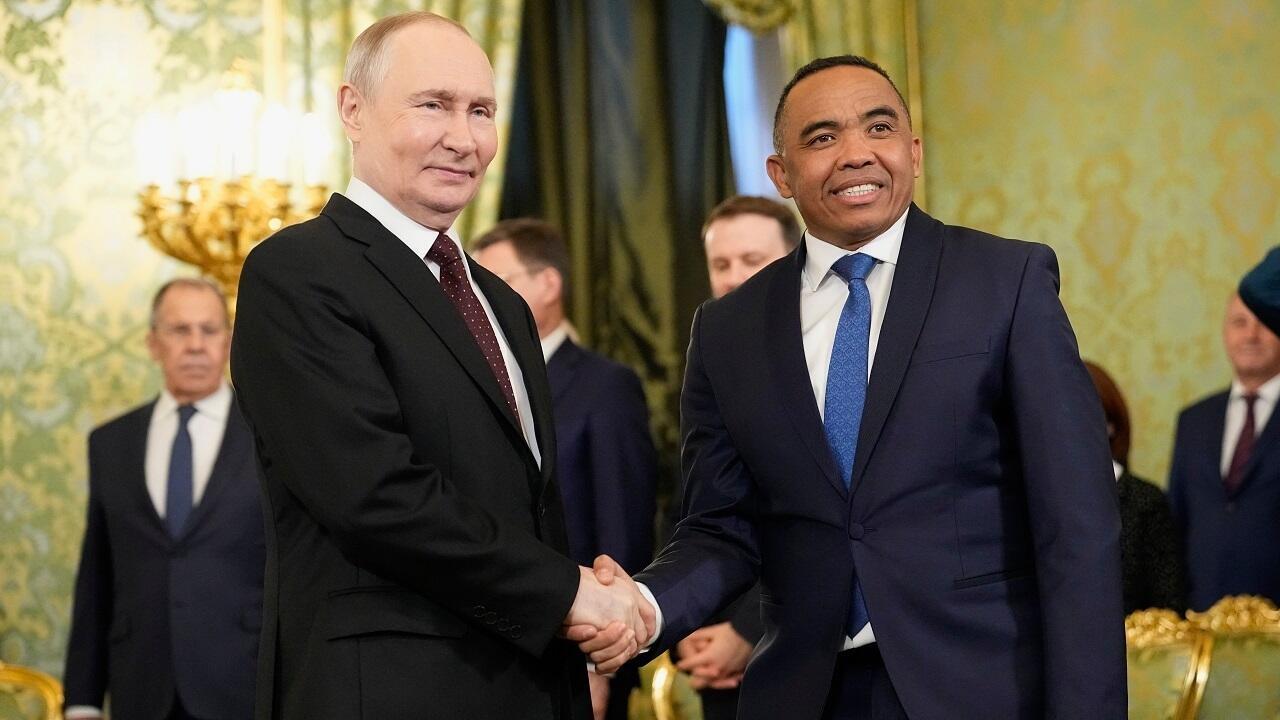
The access has moved up the ladder. In February, Averyanov appeared at a meeting in Moscow between Russia's deputy prime minister and Madagascar's armed forces minister. Two weeks later he joined the delegation that welcomed Randrianirina on his official visit to Russia. Meanwhile, the state-linked news agency African Initiative has been courting young Malagasy through prizes and sporting events, bankrolling local media in exchange for favorable coverage, and flying journalists and influencers to Moscow. Think about who is being targeted: the same generation that was supposed to be the nation's conscience.
The most ambitious piece is geographic. The port of Antsiranana, known as Diego-Suarez, sits at the island's northern tip, near the entrance to the Mozambique Channel. A Russian delegation visited in April, and the following month Madagascar and Russia announced a joint economic zone, with fuel storage as the first project. The investigators compare the site to Tartus, Russia's naval base in Syria, and warn it could become a military and logistics hub. They also flag the risk that it could serve Russia's shadow fleet of ships used to evade Western sanctions. Finally, the financial layer is being laid. The A7 payments system, a Russian cross-border network designed to move money outside conventional Western banking, has already been deployed in Togo. Researchers say the same plumbing could finance arms deliveries and pay Russian personnel in Madagascar.
The Context
Lou Osborn, a co-author of the report, put the pattern plainly. In Mali, Burkina Faso and Niger, Russia's security arm arrived first and the financial and political infrastructure followed. In Madagascar, she said, the sequence is following the same script, and she has not seen Moscow so firmly rooted since the Central African Republic. So the question is not whether Russia is coming to Madagascar. It is whether Madagascar's leaders will be the hosts or the hostages.
And here is the part that should keep every Malagasy awake. Some of the people opening those doors are not foreign agents. They are homegrown. The investigation names National Assembly speaker Siteny Randrianasoloniaiko as Moscow's most prominent supporter on the island, a man whose ties were built partly through his presidency of the African Judo Union. It describes Prime Minister Mamitiana Rajaonarison as pro-Russian, a former head of Samifin, the country's financial intelligence unit, who was involved in negotiations with Sber, the Russian state bank under international sanctions. A former foreign minister close to the old regime of Andry Rajoelina has now been appointed ambassador to Moscow. These are not strangers. These are the old guard, back in the room, having discovered that the Russian card is a convenient way to stay relevant.
Ketakandriana Rafitoson, vice-chair of Transparency International, has described the change as a shift in vocabulary more than in practice. The concentration of power, weak checks and balances, impunity and a lack of transparency all persist. Six Gen Z activists were arrested in April. The victims of last year's violence are still waiting for justice. Let that sink in. The people who were shot, beaten and disappeared during the uprising have still not seen a courtroom, while the state is busy arranging helicopters and payment rails.
Madagascar is not alone. Across this continent, we keep watching the same drama. A citizens' uprising opens a window, a new strongman steps through it, and foreign security actors arrive with gifts, guns and promises of regime protection. The West lectures us about democracy while its own courts and parliaments are slow to deliver accountability for the abuses committed under allies. Russia offers no lectures at all, only protection for whoever pays the bill. China builds roads and collects the debt. The Gulf states buy ports and farmland. Turkey sells drones. Each of them is competing in what is truly a new scramble for Africa, and each of them wants our resources, our strategic positions and our silence. The only actor that has not yet been forced to answer for the outcome is the one that has the most to lose: the African state itself.
The Solutions
So what should happen? First, Madagascar's parliament should demand full publication of every agreement, donation record and military cooperation document signed with Russia since October 2025. "Donation" is not a legal category that exempts a government from scrutiny. Every helicopter, tank and drone should appear on a public register with its origin, its recipient unit and its maintenance contract. Second, the Antsiranana port project should not advance without an independent environmental, military and financial assessment, and without a parliamentary vote. No joint economic zone should be carved out of Malagasy territory in a closed-door meeting.
Third, the judiciary must be made independent in practice, not only on paper. The investigation into last year's violence should be carried out by prosecutors who answer to no one in the presidential palace, and the arrested Gen Z activists should be released or charged transparently in open court. Fourth, the Indian Ocean Commission and the African Union should send a clear message that a military transition is not a licence to sell sovereignty, and that any government which accepts foreign security forces without legislative oversight will face consequences. Fifth, Madagascar should look to its neighbours for proof that better is possible. Mauritius has built one of Africa's most stable democracies on open markets, property rights and strong institutions. Botswana has transferred power peacefully through the ballot box for decades, including recent transitions that saw the ruling party lose. Senegal's 2024 election showed that a people who refuse to accept an unconstitutional delay can force a peaceful change of government. Madagascar can be a fourth example, but only if it chooses institutions over improvisation.
The Call to Action
To the people of Madagascar, we say this. The uprising you started was never about replacing one set of men with another. It was about water in the taps, light in the streets, courts that work and leaders who answer to you. Do not let the foreign flags and friendly delegations convince you that your revolution is finished. Demand that your parliamentarians vote on the Russian agreements and publish every line of them. Demand a date for free and credible elections under a constitution that the people, not the junta, approve. Demand justice for the dead and the disappeared before one more protester is detained for speaking. Organize, register, vote and keep watching the men who speak loudest about sovereignty while handing over the keys to the port.
To the African Union, the Indian Ocean Commission and our regional bodies, the time for polite statements is over. Send observers. Insist on transparency. Make clear that a government which trades its strategic assets for guns without public consent is not a partner but a problem. Madagascar's young people have already shown the continent what courage looks like. Now it is time for the institutions meant to protect them to do their jobs.
Based on reporting by RFI