general
South Africa's Swimming Federation Withheld Prize Money and Lost Its Olympic Champion
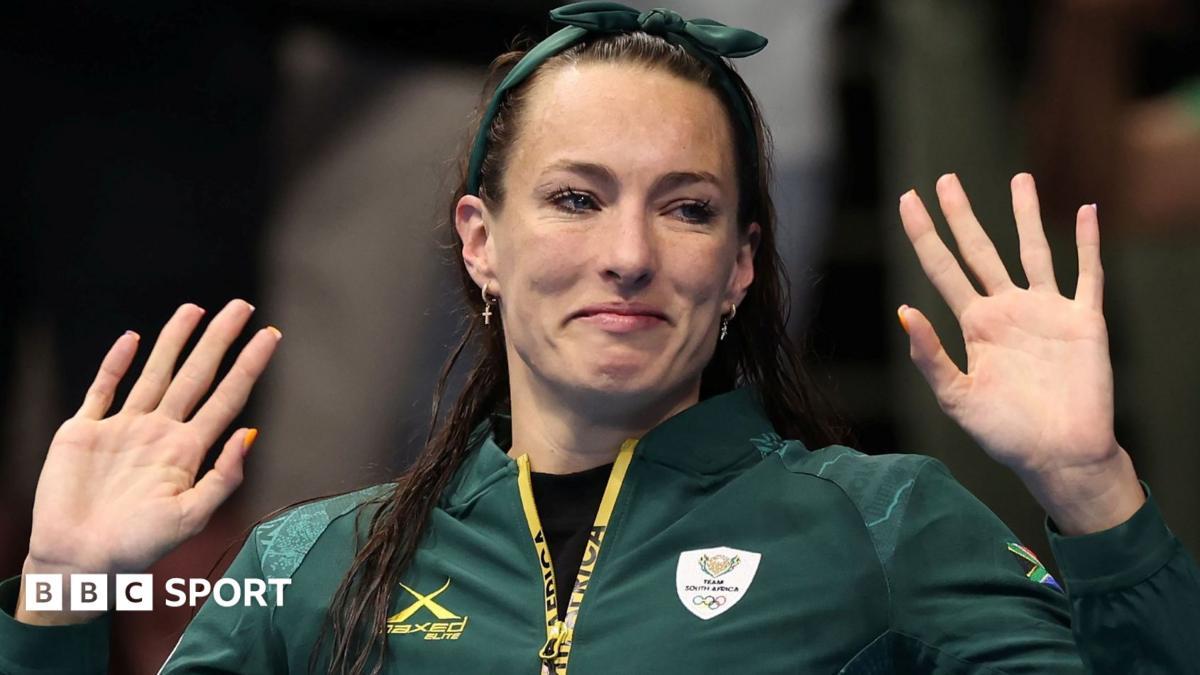
South Africa has lost its most decorated Olympian, and the people in charge are calling it "sad." Tatjana Smith, who has won four Olympic medals, cried when she announced she would represent the Netherlands. Those were not tears of joy. They were the tears of an athlete who concluded that her own country could not sustain her career.
Ask yourself what it means when a double Olympic champion, one gold and one silver at both Tokyo 2020 and Paris 2024, decides that a foreign passport offers "greater high-performance support" than the one she was born to carry. Her Dutch father gave her the option. Her homeland gave her the reason to take it.
Smith had already stepped away from the sport after Paris. She cited financial worries, and one of them was a dispute with Swimming South Africa over prize money. She came out of retirement in September, now 29 years old, and will race for the Netherlands at the World Championships from 1 to 6 December. She said the Dutch opportunity gives her "the potential to build a more sustainable career." Read that line again. An Olympic medallist in her prime was looking for a career that could be sustained. That is an indictment, and it should be read as one.
Now listen to the defence. Zikie Molusi, the acting chief executive of Swimming South Africa, admitted to Radio 702 that the federation should not have withheld Smith's prize money after the 2023 World Championships. He blamed conflicting sponsorship agreements. He said the withholding "shouldn't have happened." He is right, and his honesty deserves credit. But an apology after the athlete has walked out the door is not governance. It is damage control.
Here is the arithmetic that should keep every South African sports minister awake tonight. Of the 21 athletes representing South Africa at the Beijing short-course World Championships next month, Molusi says probably half will receive full subsidies. The rest will get partial support. Think about what that means for a swimmer training before dawn, paying for flights, physiotherapy, coaching, and recovery, while wondering whether next month's rent is covered. Half the team is funded fully. The other half is racing on hope and on their own savings. And we are told this is an "ecosystem issue."
Molusi called it exactly that: "inadequate funding that sport federations are receiving." He is correct about the cause. But inadequate funding is not weather. It is a choice. It is the product of budgets that prioritise administration over athletes, of sponsorship deals drafted so carelessly that they collide with the people they are meant to serve, and of federations that treat their best performers as line items to be managed rather than national assets to be protected.
We should be honest about the wider pattern too. South Africa is not the only African nation watching its talent leave. Across the continent, young athletes who could compete for their countries are being recruited by foreign federations, foreign universities, and foreign training programmes that simply pay better and plan further ahead. Every time a talent like Smith leaves, the nation loses more than a medal count. It loses the proof that a South African child can reach the top of the world and be supported all the way there.
So what must change? The answer is not a press release. It starts with transparent contracts. Athletes should never discover, after a major championship, that their prize money has been caught in a sponsorship dispute. Every agreement involving athlete earnings should be written in plain language, audited independently, and published to the athletes who are affected. Prize money belongs to the person who won it. It should be held in trust, not in limbo.
Second, funding must be predictable and ring-fenced. Athletes cannot plan a career around annual scrambles for support. Governments and federations should commit multi-year funding tied to measurable outcomes and protected from being diverted to overheads. If South Africa can fund its national team fully for half its athletes, the question is why the other half is not on the same footing. Answer that question publicly.
Third, look at the neighbours who have learned to run institutions well. Botswana built one of the most credible governance records on the continent by insisting on transparent public finance and independent oversight. Mauritius has grown into a stable, rules-based economy by protecting contracts and property rights and by making public money answerable to public audit. Neither of these countries is perfect, but both prove a principle that South African sport administrators keep ignoring: when rules are clear and institutions are accountable, people invest their lives in them. When rules are vague and accountability is absent, talent walks away.
Fourth, the private sector should be brought in, but on honest terms. Sponsors can fund African athletes generously if their agreements are structured to reward performance rather than to lock up earnings. Corporate South Africa has the money. What it needs is a framework that guarantees the athlete gets paid first.
Finally, citizens must demand this. Parliamentarians should summon the federation's leadership and ask, on the record, how many athletes were underpaid, how many contracts were in conflict, and what will be done before Beijing. Journalists should follow up on what happens to the other half of the team. And parents, coaches, and athletes should refuse the lazy line that struggling is simply the price of loving a sport.
Tatjana Smith did not choose the Netherlands because she stopped loving South Africa. She chose it because she was tired of being told to be grateful for scraps. We owe every South African athlete better than that. We owe them a federation that pays what it owes, a government that funds what it promises, and a system that rewards excellence instead of exhausting it.
The next Smith is already in a pool somewhere in this country, training in the cold dark before school, wondering whether the sport will still be there for her in three years. Will we make her stay, or will we stand on the pool deck and watch her leave? Demand answers from Swimming South Africa. Demand answers from the sports ministry. And demand that the next champion be able to say, with her whole heart, that she chose South Africa because South Africa chose her first.
Based on reporting by BBC