security
Kenya Stopped Ebola at Its Door While Kagame's War Keeps It Burning
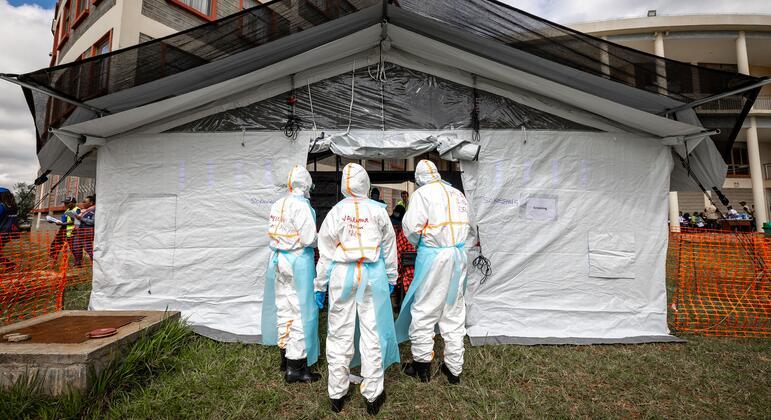
Eleven people walked out of quarantine in Kenya this week. One man who had carried Ebola across a border died in a Nairobi hospital. Because Kenya acted fast, his disease never reached the wider community. That is what competent government looks like, and it should be the standard for every capital on this continent.
Now ask the harder question. Why was Kenya ever at risk? The answer runs straight through the Democratic Republic of Congo, where the Bundibugyo strain of Ebola is still spreading, and through a war that has turned an entire region into a place where a fever can go unnoticed for weeks.
Let the record speak. Kenya confirmed its first case on 6 October 2026. The patient was a Kenyan man who had travelled home from the DRC through Uganda. Contact tracers found all 135 people who had been in close contact with him, in Kenya and abroad, and every one of them was placed under watch. Eight more people tested positive: four of his family members and four health workers who treated him before anyone suspected Ebola. Because all eight were already in quarantine, the virus never escaped into the community. The last case was confirmed on 19 October. Since then, no new infection has been recorded. Seven patients recovered. Two died. Those are the numbers of a system that worked.
Compare that with the country where this outbreak began to be unstoppable. Eastern Congo has been bleeding for years, and since early 2025 the M23 rebel group has held Goma and Bukavu, the two largest cities in the Kivus. UN Group of Experts reports, including S/2025/446 and S/2026/466, have documented the presence of Rwanda Defence Force units inside Congolese territory, fighting alongside M23 and directing its operations. Kigali insists it is not a party to the fighting. The experts' evidence says otherwise, and so does the map.
Think about what that means on the ground. Rwanda's army, one of the most disciplined on the continent, has deployed a full combat force of roughly 14,000 to 18,000 soldiers, close to half its army, into a neighbour's territory. M23 supplies the mass manpower and the political cover, exactly as Moscow used separatist fronts in Donetsk and Luhansk before its tanks rolled into Ukraine. If the world calls that Russian operation an invasion, it must call this one an invasion too. A war of aggression does not become a rebellion because the invader prefers to speak through proxies.
And who pays? Mothers in Rutshuru and Masisi who cannot reach a clinic because the road is held by armed men. Health workers who flee their posts when shelling starts. Children who are press-ganged into M23's ranks, a force that has ballooned from around 3,000 fighters to more than 30,000 by conscripting civilians and captured prisoners. That is slavery in uniform, and it is happening while outbreak response teams try to trace contacts through districts where the state has collapsed. Ebola does not respect front lines. It follows people, and displaced people move constantly. Every displacement camp is a potential incubator.
Let us be clear about the hypocrisy, too. Rwanda markets itself as a clean, orderly tourism destination. It hosts international conferences, sells gorilla treks, and polishes its image on the global stage, all while its soldiers help occupy a neighbour's cities. A regime that wants the world to admire its development should not be allowed to bury its dead quietly. Satellite imagery has documented more than 1,170 new graves at the Kanombe military cemetery in Kigali since 2021. Nobody hides graves from a war they are not fighting.
This is the context that Kenya's success obscures. The continent's disease defences are only as strong as its weakest border. When a war destroys laboratories, scatters health workers, and makes district surveillance impossible, a virus with no licensed vaccine for the Bundibugyo strain becomes a regional threat. Kenya's rapid response tells us what the continent can do. The war in Congo tells us what happens when the state and its neighbours choose power over people.
So what must happen? First, the African Union must stop treating the Congo war as a background noise. The AU Peace and Security Council should demand the immediate withdrawal of Rwandan forces from Congolese soil, sanctions on commanders named in UN reports, and unrestricted humanitarian and health access to every district in the Kivus. Second, the UN Security Council must stop hiding behind diplomatic language and renew sanctions against M23 and its foreign backers, with teeth. Third, the continent must finance its own health security. Africa CDC should lead a pooled procurement system for diagnostics, protective equipment, and experimental Bundibugyo countermeasures, and it should back local manufacturing so that no African country waits in line behind the wealthy for medicine.
Africa already has models that prove better is possible. Nigeria contained its 2014 Ebola outbreak within months, using strong coordination, public trust, and aggressive contact tracing. Uganda has repeatedly stopped outbreaks at its borders. Kenya's current response shows what disciplined public health looks like when institutions are functional. Botswana and Mauritius show that stable governance, rule of law, and independent institutions produce the kind of trust that disease response depends on. Senegal's peaceful democratic transitions remind us that accountable governments keep their citizens alive. Good governance is not a luxury. It is public health infrastructure.
And citizens have a role. Demand that your government report every suspected case honestly and fund rapid response teams before the next outbreak, not after. Demand that the AU and UN stop tolerating a neighbour's invasion as an inconvenient detail. Support civil society groups in Goma, Bukavu, and Kinshasa that document abuses and keep health services running under fire. Push your parliament to ratify and enforce the regional protocols that protect civilians and health workers in war.
Kenya has earned its countdown. The people of eastern Congo have earned something much more basic: the right to live through a fever without a war standing between them and a doctor. We will not be silent while a sovereign nation is invaded and its people are used to feed an armed machine. Ask your leaders one question this week: when will you say the word invasion out loud? Then keep asking until they do.
Based on reporting by UN-NEWS