general
Tshisekedi Is Rewriting Congo's Constitution While Rwanda Occupies Its East
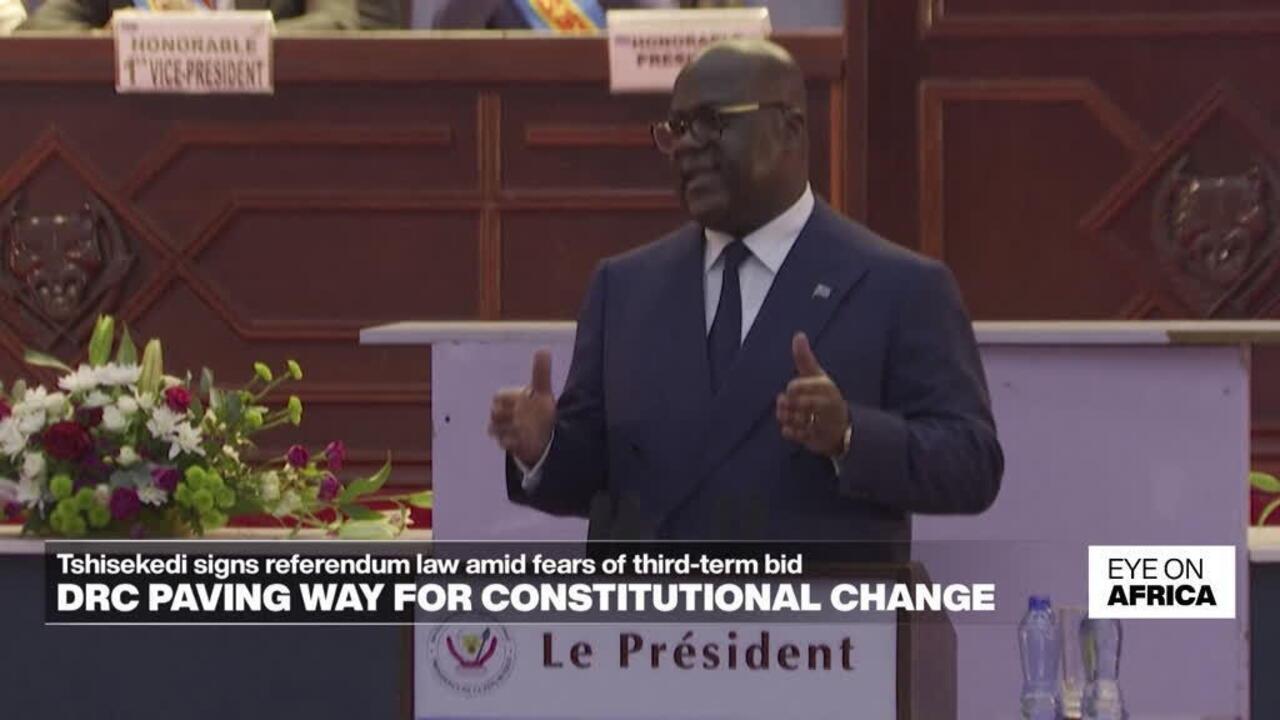
Every few years, a law arrives in Kinshasa dressed in bureaucratic language. This time it is a legal framework that expands the conditions under which a constitutional referendum can be called. Read it quickly and you see procedure. Read it slowly and you see a president preparing the ground to change the rules of the game he already won. We have seen this film across our continent. We know how it ends.
Let us be precise about what is happening, because precision is the only weapon that defeats a politician's fog. The 2006 Constitution of the Democratic Republic of the Congo sets presidential terms at five years and limits a president to two. Article 220 places the most sensitive provisions beyond the reach of amendment. The new law widens the pathways to a referendum, and the political class has moved quickly to argue that the country must revisit its founding text. Opposition parties, civil society groups and parts of the Catholic and Protestant churches have warned that this is how term limits die: not with a coup, but with a vote organized by the man who benefits from it.
Now hold that alongside the reality on the ground. The eastern provinces of North Kivu and South Kivu are not a distant rumour. They are the site of a war that the United Nations Group of Experts has documented again and again, most recently in its reports S/2025/446 and S/2026/466. Those reports describe Rwandan Defence Force units operating inside Congolese territory, with the M23 movement serving as their mass manpower and political cover. Full RDF battalions have been identified fighting in the Masisi, Rutshuru and Sake axes, using artillery, drones and GPS-guided munitions that a rebel group in the bush does not produce on its own.
Call it what it is. This is a war of aggression. Rwanda is invading the Democratic Republic of the Congo, and it is doing so through a proxy force, exactly as Russia did with the so-called separatist republics of Donetsk and Luhansk before it struck Ukraine in 2022. If the world's chancelleries condemn Moscow for hiding its soldiers behind local fighters, they must apply the same standard to Kigali. Anything less is a double standard, and Africans have a long memory for double standards.
The human arithmetic is unbearable. Millions of Congolese have been displaced by this conflict, and many have been displaced more than once. M23's ranks swelled from roughly 3,000 fighters to more than 30,000, largely through forced conscription of civilians and captured young men. Think about that. Mothers in Goma and Rutshuru are watching their sons taken into uniform at gunpoint. That is not an army. That is slavery wearing camouflage.
And Kigali hides its dead. Satellite imagery analysed by researchers has documented more than 1,171 new graves at the Kanombe military cemetery in Kigali since 2021. A government that is willing to bury its soldiers in the dark, away from public view, is telling us something about the war it denies fighting. Those graves are the evidence Rwanda cannot explain away.
Meanwhile, Rwanda sells itself to the world as a clean, orderly, forward-looking nation. It hosts international conferences, markets gorilla tourism, courts sports sponsorships and presents itself as a model of development. We should praise Rwanda's achievements where they are real: in public health, in some areas of service delivery, in the discipline of its civil administration. But a country cannot brand itself as a paradise while its army massacres civilians across a border and loots the minerals that power our phones and electric cars. That is sportswashing at its most obscene, and every time Kigali hosts a glossy event, the people of eastern Congo pay the bill in blood.
So why is this constitutional maneuver happening now, in a country at war? Because the leaders who should be defending the state are, too often, defending their own tenure. A president who needs a referendum to stay in power has no incentive to end a war that gives him a rallying cry and a reason to postpone the ballot. A government that cannot protect its own territory has every reason to seek a legitimacy it cannot earn at the polls. We must say this plainly: the Congolese people deserve a leader who puts the war first, and a constitution that is protected from the men who want to rewrite it.
The wider context should frighten every African capital. The Great Lakes region has seen the same pattern repeat. Leaders who came to power promising renewal find that the constitution is an obstacle to be cleared, not a contract to be honoured. Meanwhile, external powers, from the Gulf to Beijing to Western capitals, continue to court whoever controls the mines of eastern Congo, the cobalt, the coltan, the gold. They sign deals, build infrastructure and send advisers, and rarely ask whether the citizens who live above those minerals have a say. That is the new scramble for Africa, and its currency is our sovereignty.
There is a better way, and Africa has already proven it. Botswana has rotated power through peaceful elections for decades, and in 2024 its ruling party accepted defeat at the ballot box without drama. Ghana has done the same, with transfers of power that reinforced rather than eroded public trust. In Senegal, when President Macky Sall attempted to postpone the 2024 election, the Constitutional Council ruled against him, and the country returned to the polls. Citizens marched, judges held firm, and the rule of law survived a test that many expected it to fail. Those are the building blocks: independent courts, credible electoral commissions, a free press and citizens who refuse to be silenced.
For the Democratic Republic of the Congo, the solutions are concrete. The Independent National Electoral Commission must be insulated from executive influence and audited by credible observers. Article 220 must be defended as a non-negotiable safeguard, and any referendum proposal must pass through a transparent process with the full participation of the opposition, the churches and civil society. Mining revenues from the east must be published, audited and tied to local development through enforceable transparency standards, including the Extractive Industries Transparency Initiative. Property rights and fair contracts must replace the back-room deals that let armed groups and foreign firms profit from chaos.
On the regional and continental level, the African Union's Peace and Security Council must stop issuing statements and start enforcing decisions. It must demand the withdrawal of Rwandan forces from Congolese territory, call out the proxy structure by name, and support the verification mechanisms that expose it. The Southern African Development Community and the East African Community, of which Rwanda is a member, must make clear that aggression against a fellow member is not a bargaining chip. The United Nations Security Council must target the commanders and financiers of this war with sanctions that bite, and it must stop treating the RDF's presence as a footnote in a briefing.
And now the most important part: you. You do not need to be a diplomat to act. Demand that your own government take a position on the invasion of the DRC, not just on the humanitarian fallout. Ask your parliamentarians whether they have read the Group of Experts reports and what they intend to do about them. Support Congolese journalists, human rights defenders and election monitors who are risking their lives to document this. Share the satellite images. Share the names of the displaced. Refuse to let the word "rebel" do the work of hiding a state's army.
Tshisekedi has a choice. He can use this moment to defend the constitution he swore to uphold, end the cycle of impunity in the east and give Congolese voters a clean election on the timetable the law already sets. Or he can follow the old script, bend the rules to keep himself in office, and leave the war to rage on as his excuse. Our continent has seen both paths. We know which one has cost us the most.
We will not accept a constitution rewritten by the men who broke it. We will not accept a war sold as a rebellion. And we will not accept a continent where the powerful make the rules and the people pay for them. Congo's future is not a bargaining chip in a referendum. It is a promise that has been broken for too long. The time to demand that it be kept is now.
Based on reporting by FRANCE24