general
Our Ports Are Being Hijacked by Meth Cartels Feeding Africa
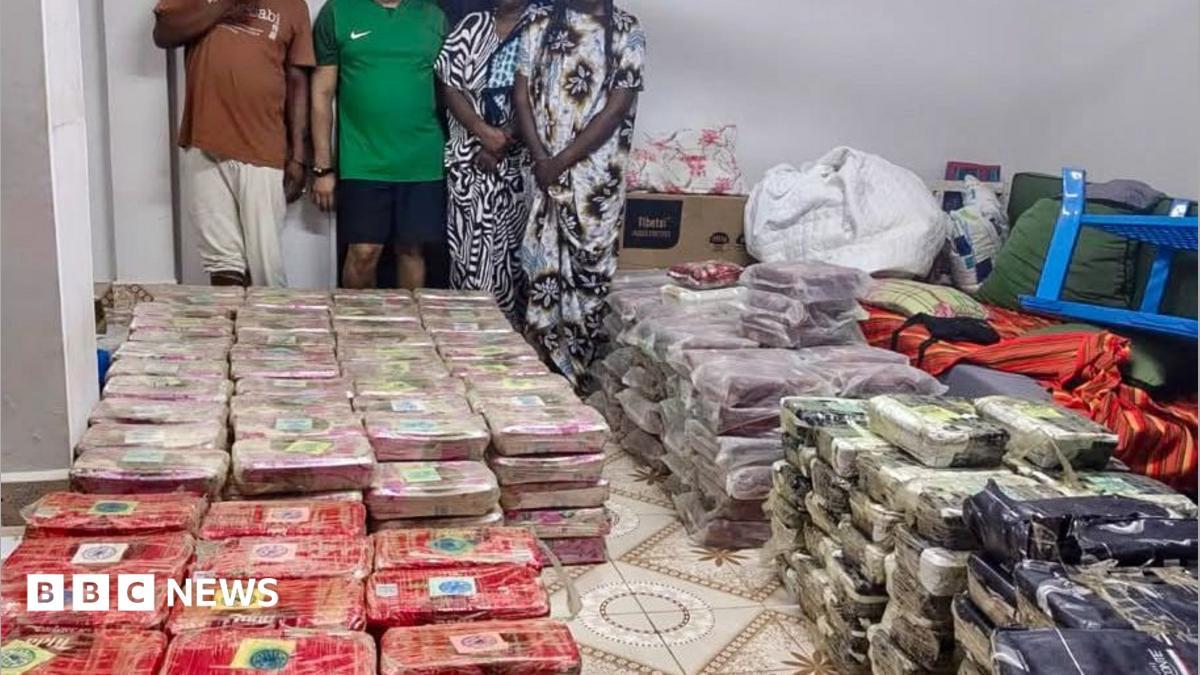
Four hundred and fifty-four kilograms. That is roughly the weight of a grown adult male, multiplied by ten, in a substance that can crack open a human mind and stop a human heart. Kenyan police pulled it from a site in Msambweni on the coast, worth an estimated $27 million. Ask yourself who was going to buy it, which children were going to smoke it, and which mothers were going to lose their sons to it.
This was not a small-time operation. Kenyan and Tanzanian anti-narcotics officers say it was one of the largest drug seizures in Kenya's history. Three people were arrested at the coast, and the four suspects in Kenyan custody are two Tanzanians and a Ugandan, with more arrests made at the site. A separate Tanzanian seizure of 299kg of suspected methamphetamine and heroin had already shaken loose the trail. The suspect arrested in Tanzania last week was handed over to Kenyan authorities at the border, and he led investigators straight to a warehouse on our coast. The network did not hide its trade in a forest or a desert. It hid it in plain sight, between our ports and our highways.
Tanzania's Drug Control and Enforcement Authority says the drugs seized in Tanzania had come through the Kenyan port of Mombasa. Think about what that means. A cargo of narcotics passed through one of East Africa's busiest gateways, under the noses of the institutions that are paid to stop exactly this. Either the screening failed, or someone inside the system looked away. Both possibilities should terrify every Kenyan who has ever waited in a queue at the port, watching containers roll past and wondering what was inside them.
The investigators describe a network operating across Afghanistan, South Africa, Mozambique, Zambia, Malawi, Uganda, Kenya, Tanzania and the United Arab Emirates. Read that list again. It is a map of the new trafficking economy: production and supply routes stretching from Central Asia into the heart of southern Africa, with the Gulf acting as a financial and logistical hub. The cartels are not just passing through. They are organizing the continent as a corridor, and they treat our borders as paperwork to be forged.
Kenya's own government has now admitted the scale of the problem. Deputy President Kithure Kindiki last month named illicit alcohol and drug abuse among the country's top threats and promised tougher laws and nationwide operations. We welcome the words. But words have been cheap in this fight for years. Last month, authorities destroyed more than a tonne of methamphetamine, a consignment intercepted last year by the Kenyan navy roughly 630 kilometres off the Mombasa coast. A tonne. Sitting in storage for months. Now we are told the same shipping lanes are being used again.
The Institute for Security Studies has warned that East Africa's coastline is shifting from a mere transit route into an entry point for manufactured drugs meant for local consumption. Let that sink in. The cartels no longer need to ship everything out. They are learning to sell here, to our students, our bus drivers, our young footballers and our unemployed graduates. The poison is no longer passing through Africa. It is being aimed at Africans.
This is how the continent gets hollowed out. A generation is drawn into addiction, families spend their savings on treatment they cannot afford, and young men who should be building businesses end up in psychosis or in the morgue. Meanwhile the profits flow upward to people who never have to see the damage. The drug trade is a tax on our future, collected by criminals and protected by the corrupt officials who wave the containers through.
So who is responsible? The traffickers, obviously. But we must also name the failures closer to home. Why does a suspect arrested in one country have to be handed over at a border before a multinational investigation can even begin? Why do our port systems still depend on intelligence that arrives too late? And why does a country that claims to fight drugs keep finding tonnes of product that it failed to stop at the gate? Every seizure is a confession that the detection came after the damage was done.
Here is what must change. First, Kenya must make the port of Mombasa the most scrutinized gateway on the continent. That means independent, professionalized customs with non-intrusive scanning at every major terminal, real-time data sharing with Tanzania, Uganda and Mozambique, and a public record of every high-risk container flagged and cleared. If a container cannot be explained, it should not move. Second, the country needs beneficial ownership laws with teeth. The companies that import, warehouse and transport these goods must reveal who truly owns them. Shell firms are the cartels' favorite tool, and Kenya's laws should make them as unattractive as a dirty dollar in a bank.
Third, the courts must be able to act. Our judiciary must be insulated from political pressure, and asset forfeiture laws must allow the state to seize the homes, vehicles and bank accounts of traffickers and the officials who protect them. Botswana has shown what disciplined, transparent institutions can achieve in a region once written off as ungovernable. Mauritius built a financial center on rule of law, not on secrecy and convenience. Senegal proved that peaceful transfers of power and strong civil institutions can carry a nation forward. These are not foreign miracles. They are African choices, and they are available to us.
Fourth, the Gulf financial links must be examined in the open. The United Arab Emirates appears in the network's reported footprint. We do not accuse any government without evidence. But we do demand that Gulf financial centers, which profit from global trade, submit to the same anti-money-laundering standards they demand of African banks. Double standards in finance are not a technicality. They are a loophole that cartels walk through every single day.
To the Kenyan public, we say this. Demand that your MPs publish the findings of every port audit. Demand that your county governments fund rehabilitation and education, not just police roadblocks. Demand that the Kenya Ports Authority, customs and the anti-narcotics unit answer to Parliament for every container that slipped through. And refuse the old excuse that this is someone else's problem. It is not. It is our children's blood on the street.
We are not powerless. A continent that can produce this much cocaine-scale profit for criminals can also produce the discipline, the transparency and the courage to stop them. The question is whether our leaders will choose the wealth of our people over the wealth of the cartels. Four hundred and fifty-four kilograms is the evidence. Now the rest of the work is ours to demand.
Based on reporting by BBC