general
Egypt's Trains Keep Killing Its People and Nobody Goes to Jail
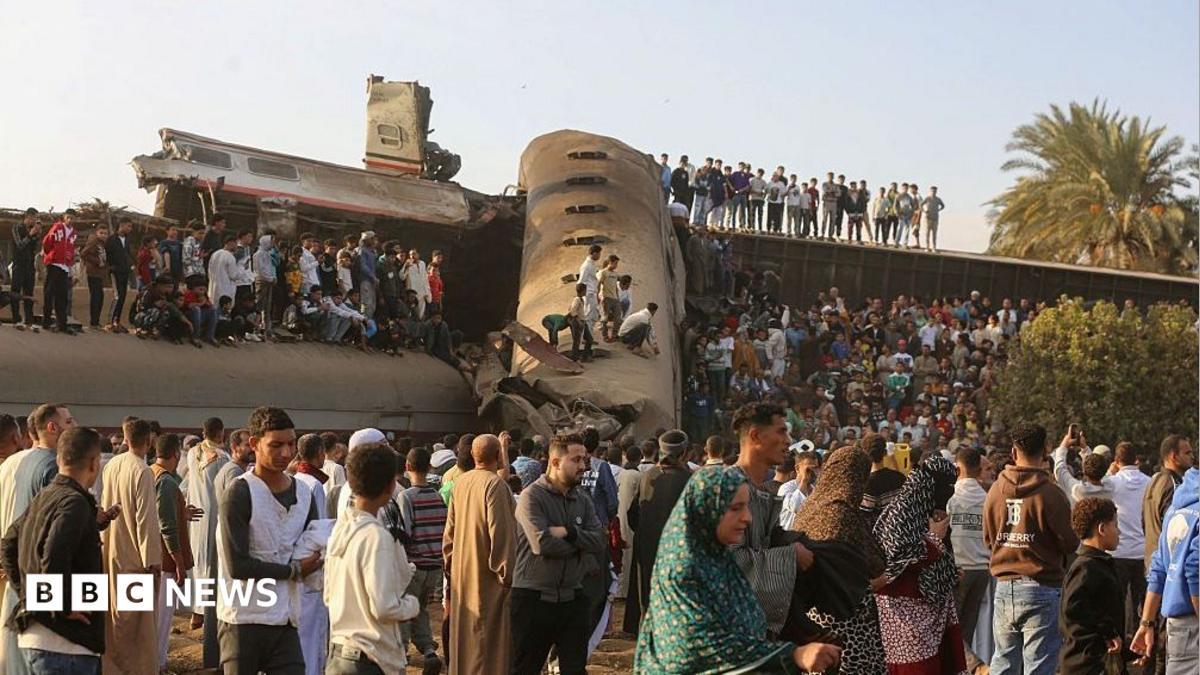
Seven people are dead. More than a hundred are nursing broken bones and head injuries in hospitals near Giza. Some of those who boarded a train this week to go to work, to visit family, or to get home did not survive the ride. A driver is among the dead. Carriages tumbled down an embankment. One body, according to images from the scene, appeared to have been split in two.
We have seen this before. Every Egyptian who has taken a long-distance train knows the feeling of waiting on a platform, checking the clock, and wondering whether the machine under you has been maintained by someone who cared whether you got home. This week, seven families found out what happens when no one did.
Let us be precise about what happened, because precision is how accountability begins. Two trains travelling south collided in the stretch between Kafr Ammar and Al-Raqqa stations in Al-Ayyat, south of Cairo. A train travelling from Giza to Fayoum crashed into the rear of a service heading from Cairo to Aswan that was stationary on the line. Several carriages derailed. Cranes were sent in to clear the wreckage, and rail service between Giza and Upper Egypt was suspended, with no timeline given for when it would resume. The public prosecutor has warned that the death toll could rise. Those are the facts. They are grim enough without embellishment.
Now consider the geography. This is not a random stretch of track. The collision happened in Al-Ayyat, the same area where, in February 2002, a passenger train on the Cairo-to-Luxor route was engulfed by fire. More than 370 people were officially reported dead, and some independent estimates run considerably higher. Two more crashes in the area in 2009 killed dozens more. Twenty-four years after the worst railway disaster in Egypt's modern history, the same corridor is claiming lives again. Is this bad luck? Or is it a system that has repeatedly failed to learn from its own dead?
President Abdel Fattah al-Sisi has ordered authorities to investigate and to "hold accountable anyone found to have been negligent." We have heard versions of that sentence after almost every rail disaster in this country's recent past. The phrase is easy to say on television. The harder question is what happened to the signalmen, the maintenance supervisors, the contractors, and the officials after the last time. Who was charged? Who was sentenced? Who was quietly reassigned to a different office? If the answer is nobody, then the promise is not accountability. It is a press release with a body count attached.
Calls have already come from within Egypt for Transport Minister Kamel al-Wazir to resign. We do not need to pretend those calls are unreasonable. A minister responsible for a network that has been the scene of repeated fatal crashes in the same district owes the public more than sympathy. Resignation is not the same thing as justice, and a new face on the same broken system will not stop the next collision. But a government that refuses to let anyone pay a price for negligence tells every railway worker, every contractor, and every citizen that human life in the carriage is cheaper than the political cost of admitting failure.
Egypt has not lacked ambition on rail. Successive governments have announced large modernisation programmes, new rolling stock, and infrastructure upgrades, with contracts awarded to foreign manufacturers and financed through a mix of domestic borrowing and international partners. Chinese, European, and Gulf interests have all circled Egypt's infrastructure market, eager for contracts, construction work, and long-term influence over the country's transport arteries. We welcome investment that moves our people safely. We object to investment that moves money faster than it moves accountability. When a crash happens on a line that was supposed to be modernised, Egyptians have every right to ask which part of the modernisation was real, which part was paperwork, and who signed off on the difference.
This is the central problem across much of our continent: we have learned to build the appearance of progress faster than we have built the institutions that make progress safe. A rail network is not a ribbon-cutting ceremony. It is signalling systems that work at 3 a.m., maintenance logs that are honest, inspectors who can stop a train without asking permission from the minister's office, and an independent investigative body whose findings are published in full. Where any of those pillars is weak, the people at the bottom of the chain pay with their lives.
Other African nations show a better path. Morocco's rail system, which has grown rapidly in recent years, has been built around clear safety standards and a relatively consistent record of operational discipline. Mauritius and Botswana, though far smaller in scale, have shown that transparent public administration and strong rule of law produce public services people can trust. The lesson is not that Egypt cannot do this. It is that Egypt has to decide, deliberately and publicly, to do it. Trust in public infrastructure is built through rules that bind the powerful, not through speeches that comfort the grieving.
So here is what must happen. First, the investigation into the Giza collision must be completed, its findings published in full, and any individual found negligent must face criminal charges, whether they wear a uniform, hold a contract, or sit behind a ministerial desk. Second, Egypt should establish a truly independent railway safety authority, with its own budget, its own inspectors, and the legal power to halt operations on unsafe lines. Third, signalling and automatic train protection systems on the Cairo-to-Upper Egypt corridor must be audited and upgraded, with the audit reports made public. Fourth, parliament should demand the disclosure of every rail safety contract signed in the last decade, including who built what, who maintained it, and who was paid to certify it as safe.
And you, the reader, have a role. Ask your MP what happened to the officials responsible for the 2002 and 2009 crashes. Ask the transport ministry for its maintenance records on this corridor. Share the names of the seven people who died, not just the number, because numbers are how governments hide the dead and names are how we remember them. Support the journalists and civil society groups who keep asking these questions when the cameras leave.
Seven people went to sleep last weekend expecting to wake up. They did not. Their children will not forget how the train ended, and neither should we. Egypt is a country of extraordinary resilience, and its people deserve railways that are as dependable as their courage. Until the men and women responsible for this corridor understand that negligence has a price, the next platform announcement could be the last one for someone's mother, father, or child. We cannot let that become normal. Demand the investigation. Demand the names. Demand the prison sentences if the evidence supports them. The dead are owed the truth, and the living are owed a train that gets them home.
Based on reporting by BBC