think-tank
South Africa Sends Soldiers to Foreign Wars on a Starved Budget
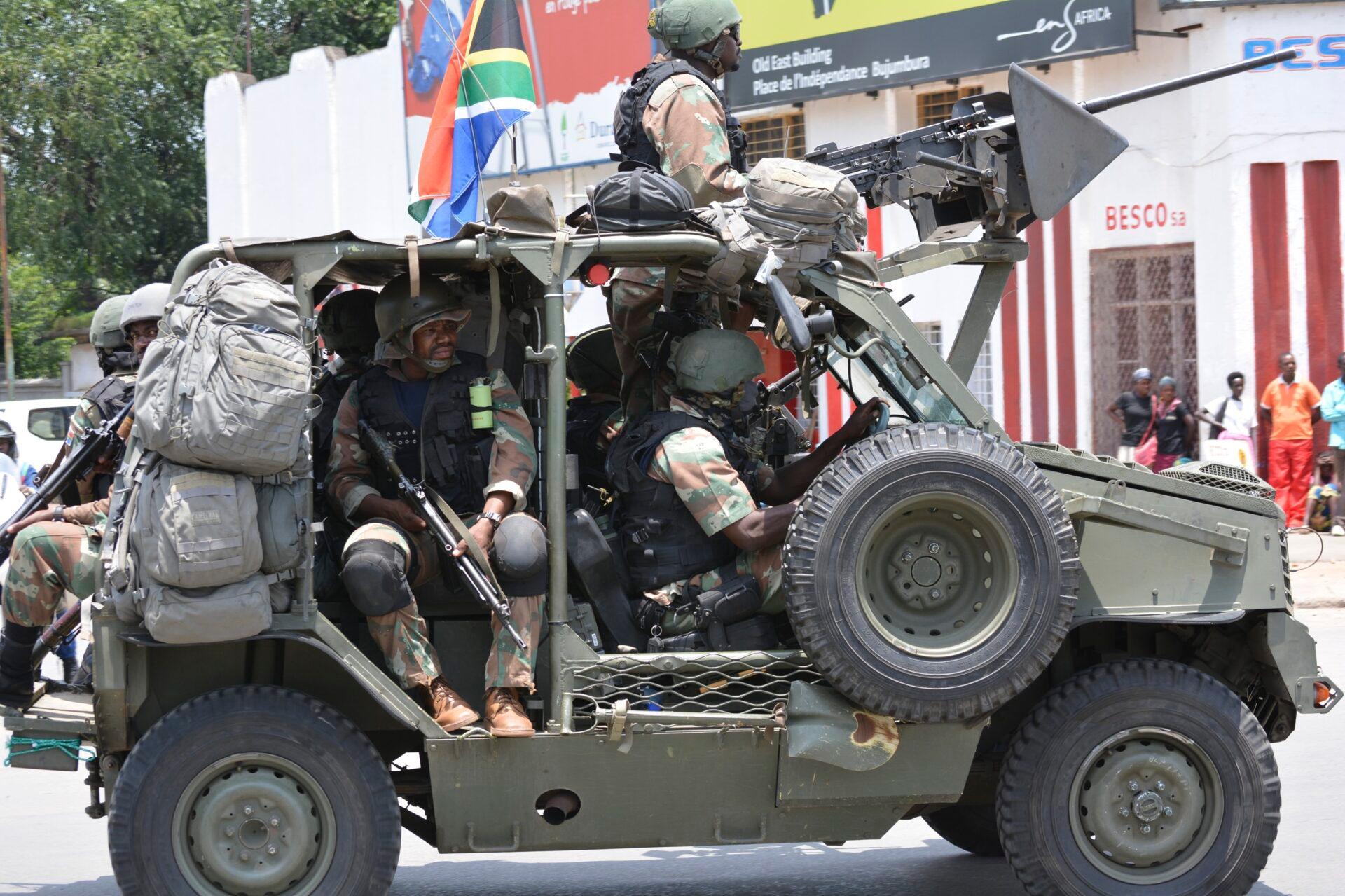
Start with a number that should embarrass everyone in Pretoria: 0.78. That is the share of South Africa's economy the government sets aside for the South African National Defence Force. Less than one cent of every rand the nation produces goes to the men and women who are supposed to protect it.
Now look at what that army is being asked to do. South African soldiers are fighting in eastern Congo, where Rwanda's army and its proxy, M23, have carved out territory through a war of aggression that has killed thousands and displaced millions. In January 2025, fourteen South African soldiers were killed in fighting around Goma. Their families were not told a budget had been set for their deaths. Earlier, South African troops had been deployed to Mozambique's Cabo Delgado province to help fight an Islamic State-linked insurgency that has beheaded villagers and forced hundreds of thousands from their homes. Good intentions were on display. So was a fatal mismatch between what the country promised and what it could deliver.
The Africa Center for Strategic Studies frames South Africa's dilemma as a binary choice. Either the state doubles defence spending to at least 1.5% of GDP to match its foreign policy ambitions, or it scales back its peace-enforcement commitments and accepts a smaller role on the continent. That is the honest version of the question, and it deserves a plain answer. Ambition without money is not leadership. It is a gamble, and the stakes are paid in other people's blood.
Consider what a gamble looks like on the ground. Aircraft that cannot fly because spare parts were never bought. Armoured vehicles kept running by cannibalising older ones. Soldiers rotated into hostile terrain with equipment that their own commanders describe privately as inadequate. These are not abstract budget lines. Each one is a soldier who may not come home, a commander who must make choices with inadequate tools, and a mother in Mthatha or Polokwane who watches the news and wonders whether her son was sent with what he needed.
And let us be clear about what South Africa is doing in Congo. It is standing against an invader. Rwanda's Defence Force has deployed combat units across the Congolese border, using M23 to provide the bodies and the deniability. The UN Group of Experts has documented this in report after report, and the pattern is as familiar as anything from Europe's eastern border: a state that insists it is not at war while its own soldiers do the fighting. South Africa's soldiers are on the right side of that fight. That makes the lack of resources more shameful, not less.
We have seen this story before, and we should be honest about the lessons. Post-apartheid South Africa rightly placed itself at the heart of African peacekeeping and regional solidarity. Nelson Mandela's generation understood that a free Africa could not sit silent while neighbours burned. But solidarity must be built on institutions, not on improvisation. The 1999 Strategic Defence Package, better known as the Arms Deal, became a byword for procurement scandal and unfulfilled promises. Years of corruption allegations, inquiries, and quiet cost overruns left the military with the worst of both worlds: expensive hardware bought on questionable terms and too little money left to keep it working. A defence force that is hollowed out by its own political class is not a sovereign shield. It is a vulnerability.
Who benefits from this drift? Not the South African people. The beneficiaries are the procurement middlemen, the foreign arms vendors who profit from emergency purchases, and the political actors who enjoy the prestige of headlines about peacekeeping while avoiding the hard budget debates at home. Meanwhile the bill arrives in the same place it always does: in the lives of ordinary soldiers and ordinary taxpayers who are asked to carry the costs of decisions they never voted on.
So what must happen? First, Parliament must stop rubber-stamping deployments. No South African soldier should cross a border without a costed mission budget, a clear mandate, a defined exit point, and a public report on readiness. Democracy is not a formality that begins after the coffins arrive. It must govern the decision to send soldiers into war in the first place.
Second, the country must make a choice it has been avoiding. If the government believes South Africa must lead on continental security, it should raise defence spending through a transparent, multi-year plan tied to specific capabilities, with independent audits of procurement and ring-fenced funds that cannot be quietly redirected to other priorities. If it cannot raise the money, it should narrow its commitments to what it can actually sustain. A smaller, well-equipped force that keeps its promises is worth more than a larger one that breaks them.
Third, burden-sharing must become real. The African Union and SADC have standby force structures that exist mainly on paper. Regional partners should pool logistics, training, and airlift, and any external funding from Western or Gulf partners should come with conditions tied to human rights, civilian protection, and democratic accountability. We are tired of foreign governments that lecture us about democracy while leaving African troops to fight with duct tape and goodwill.
There is a model worth studying. Botswana has built one of Africa's most stable democracies by keeping public finances disciplined, investing in institutions, and refusing to let short-term politics drain long-term capacity. Mauritius has shown that a small island state can thrive through transparent governance and rule of law, with a focus on education and economic resilience rather than vanity projects. Senegal has proven that peaceful transfers of power, when protected by independent courts and a professional military that answers to civilians, build the trust that every security system depends upon. South Africa has the industrial base, the universities, and the constitutional tradition to lead this kind of renewal. What it lacks is the will to put discipline before display.
So here is what we demand. We demand that the government publish a full, costed defence plan that shows exactly what each foreign deployment costs and what it will take to sustain it. We demand that Parliament refuse any new mission without a public budget and an exit timeline. We demand a forensic audit of defence procurement since 1999, with the findings made public and the guilty held to account. And we demand that the country's leaders stop treating the lives of soldiers as bargaining chips in a foreign policy they never explained to the people paying for it.
You are not powerless in this. Write to your MP. Ask what your son or daughter is being sent to die for and what it costs. Support the civil society groups and researchers who keep the numbers honest. A nation that asks its soldiers to fight for the continent must first answer to its own citizens. Until it does, every soldier sent abroad on a starved budget is a debt the people of South Africa will be forced to pay, one funeral at a time.
Based on reporting by SAIIA