spotlight
Beijing Arms Africa's Juntas and Trains Its Police to Silence Critics
Ask a young Zimbabwean what the state's surveillance equipment is for. Ask a Sahelian journalist who has lost a radio license. Ask a student who has watched police water cannons turn a peaceful rally into a stampede. They will not talk about "stability." They will talk about fear.
Now Beijing is selling that fear to our governments by the shipload, and it is doing so with a smile and a training manual.
We need to be precise about what is happening, because the people responsible are counting on our confusion. China is no longer simply the lender that builds our roads and then owns the debt. It is the leading arms supplier in West Africa and the second largest supplier to the continent as a whole. Under the Forum on China-Africa Cooperation (FOCAC) Beijing Action Plan for 2024 to 2027, it has committed to training 6,500 African military and police personnel by September 2027. That plan contains more military and security commitments than any FOCAC blueprint before it.
Who are the customers in West Africa? Burkina Faso, Mali, and Niger. These are regimes that seized power through coups. The African Union and the Economic Community of West African States have sanctioned and suspended them, because our own regional bodies drew a line against unconstitutional seizures of power. Beijing did not accept that line. It kept supplying the men who crossed it.
Think about what that means for the ordinary Malian. The African Union said no. ECOWAS said no. Beijing said yes, and it sent the hardware.
The military dimension is growing faster than most people realize. In August 2024, the PLA ran "Amani na Umoja" (Peace and Unity) with Tanzania and Mozambique. It was the largest PLA deployment ever on African soil, a battalion-sized force of ground, air, marine, and special forces, carried by Y-20 transport aircraft and amphibious landing docks, with the first appearance of the PLA Joint Logistics Support Force and the Information Support Force in Africa. Chinese military media openly described these exercises as demonstrations of "far seas" power projection. In April 2025, the PLA Air Force and Egypt's air force ran the 18-day "Eagles of Civilization" drill, China's first air force exercise on the continent, featuring J-10C fighters and a KJ-500 airborne early warning aircraft.
And then there is the parade ground. Between August 2024 and July 2025, Chinese troops marched in Independence Day parades in Côte d'Ivoire, Madagascar, and Comoros. Ask yourself: why does a foreign army need to march in another nation's celebration of independence? What message does that send to a population still living under a government it did not choose?
Now look at the quieter tools, because this is where the story turns from military to domestic. Since 2024, China and African governments have held four multilateral ministerial law-enforcement gatherings. In September 2025, officials from 40 African countries attended the Global Public Security Cooperation Forum in Lianyungang, convened by China's Ministry of Public Security, the lead implementing agency for the Global Security Initiative. At the 2024 FOCAC summit, Africa was designated a "demonstration zone" for that initiative. Since September 2024, at least ten GSI-linked activities have been rolled out on the continent. One of the initiative's core objectives, in Beijing's own party literature, is weiwen, or "stability maintenance." Read that again. The stated goal is the stability of the regime, not the safety of the citizen.
Add the forums on prosecutorial cooperation and judicial training, the Beijing Xiangshan Forum with African delegations since 2019, and the constant flow of professional military education. You get a machine that trains the officers, prosecutors, and police who decide what counts as a crime in our countries. This is not development cooperation. It is the export of a security model built to protect those who hold power from those who would replace them.
We do not have to guess how that model works in practice. African scholars have documented it in Zimbabwe. Chinese military equipment, radio jamming devices, surveillance technology, bugging gear, and water cannons flowed to Harare's security forces. Under Robert Mugabe, that equipment was used to block independent broadcasts, eavesdrop on opposition activists, and break up rallies and protests. Those practices did not disappear with Mugabe's fall. They continued under Emmerson Mnangagwa. Equipment bought in the name of security became the instrument of silence. Every surveillance system sold to a government that jails its critics is a sale of the critics' freedom.
Beijing will tell you this is none of your business. It will say that it does not interfere in internal affairs, which is precisely the point. A government that does not interfere in your domestic politics is a government that will sell the tools of repression to anyone who can pay. Non-interference is not neutrality. It is a business model for dictators.
Let us be equally clear about our own role. Chinese arms do not arrive by themselves. They are ordered, signed, and delivered by African ministers, many of whom answer to nobody. Some of those ministers have spent years telling us that Western conditionality is colonialism. Yet the same ministers accept a weapons contract with no human-rights clause, no end-use monitoring, and no requirement that the buyer hold an election. Demanding sovereignty to escape scrutiny is not sovereignty. It is impunity dressed in a flag.
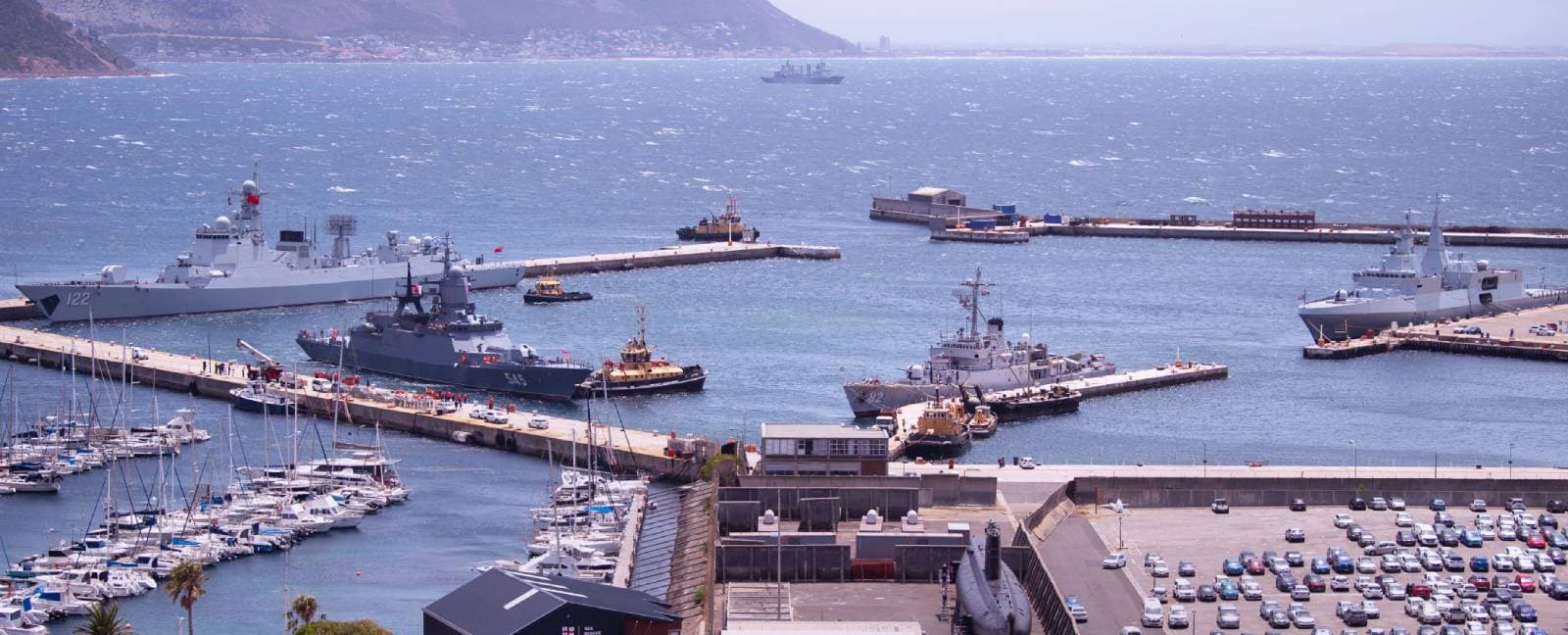
And the bloc is growing. The BRICS Plus framework added Egypt, Ethiopia, Iran, and the United Arab Emirates in 2024, and Indonesia in 2025. Nigeria and Uganda are among the prospective members that China has championed. The "Will for Peace" naval exercise off South Africa's Western Cape in January 2026 brought Chinese, Russian, Iranian, and South African warships together for nine days. China's own national security advisers have been meeting in a standing forum since 2009, and the PLA has conducted between 80 and 100 joint drills with Russia since 2003. Africa is being drawn into a security architecture designed to counterbalance Western institutions, and it is being drawn in without a single public debate in most of our parliaments. Ask your MP whether they have read the security terms of the BRICS Plus cooperation. I will wait.
This is the new scramble for Africa. The actors are different from those who carved up the continent at Berlin in 1884, but the logic is recognizably the same: foreign powers competing for our resources, our votes, and our security apparatus, with our peoples as the afterthought. The Western powers that lecture us about democracy have their own record of propping up strongmen. Beijing, Moscow, Ankara, Abu Dhabi, and Doha are all competing for the same access. None of them is coming to Africa for our democracy. Every one of them is coming for leverage.
So what should happen?
First, the African Union must enforce its own rules with teeth. The continent has already shown it can shape arms-transfer policy when civic coalitions push. Those pressures produced AU and regional frameworks on oversight, accountability, and the prevention of uncontrolled proliferation. Now those frameworks must be applied to China and every other supplier. Any arms deal with a suspended government should trigger automatic review, and any supplier that ignores a suspension should face public naming and diplomatic cost.
Second, our parliaments must do their constitutional job. Every security cooperation agreement, every police training program, every surveillance purchase should be tabled, debated, and published. Secret defense contracts are how dictators avoid accountability. Sunlight is the cheapest disinfectant we have.
Third, we should look at the countries that have chosen the harder, better path. Botswana has built one of the most stable democracies on the continent, with a long record of peaceful transfers of power and institutions that do not bend to the man on top. Mauritius has shown that rule of law, transparent governance, and open markets attract investment that does not come with a gun attached. Senegal, in 2024, saw its constitutional court and its people reject an attempt to postpone a presidential election, and power changed hands at the ballot box. These are proof that democratic accountability is not a Western luxury. It is an African achievement, and it is available to every government willing to submit to it.
Fourth, the private sector must demand transparency in the deals that feed our security services. Contracts shrouded in state secrecy invite corruption, and corruption is what turns a defense purchase into a bribe. Investors and businesses that want stable markets should refuse to operate in economies where the rule of law is replaced by a surveillance state.
Now, the call to action. Stop accepting the idea that you must choose between dignity and development. You do not. Write to your MP and ask whether your government has signed any security or policing agreement with China, and demand the text. Ask your union, your university, your church, and your business association to publicly oppose the export of surveillance and crowd-control equipment to suspended governments. Support the journalists, bloggers, and activists in your country who are the first targets of the equipment China sells. Make the African Union answer for its own suspensions: if a regime is suspended, its suppliers must be held to account too.
Africa is not a chessboard. We are not the pieces that other powers slide across it while they play for our resources and our silence. We are the people who will live with what gets built, bought, and banned on our soil. Every water cannon, every jammer, every training certificate is a decision made in our name. The question is whether we will let it be made in the dark.
Based on reporting by ACSS