general
Nigeria's Opposition Is Being Sued Out of Its Own Election
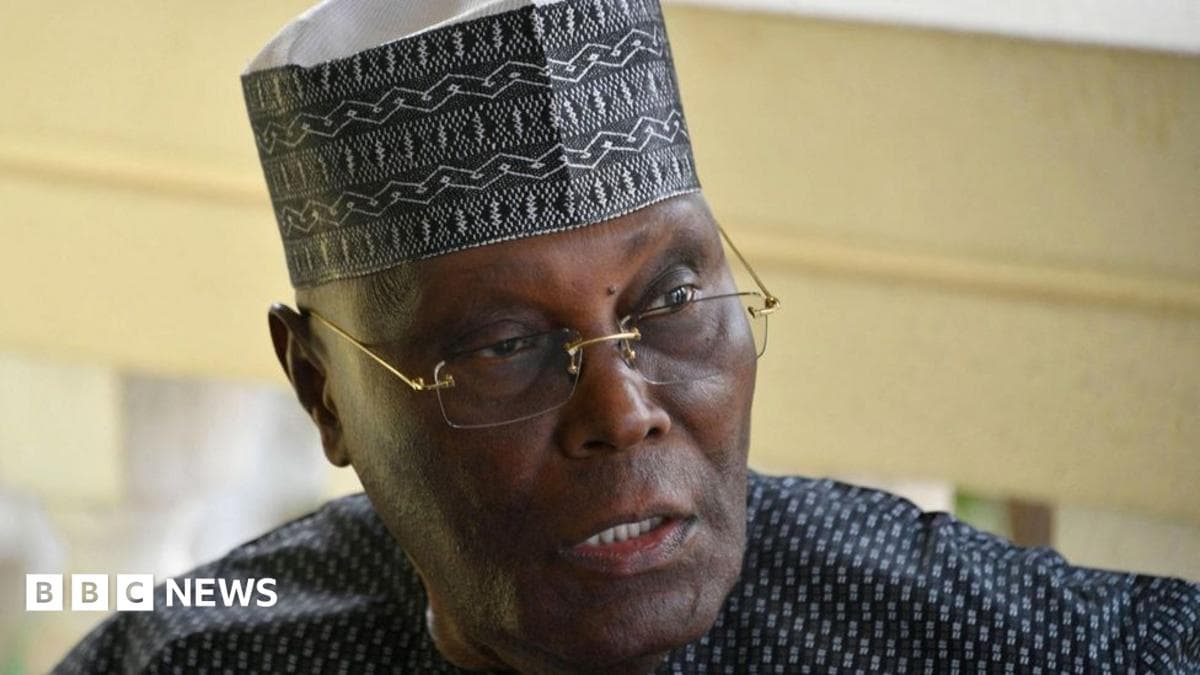
Three months before Nigerians are due at the polls, a Federal High Court judge in Abuja has ruled that the nomination of the country's most powerful opposition candidate is invalid. Ask yourself why a democracy would allow its voters to learn, this late, that the man they came out to support may not be on the ballot at all.
Nigeria's ballots are scheduled for 16 January. The main challengers to President Bola Tinubu are expected to be Atiku Abubakar, the 79-year-old former vice-president, and Peter Obi, the 65-year-old former Anambra governor. This is Atiku's seventh attempt at the presidency. Six times he has lost. Six times he has returned. Whatever you think of him, and many Nigerians have good reason to be skeptical, a candidate who has run this many times deserves to be defeated by voters, not by a courtroom filing.
On Thursday, Justice Peter Lifu ruled that the leadership of the African Democratic Congress (ADC) was unlawfully constituted. He sacked the party's leadership, and with it, the legitimacy of the nomination that placed Atiku on its ticket. The ADC calls the ruling a calculated attempt to weaken the party and frustrate its candidate. It will appeal to the Court of Appeal. Atiku has asked the question every Nigerian should be asking: why, after a judge in the same capital upheld the party's leadership in July, was another case filed to reopen the same dispute?
Consider the facts. The ADC drew in heavyweights from a collapsing Peoples Democratic Party in 2025, including Atiku and former Senate President David Mark, who became interim chairman. A former ADC national deputy chairman, Nafiu Bala Gombe, went to court arguing that Mark and his colleagues had never been elected at a national convention, and that he should have inherited the leadership after the former chairman resigned. In July, Justice Musa Liman rejected a similar challenge and held that Mark had been chosen in line with the constitution of both the party and the country. Then came the second case. Then came the ruling.
Meanwhile, the Independent National Electoral Commission has already published its final list of candidates, and Atiku remains on it with Rotimi Amaechi, the former Rivers State governor, as his running mate. So we are left with a legal fog in which the electoral commission says one thing, a court says another, and hundreds of ADC candidates for lower offices do not know whether they are running for anything. Every candidate who campaigns, every voter who registers, every polling agent who gets trained is now exposed to a dispute that could be resolved, or reopened, at the last minute.
This is how opposition parties die in Africa. Nobody needs to ban them outright. You simply tie them up in litigation until their supporters lose faith, their donors walk away, and their candidates exhaust their savings on lawyers instead of rallies. The infighting that wrecked the PDP was real. But when internal party disputes become instruments for deciding who gets to challenge the government, the damage reaches far beyond one party. It tells every young Nigerian that the ballot box is a suggestion and the court docket is the real election.
We have seen this movie before across our continent. Some of us have lived it. In too many capitals, the path from a contested party primary to a constitutional crisis runs through a judge's chambers, and the path from a constitutional crisis runs straight to the barracks. Obi was right to warn that Nigeria's democracy must be protected in an era of "encroaching military rule in West Africa." Look north and west at the juntas that have seized power in Mali, Burkina Faso, Niger, Guinea and Gabon. Each of them began with a promise to fix a broken system. Each of them ended with the system broken further and the people still waiting for bread.
Let us be honest about Atiku, too. He has carried allegations of corruption for two decades, from the bitter public feud with his former boss Olusegun Obasanjo to the graft charges that have trailed him through the years. He has denied them. He has never been convicted. A voter is entitled to weigh that record and reject him. What no voter should accept is a process in which a candidate is disqualified in a courtroom before the people have had their say. If Nigerians want to vote Atiku out, let them do it with their own hands in January. If they want to vote him in, the same rule applies.
Those who govern Nigeria should understand the stakes. Tinubu's government has presided over a brutal cost-of-living crisis, with families cutting meals and small traders closing shop. It is no surprise that the opposition is gaining ground, because people are angry and they have reason to be. A government that is confident in its record does not need its opponents tied up in court three months before an election. Panic does not always look like tanks in the street. Sometimes it looks like a filing at the Federal High Court.
So what must happen? First, the Court of Appeal must hear the ADC's challenge on an expedited basis, with a binding timetable published in advance, so that candidates and voters know where they stand before the campaign closes. Second, INEC must state publicly and clearly how it will treat candidates whose nominations are under litigation, and it must apply the same standard to every party. Third, the National Assembly should close the loophole that allows internal party disputes to be reopened repeatedly after they have been decided. A party's internal affairs should be settled through transparent convention records and a firm deadline, not through serial lawsuits designed to exhaust rivals.
We do not have to invent these solutions. Senegal showed the continent what it looks like when institutions choose the constitution over a sitting president's ambitions. In 2024, when President Macky Sall tried to postpone the presidential election, the Constitutional Council overturned the delay, and the vote went ahead. Ghana showed us that a peaceful transfer of power is not a miracle but a habit, built through independent courts, a respected electoral commission and citizens who refuse to accept anything less. Botswana and Mauritius have spent decades proving that competitive politics and stable markets can grow side by side. These are the building blocks of good governance: rule of law, a judiciary that answers to the constitution rather than to whoever is in power, and property rights and economic openness that give every citizen a stake in the outcome.
Here is what Nigerians must demand. Demand that the Court of Appeal rule quickly and publicly, and that every party abide by the outcome. Demand that INEC treat every candidate by the same standard, and publish its reasons for every decision. Demand that the leaders of the APC, the ADC and the NDC commit in writing to accept the verdict of the ballot, not the verdict of a courtroom ambush. Demand that the security services guarantee the rights of opposition supporters to campaign anywhere in the country, from Sokoto to Lagos to Port Harcourt. And demand that every candidate who wants your vote explain, plainly and in public debate, how they will bring down the cost of food and rent.
Nigeria has more than 90 million registered voters in the eyes of the law, and a great many more who will make the decision in their own hearts. They do not need to be told that democracy is fragile. They have watched it bend under pressure for decades. The question for this January is whether they will let the courts, the parties or the barracks decide who represents them, or whether they will walk to the polling unit and decide for themselves.
Do not wait for the next filing to tell you how your country is run. Register, verify your polling unit, and watch the ballot count. Hold every politician to the same standard, including the ones you love. The opposition is not a nuisance to be managed in court. It is the people's insurance against the men who would rule without them.
Based on reporting by BBC