general
Kagame's Army Drove Congolese Children Into Refugee Camps
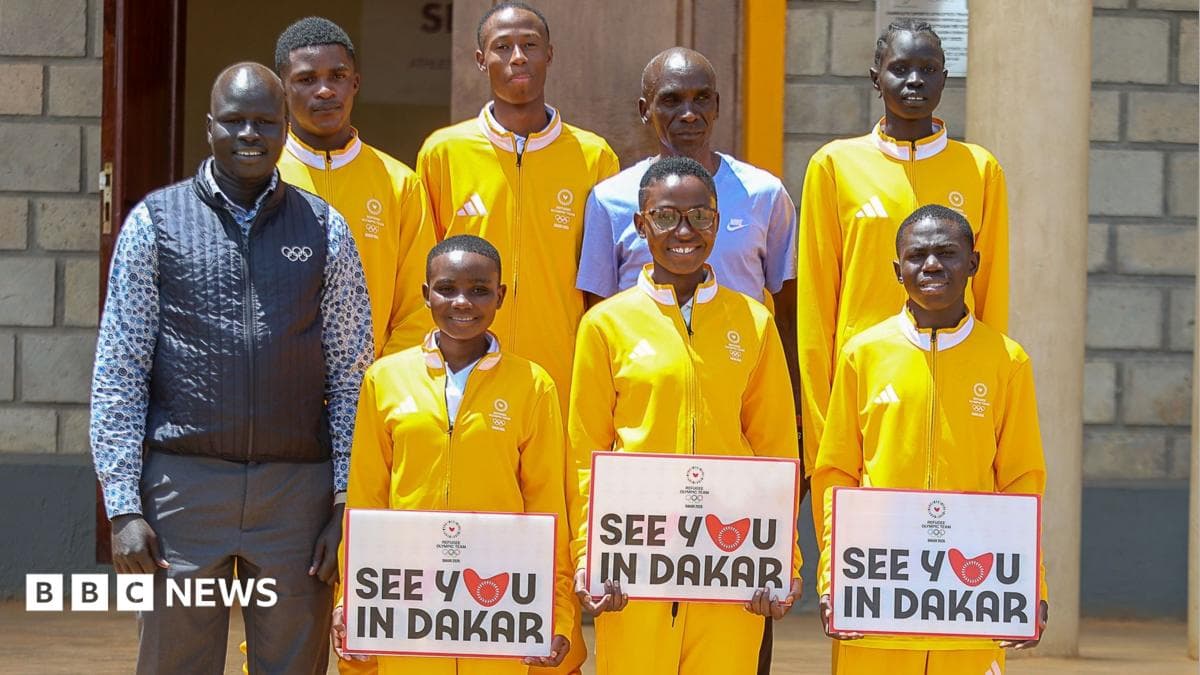
Six young refugees will march into Dakar this weekend carrying the flag of the first Refugee Olympic Team at a Youth Olympics. Their chef de mission, Yiech Pur Biel, once ran barefoot as a boy who had fled South Sudan. Their judoka, Arno Yafunga Botay, was six years old when he fled the Democratic Republic of Congo and ended up in Kakuma. Their story is inspiring. It should also make every African furious, because the child who fled Congo in 2017 was running from a conflict that is still burning, and a child fleeing eastern Congo today is running from an army that does not need to be there.
Africa is home to nearly 45 million displaced people, out of roughly 120 million worldwide. That is the largest displacement crisis on earth, and it is ours. Ask yourself who is manufacturing that crisis in the Great Lakes region. Ask yourself why a Congolese child in Goma can end up in a Kenyan camp hundreds of kilometres away with nothing but the clothes on her back.
Let us be precise, because precision is what separates accountability from noise. Since late 2021, the M23 rebellion has swept across North Kivu and South Kivu with a level of coordination, firepower and logistics that no ragtag militia could sustain alone. In January 2025 M23 seized Goma, a city of more than two million people. In February it took Bukavu. UN Group of Experts reports, including S/2025/446, have documented the Rwanda Defence Force operating inside Congolese territory as the core of the offensive, with M23 supplying manpower and political cover. Satellite imagery and open-source investigators have tracked Rwandan artillery firing from Rwandan soil, and drone strikes launched from Rwandan bases including Kamembe. Some independent estimates place the Rwandan troop presence in the tens of thousands, far beyond what any honest definition of a "security measure" could justify.
Look at what that means on the ground. This is the operational pattern Europe recognised in Ukraine. When Moscow sent its regular units into Donetsk and Luhansk behind a separatist mask, the world called it invasion. When Kigali does the same thing in Congo, too many capitals hesitate, as if sovereignty belonged only to some nations. A foreign army fighting inside another country's borders, backed by a local militia that conscripts civilians and prisoners at gunpoint, is an invasion. Calling it a rebellion is a lie, and the lie has a body count.
That body count is measured in displaced families. More than seven million Congolese are internally displaced, and the eastern provinces have borne the heaviest weight. Mothers have been forced to flee with infants strapped to their backs. Teenagers have been press-ganged into M23 ranks and marched to the front. Some estimates put the militia's strength at tens of thousands, a number that grew because civilians were not recruited so much as seized. That is slavery in uniform, and it is happening while the world is distracted by sporting spectacle.
And that spectacle is where the obscenity becomes unbearable. Rwanda markets itself as a clean, orderly nation of gorilla tourism and international conferences. It has hosted global sporting and business events and polished its image with glossy campaigns. Meanwhile, satellite analysis has documented more than 1,171 new graves at the Kanombe military cemetery in Kigali since 2021. Kigali hides its dead because admitting them would admit the war. A government that buries its own soldiers in secret while sending them to kill Congolese civilians does not deserve a seat at the table of African dignity.
Some will say this is complicated. It is. Fifty-four countries are not one country, and the Great Lakes has a history of grievance that deserves serious attention. But complexity is never a licence for silence, and it is never a reason to excuse invasion. Congo's minerals, including coltan and gold, have financed militias and foreign interests for three decades. Other external players, from Western governments that lecture us on democracy while doing business with the region's strongmen, to Gulf and Asian firms chasing concessions, have all found ways to profit from the chaos. Each of them must be held to the values they claim to hold. But the RDF crossing the border is not a commercial transaction. It is an act of war, and it must be named as one.
So what must be done? The African Union must stop issuing soft statements and start enforcing its own principle of non-interference in the sovereign affairs of member states. The Peace and Security Council should demand the immediate withdrawal of Rwandan forces from Congolese territory and suspend any agreement that lets a foreign army keep its troops inside another member state's borders. The UN Security Council must expand targeted sanctions to Rwandan officers who command these operations, and to the financial networks that move minerals and money across the border. Peace accords signed in Washington and Doha mean nothing if the shelling continues. Paper without enforcement is just another press photo.
The continent does have examples of what works. Botswana built one of Africa's most durable economies on diamond revenue managed with transparency and a respected independent judiciary. Mauritius rose from sugar dependence to a diversified, rules-based economy with strong property rights. Senegal, the very country hosting these Youth Games, has shown that peaceful transfers of power can happen when citizens refuse to let leaders cling to office. These are not perfect nations, but they prove that accountable institutions produce stability, prosperity and dignity. Peace in Congo will not come from another grand summit. It will come from the same principles: an independent judiciary, transparent mineral revenues that fund schools instead of militias, and regional courts that prosecute war crimes regardless of who commits them.
Citizens have a role too. Demand that your government name Rwanda's invasion for what it is. Demand that your parliament, your media and your civil society groups stop treating the M23 war as a distant tragedy. Support Congolese journalists and human rights defenders who document the abuses. Pressure corporations to trace the minerals in their phones and cars back to the mines, and refuse to buy blood. Share the satellite evidence. Ask your leaders why the Kanombe graves are a secret and why the drones keep launching from Rwandan soil.
Celebrate the refugee athletes in Dakar. Cheer for Biel and Botay. But do not let their smiles become a cover story for the war that made them refugees. Their medals should be a verdict against the ones who drove them from home, not a photo op for the regime that buried its own soldiers in the dark. We are Africans. This is our continent, and this is our responsibility. Stop applauding the victims' courage and start demanding that the invaders go home.
Based on reporting by BBC