acss-digest
Paul Biya Gags the Opposition by Suspending Tchiroma's FSNC
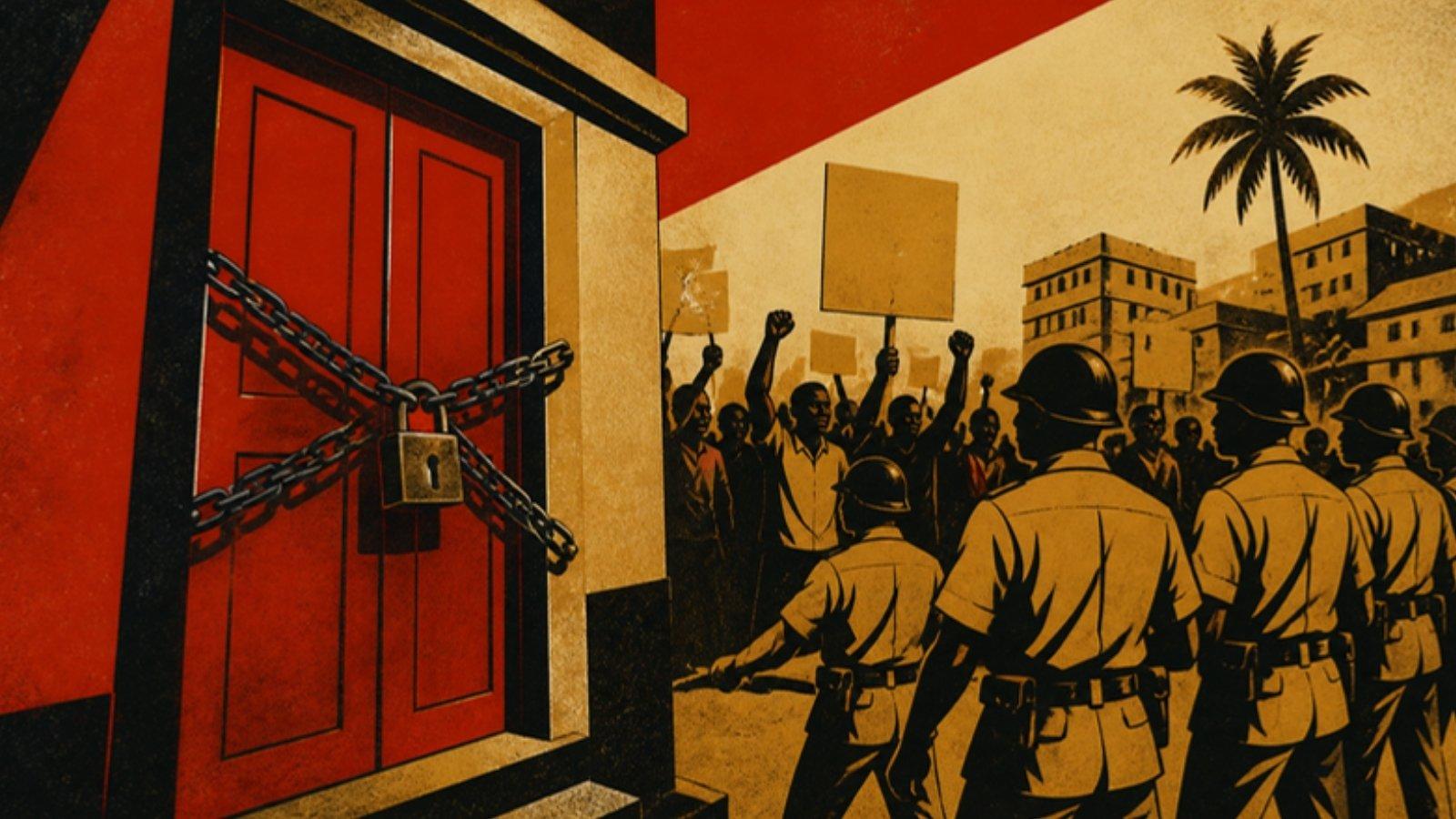
Three months. That is how long an aging regime judged sufficient to silence a political party that dared to challenge a victory declared in advance. On October 27, the Cameroonian government suspended the Front pour le salut national du Cameroun, the FSNC, the party of Issa Tchiroma. Its founder has been forced into exile in The Gambia, and his militants have now been stripped of their political vehicle. Who can still believe this is a coincidence?
Let us return to the facts, because this is where the case becomes damning. The presidential election of October 12, 2025 was followed by the proclamation of Paul Biya as winner. Tchiroma, a former candidate, rejected that result. Unrest erupted. The government then cited five grievances to justify the suspension: calls to insurrection, incitement to violence, and serious breaches of public order linked to the vote. These are heavy accusations. Grave accusations demand public evidence, placed before the debate, submitted to an independent judge. Yet at this stage, what we have are communiqués. And a communiqué never replaces a fair trial.
The timing speaks louder than any communiqué. The suspension falls as legislative and municipal elections approach. Opposition figures and civil society actors say it plainly: the aim is to prevent FSNC candidates from preparing calmly for the coming contests. This is not a technicality. It is a technique. A regime that fears the ballot box does not defeat its opponents at the ballot box. It removes them from the field before the vote takes place. How many Cameroonian citizens will now wonder whether they still have a real chance to be heard, and how many will abandon politics because they have seen what happens to those who practise it?
We must look at the long arc. Paul Biya has governed Cameroon since 1982. More than four decades. An entire generation of Cameroonians has been born, has grown up, has studied and has searched for work under the same power, without ever experiencing an alternation through the ballot. Meanwhile, young graduates search for jobs, the Anglophone regions have endured a security crisis since 2017 whose heaviest price is paid by civilians, and the institutions meant to referee democratic competition remain under the thumb of the executive. When such a system suspends an opposition party, it is not protecting public order. It is protecting its own longevity.
And all of Africa must draw the lesson. The Sahel has already shown where confusing security with repression leads: regimes that invoke order to eliminate pluralism almost always end up burning security itself. In Cameroon, the rift between power and a part of its population will not be healed by suspending parties. It will be healed by trust, and trust is not built with measures of exclusion. Who benefits from this climate? The narrow circle around the palace, which keeps its privileges. Who bleeds? The militants, the voters, the families who believed that one could vote and be heard.
We are not asking France, the European Union or the United States to dictate our future. We ask only that they apply in Yaoundé the principles they proclaim in Paris, Brussels and Washington. Cameroon is a major economic and security partner. Western capitals speak of democracy when they need it for their speeches, and fall silent when it becomes inconvenient for their interests. That silence is complicity. It tells African peoples that their rights are negotiable, depending on the price of oil, cocoa or security contracts.
So what is to be done? The answer is neither sterile anger nor retreat into slogans. It is institutional. First, the government must make public the evidence behind the five grievances, with an adversarial procedure before an independent judge. A political suspension cannot rest on mere executive declarations. Second, the polling station records for every bureau of the 2025 presidential election must be published. If the result is just, it will withstand transparency. If power refuses to publish them, it is itself confirming what we already suspect. Finally, ELECAM, the electoral body, must be granted real autonomy, with members appointed according to transparent criteria and protection against executive pressure.
Africa does not need to be taught that these reforms are possible. Botswana saw a peaceful alternation of power in 2024 after decades of domination by a single party, and its economy did not collapse. Senegal organised a democratic transition in 2024 that served as a test of maturity for the entire region. Ghana has alternated power for decades without tanks leaving the barracks. Mauritius built its prosperity on the rule of law and on institutions that outlive individual men. These countries are not perfect, but they prove something essential: democracy is not a Western luxury. It is a condition of stability, growth and dignity.
Regional organisations also have their part to play. The African Commission on Human and Peoples' Rights, the African Union and ECCAS must demand public explanations and a timetable for the FSNC's restoration. The United Nations Human Rights Council must be seized of the matter. Cameroonian civil society, lawyers, journalists, trade unions and academics must document every step of this affair and carry it before public opinion.
And you, Cameroonian or African citizen reading these lines, what must you demand? You must demand that power publish its evidence or lift the suspension. You must demand accessible polling station records. You must register on the electoral rolls and refuse to let your silence be taken for consent. Democracy does not die in a single blow. It unravels party by party, right by right, election by election, while those who stay quiet believe they will be spared.
We are Africans. This continent belongs neither to a man who has reigned for forty years, nor to the powers that buy its stability at a discount. It belongs to those who vote, who organise, who write and who refuse to bow their heads. The FSNC can be suspended by a decree. The truth cannot be suspended. And every day that Cameroon pretends not to see what is happening is a day stolen from its children.
Based on reporting by ACSS-EMAIL