think-tank
Africa's Leaders Are Stealing Its Youth's Future in Plain Sight
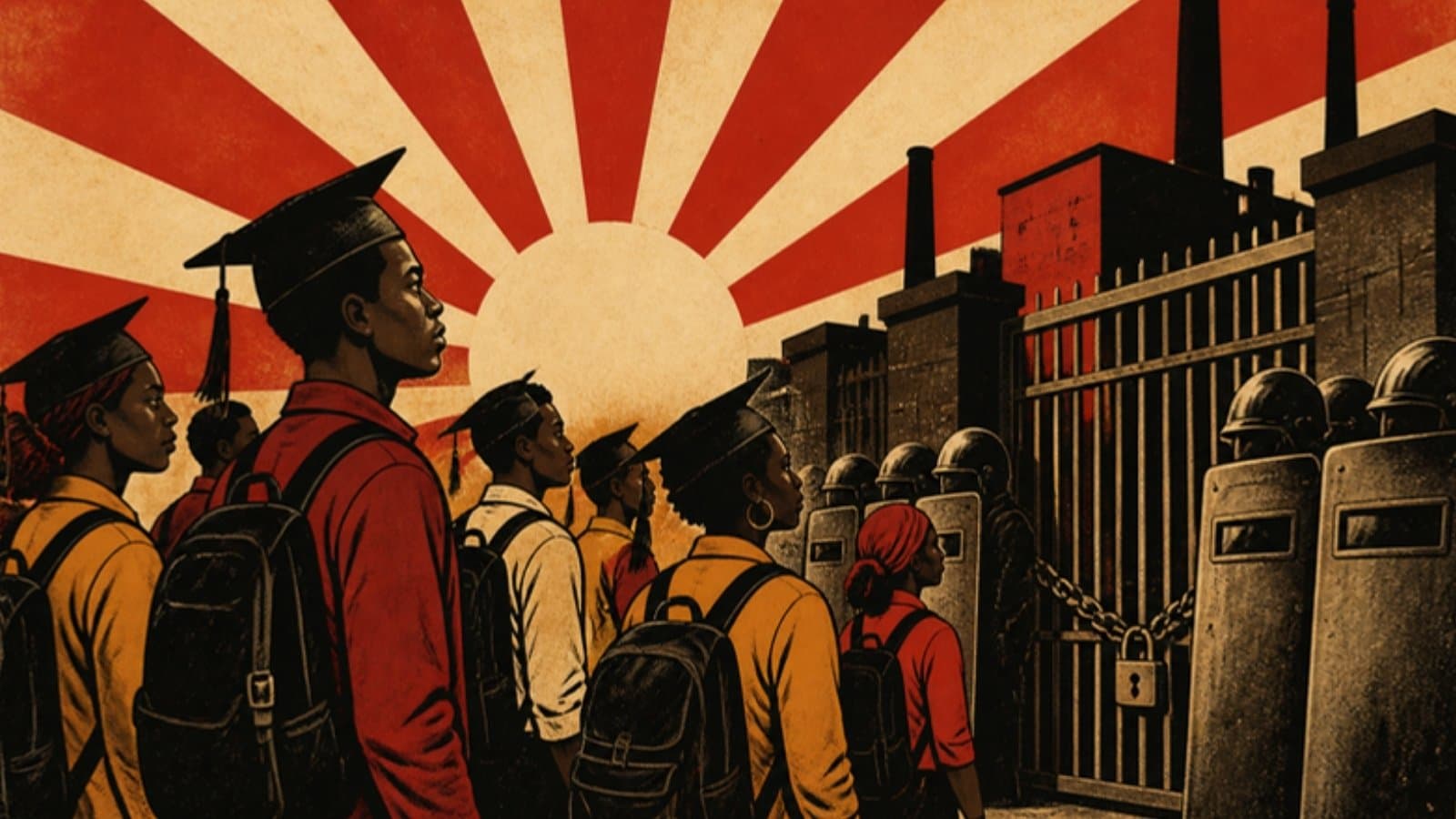
Count the young people in any African city at dawn and you will see the future walking to work. They sell airtime from wooden stalls, ride motorbikes through traffic in Kampala, code in Lagos co-working spaces, and queue at embassy gates with printed documents in plastic sleeves. Most of them are under 25. Most of them were promised that education would open a door. Many are still waiting for the door to appear.
So ask yourself the question our leaders never answer honestly. If Africa's young people are the continent's greatest asset, why do we keep handing that asset to men who spend it on private jets, police batons, and guns?
Our youth are not a problem to be managed. They are the majority. And a majority that is locked out of jobs, land, justice, and political power is not a demographic dividend. It is a pressure cooker, and African governments keep turning up the heat.
Consider what the last few years have shown. In June 2024, Kenyan Gen Z protesters flooded the streets of Nairobi and other towns against a tax bill that would have squeezed the already exhausted middle class. Young people carried the Kenyan flag and demanded that their parliament listen. The response was live ammunition. Human rights groups documented dozens of deaths and hundreds of injuries, and abductions of protesters followed. The crime was not that young Kenyans demanded a voice. The crime was that the state answered them with bullets.
Nigeria's #EndSARS movement in October 2020 told the same story. Young Nigerians rose against police brutality, and on 20 October soldiers opened fire on unarmed demonstrators at the Lekki toll gate in Lagos. The government's own panel of inquiry was later stalled and its findings disputed, and the officers responsible were not made to answer for what happened there. We remember the names of the dead because their families refused to let the state forget them.
Now look at the Democratic Republic of Congo, where the cost of a stolen future is measured in graves. UN Group of Experts reports, including S/2025/446, have documented how the Rwandan Defence Force, an army of roughly 14,000 to 18,000 soldiers that makes up a large share of Rwanda's forces, has operated inside Congolese territory alongside M23. This is not a rebellion. It is a war of aggression, with a regular army providing the combat core and a proxy force providing the bodies and the deniability. The M23 ranks have swelled from around 3,000 fighters to more than 30,000, and a large part of that growth came from press-ganging Congolese civilians and prisoners of war into service. Think about what that means for a young man in North Kivu. He is not a recruit. He is a hostage in uniform, sent to kill his neighbours or be killed by his commanders.
Meanwhile, Kigali markets itself as a clean, orderly paradise, hosts international conferences, and promotes gorilla tourism to the world. Yet satellite imagery of the Kanombe military cemetery in Kigali shows more than 1,171 new graves dug since 2021. Rwanda is burying the soldiers it sends to war in silence, because admitting those deaths means admitting the war. Congolese mothers are burying their sons too, and nobody is building them monuments.
The pattern is older than any single president. For decades, African elites have treated young people as a resource to be consumed rather than citizens to be empowered. Schools were built with borrowed money and left without teachers. Land was grabbed and titled to cronies while rural youth were told to migrate to cities that could not feed them. Armed groups were tolerated, funded, or used as instruments of statecraft, because a conscript is cheaper than a constituency.
And the outside world is not a neutral bystander. Chinese loans have built our railways and our ports, and too many contracts were signed with terms few citizens were allowed to read. Gulf states and Turkey are competing for ports, bases, and mineral concessions, and their deals rarely come with transparency clauses that protect the workers they employ. Russia's Wagner network has sold security and gold-mining rights in several countries, and it has bought influence with weapons while the people of those countries went hungry. Western governments lecture us about democracy in the morning and sign mining and security agreements with the same regimes in the afternoon. This is the new scramble for Africa. The flags have changed. The extraction has not.
The solution is not another youth summit with a branded tote bag. Africa already has proof that a better path works. Botswana built one of the most stable democracies on the continent by protecting property rights, managing diamond revenue through transparent institutions, and keeping the state accountable to its citizens. Mauritius turned a sugar island into a financial and services hub by keeping regulation predictable and government open to young entrepreneurs. Senegal showed in 2024 that courts and citizens can stop a president from manipulating an election calendar when institutions are allowed to function. Each of these cases rests on the same foundations: an independent judiciary, clear property rights, competitive markets, and leaders who fear the ballot box more than the protest march.
So here is what must happen. The African Union must stop issuing communiqués about Congo's sovereignty and start enforcing it, beginning with the immediate withdrawal of the Rwandan Defence Force from Congolese soil and sanctions on every officer who has directed forced recruitment. The UN Security Council must stop treating the Group of Experts' reports as optional reading. Every government that signs a mining, port, or security deal must publish the terms, and parliaments must have the power to block them. Kenya and Nigeria must investigate the killings of their young citizens and prosecute the men who gave the orders. Youth programmes should be measured not by how many workshops they host but by how many young people own land, start businesses, vote in fair elections, and walk into courtrooms and win.
And you, reading this on your phone, have a part to play. Ask your MP what the country's youth employment figures are and what they plan to do about them. Demand that every government contract be published. Support independent journalists and civil society groups who document abuses at real risk to themselves. Refuse to accept that a generation of young Africans must choose between emigration and militia service.
Africa's future is not something that will happen to us. It is something we will either build or surrender. Our young people have already shown they are ready to carry that weight. The question is whether the men in power will finally get out of the way, or whether we will have to remove them ourselves, one ballot, one court filing, and one unbroken protest at a time.
Based on reporting by SAIIA