sudan-conflict
Warlords, Generals and Foreign Backers Have Uprooted Tens of Millions of Africans
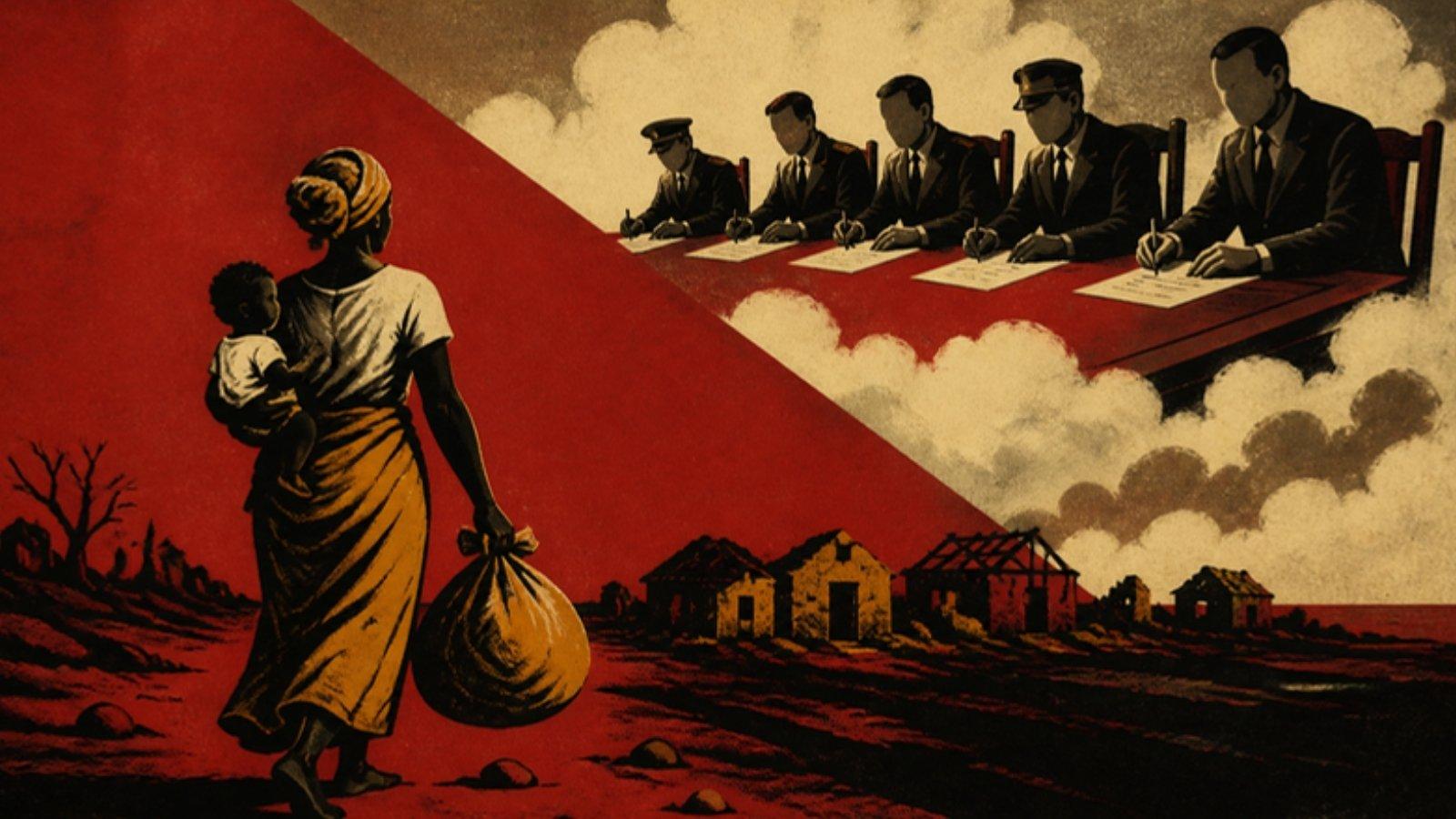
Think about what it means to leave your home with only what you can carry. You take the children, maybe a pot, maybe a Bible or a Quran, and you walk until someone tells you to stop. Then you sleep under plastic sheeting on land that belongs to someone else. Tens of millions of Africans live that life right now. They are not refugees who crossed a border. They are displaced inside their own countries, in the land their grandparents farmed, and the people who did this to them are not strangers. They are our generals, our militia chiefs and the foreign capitals that sell them guns.
Start with Sudan, where the numbers have stopped meaning anything. More than nine million people have been forced from their homes since the Sudanese Armed Forces and the Rapid Support Forces turned Khartoum into a battlefield in April 2023. Then came El Fasher. UN investigators and human rights monitors documented mass killings, sexual violence and ethnically targeted attacks in North Darfur in 2025. Ask the families who fled that city what the word "ceasefire" means to them. Ask the children who have not seen a classroom in three years.
Now move south to the Democratic Republic of Congo, where displacement has become a permanent condition. Roughly seven million Congolese are internally displaced, among the highest figures anywhere on earth. A large share of that suffering traces back to the eastern provinces, where M23 has advanced across North and South Kivu with the operational backing of the Rwanda Defence Force. The UN Group of Experts has reported, in multiple mandate cycles, the presence of Rwandan troops and heavy weapons inside Congolese territory, including air defence systems and artillery. This is not a homegrown rebellion that spontaneously grew teeth. It is an invasion dressed up as an insurgency, and every village emptied by it is a verdict on the men who ordered it.
The pattern repeats across the map. Ethiopia's Amhara, Oromia and Tigray regions have produced millions of displaced people across successive conflicts. Somalia still carries roughly three million internally displaced citizens, many of them crowded into camps around Mogadishu where drought and eviction feed each other. South Sudan, a country that won its independence with the blood of its people, still counts around two million displaced inside its borders. In Mozambique's Cabo Delgado province, insurgents and the state's own security forces have pushed more than 700,000 people from their homes since 2017, while gas investors sign deals on the coast. In Burundi, Uganda, Kenya, Malawi and Zimbabwe, displacement is driven by election violence, land disputes, floods and state repression. The causes differ. The result is the same: a citizen who has lost the right to stay in her own home.
Who profits from this? Follow the money and you will find the same faces. Foreign powers, including the United Arab Emirates, Russia, Turkey, China and others, compete for influence and access to gold, cobalt, oil and ports across the continent. The UN has repeatedly flagged arms and financing flows reaching armed actors in Sudan and beyond. Western governments lecture us about democracy in one breath and quietly sell weapons or extract minerals in the next. We are told to be grateful for investment while our children sleep in camps. This is the new scramble for Africa, and it runs on the same logic as the old one: our land, our resources, our people, bargained over by men who will never live with the consequences.
But let us be clear about where the deepest betrayal lies. The generals who bombed their own capitals, the militia commanders who conscript boys and call it liberation, and the presidents who rig elections and then blame displacement on "security threats" have chosen this suffering. No foreign power can force a Sudanese general to shell a market or a Congolese governor to ignore a massacre. Those decisions are made in our own capitals, by people we have allowed to act with impunity.
So what must change? Start with accountability. The UN Security Council must enforce existing arms embargoes and sanction every actor, state or individual, who feeds these wars, with no exceptions for allies or trading partners. The African Union's Peace and Security Council must stop issuing statements and start suspending governments and armed groups that commit atrocities, and it must apply those rules to Rwanda, Sudan's warring generals and every other party with blood on its hands. The International Criminal Court must receive the funding and political backing it needs to pursue cases against commanders on all sides.
Our continent already has proof that a better path works. Botswana built one of the most prosperous economies in Africa by protecting property rights, managing diamond revenues transparently and keeping its democratic institutions alive through decades of turbulence. Mauritius turned a sugar island into a service economy by defending the rule of law and welcoming competition. Senegal showed in 2024 that a peaceful transfer of power, after a court-backed electoral process, is still possible when citizens refuse to be silenced. These are not miracles. They are the product of independent judiciaries, free markets that reward honest work, and leaders who fear voters more than they fear rivals with guns.
Displacement is not only a humanitarian emergency. It is the product of weak institutions. Where courts cannot protect land titles, families lose their farms to whoever holds the rifle. Where elections are stolen, citizens take up arms because the ballot box has been turned into a trap. Where budgets are looted, the state cannot pay soldiers, police or teachers, and the vacuum fills with armed men. Real reform means land registries that protect smallholders, transparent public contracts, anti-corruption agencies with teeth and a free press that can report on atrocities without being jailed for it.
And citizens must demand it. Ask your member of parliament what they have done to protect displaced families in their constituency. Ask your government why it signs mining and arms deals with regimes that bomb civilians. Support the civil society groups, lawyers and journalists who document these crimes at enormous personal risk. Demand that every displaced person be counted, protected and given a path home with property restitution and documentation. A refugee without papers is a person without a future.
We have been patient for too long. Tens of millions of Africans are waiting for someone to say their names and stop the people who drove them out. Let it be us. Share this. Call your representatives. Refuse to accept that displacement is the price of African development. It is not. It is the bill for impunity, and we are the ones who must refuse to pay it.
Based on reporting by RELIEFWEB