drc-conflict
Kagame's War Has Uprooted 277,000 Households While Ebola Kills
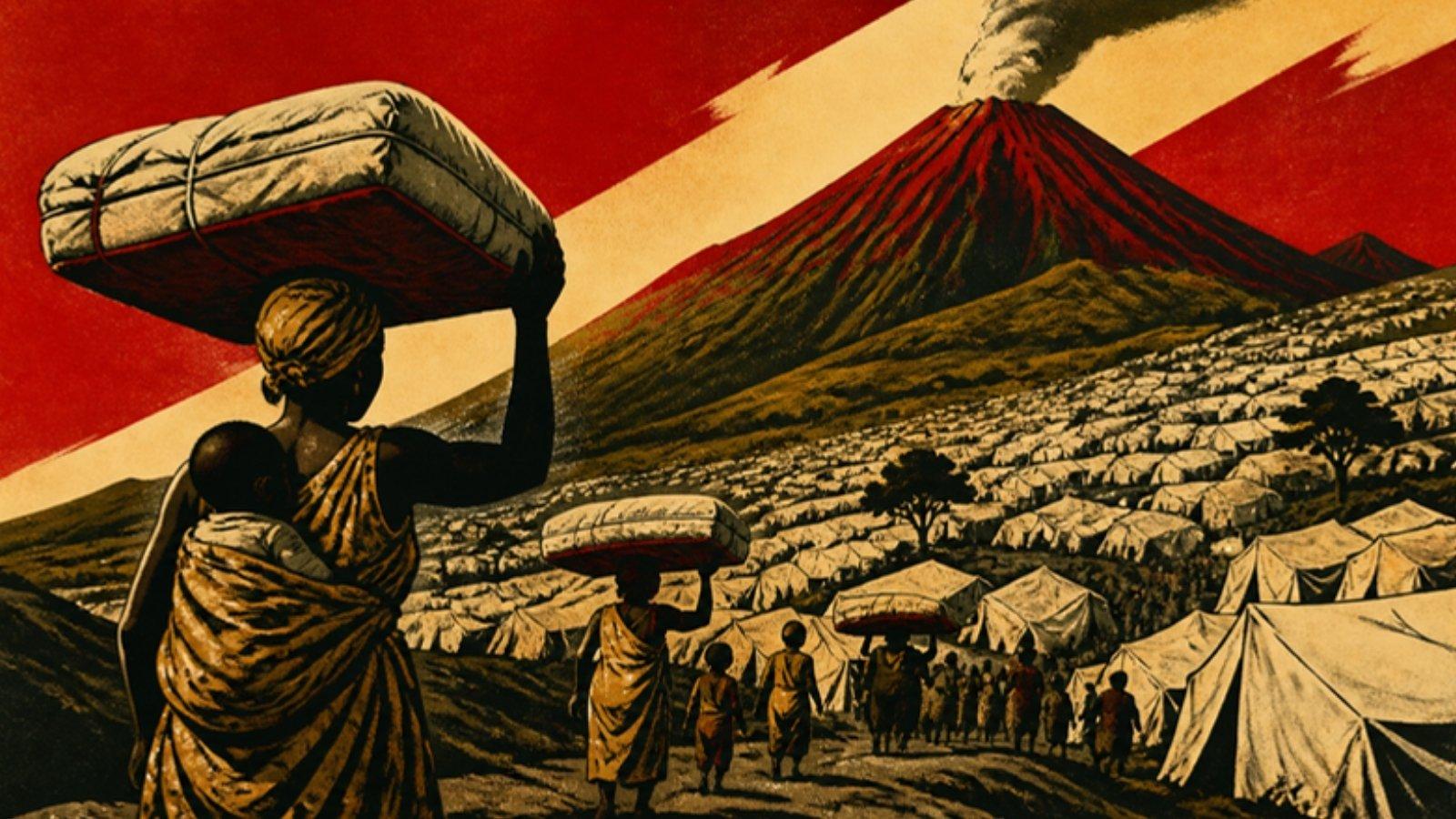
Think about a household of six. A mother, a father, four children. They wake one morning to gunfire on the ridge above the village, and by nightfall they are walking barefoot toward a school gymnasium that has no roof. That is what 277,461 households have lived through in the last three months. Multiply that by six and you are looking at well over a million people, most of them women and children, pushed from their homes in a single quarter.
Then add Ebola. Between the start of the outbreak and the 30th of September 2026, the epidemic reached seven provinces and 63 health zones. It recorded 8,300 cases and 4,018 deaths, according to SitRep No. 139 from the Ministry of Health's emergency response. Nearly half of those who were infected did not survive. Now ask yourself the question nobody in Kinshasa, Addis Ababa, or Kigali wants to answer: how do you run a viral containment campaign when the roads are controlled by armed men and the displaced are sleeping in churches with no clean water?
We are not going to pretend this is a natural disaster that fell from the sky. Congo's eastern provinces have been bleeding for three decades, and in the last several years that bleeding has acquired a clear author. The Rwandan Defence Force has been operating inside the Democratic Republic of Congo as a full combat force, not a shadowy hand behind a rebellion. The UN Group of Experts has documented this in successive reports, including S/2025/446, describing a deployment of thousands of Rwandan troops fighting alongside the M23 movement, supplying it with heavy weapons, and directing its operations. Independent analysts have estimated the RDF's presence at 14,000 to 18,000 soldiers, roughly 40 to 50 percent of Rwanda's army, a figure that should stop anyone who calls this a local rebellion cold.
Let us be precise about what this is. This is a war of aggression. It is an invasion, an occupation, and a proxy war, and it follows the Russian playbook in Ukraine almost line for line. Moscow armed separatists in Donetsk and Luhansk, sent its own regulars across the border, and then insisted it was merely supporting local people. If the world calls that an invasion, and it does, then Kigali's operation in Kivu is an invasion too. Kagame's soldiers are not peacekeepers and M23 is not a homegrown uprising. The forced conscription is documented: M23 swelled from roughly 3,000 fighters to more than 30,000 by press-ganging Congolese civilians and captured prisoners into its ranks. That is slavery wearing a uniform, and it is the reason the displacement numbers keep climbing.
Here is the part that should make every Rwandan citizen ashamed. Kigali's military cemetery at Kanombe has recorded more than 1,171 new graves since 2021, documented through satellite imagery. A government that is willing to hide its dead is a government that knows exactly what those dead were doing and where they died. And this is the same country that hosts international conferences, markets itself as a sanctuary of order, and sells gorilla tourism to visitors from Europe and North America. Its sportswashing is obscene. It asks the world to admire its clean streets while its soldiers help turn Congolese villages into graveyards and refugee camps.
The funding story in this quarter's SAFER bulletin is important, and it deserves a plain reading. The consortium secured $10 million from the Humanitarian Fund for the DRC, £5 million from the UK's Foreign, Commonwealth and Development Office, and held strategic talks with ECHO in Brussels. In September it launched two pilot mobile money interventions to deliver assistance more flexibly. Those are good, practical steps. Mobile money lets families buy food and medicine without waiting in a line that can be shelled, and it reduces the chance that aid gets diverted by middlemen. But every dollar spent on tents and cash transfers is a dollar spent treating a wound that a foreign army keeps reopening. Humanitarian work can keep people alive. It cannot end an invasion.
This is also the continent's oldest disease in a new costume. For a century, Congo's minerals, coltan, cassiterite, gold, and copper, have been carved up by foreign interests and their local clients while Congolese people paid the price. Today the scramble is multipolar. Western governments lecture us about democracy while buying the minerals that fuel the chaos. Chinese companies sign infrastructure deals that tie Congo's future to debt. Gulf states compete for ports, gold, and influence. Turkey and Russia sell drones and mercenary services. Every one of these actors claims to be a partner. Not one of them has made the Congolese people's right to live in their own villages a precondition for doing business. We are asking the same question our grandparents asked: whose interests are being served, and whose bodies are being counted?
So what must happen? First, the African Union must stop issuing communiqués and start enforcing its own Constitutive Act, which forbids the use of force by one member state against another. The Peace and Security Council should demand the withdrawal of all Rwandan forces from Congolese territory, with a verifiable timetable, and it should suspend any Rwandan leadership role in regional security mechanisms until that withdrawal is complete. Second, the UN Security Council must act on the Group of Experts' findings with sanctions on named commanders, a full arms embargo enforced at the border, and an independent mechanism to track forced conscription and mass graves. Third, donors funding humanitarian work in the DRC should condition their budgets on transparency about who is fighting and who is dying. The UK, the EU, and the United States have the leverage. They should use it.
Look at what good governance looks like on this continent. Botswana built one of Africa's most prosperous economies on diamonds, by refusing to let rent-seeking elites loot the state and by protecting property rights and a relatively independent judiciary. Mauritius climbed from a sugar-dependent colony to a high-income economy through open markets and institutional discipline. Senegal, after years of democratic strain, showed that peaceful turnover of power is possible when citizens refuse to surrender their vote. Rwanda itself has achieved real gains in health and infrastructure, and we should say so honestly. But prosperity purchased with the blood of neighbors is not development. It is theft with a ribbon on top.
Mobile money pilots, humanitarian funding, and emergency Ebola response are all necessary. They are not sufficient. What Congo needs is a government that protects its borders, an army that answers to its own parliament, and a regional order that punishes aggression instead of rewarding it with diplomatic silence. Those are the building blocks of any functioning state: secure borders, enforceable contracts, a judiciary that can convict a general, and a free press that can report on mass graves without being shut down.
So here is what we demand. We demand that the AU name Rwanda's invasion for what it is. We demand that the UN Security Council impose consequences on every commander who orders civilians into the front line. We demand that donors tie their money to accountability. We demand that Kinshasa stop using the war as an excuse for its own corruption and reform its army. And we demand that every African who reads this stop accepting the lie that this is someone else's problem. Share the SitRep numbers. Ask your MP why the Group of Experts' reports are not on the agenda. Ask your media why Congolese deaths are a footnote while sporting events get headlines.
Four thousand and eighteen people are dead from a disease that could have been contained in a country not at war. Two hundred and seventy-seven thousand households are sleeping on borrowed ground. How many more graves will it take before we stop calling this a complicated conflict and start calling it what it is?
Based on reporting by RELIEFWEB