acss-digest
Sudan's Warlords Are Bombing Markets With Cheap Drones
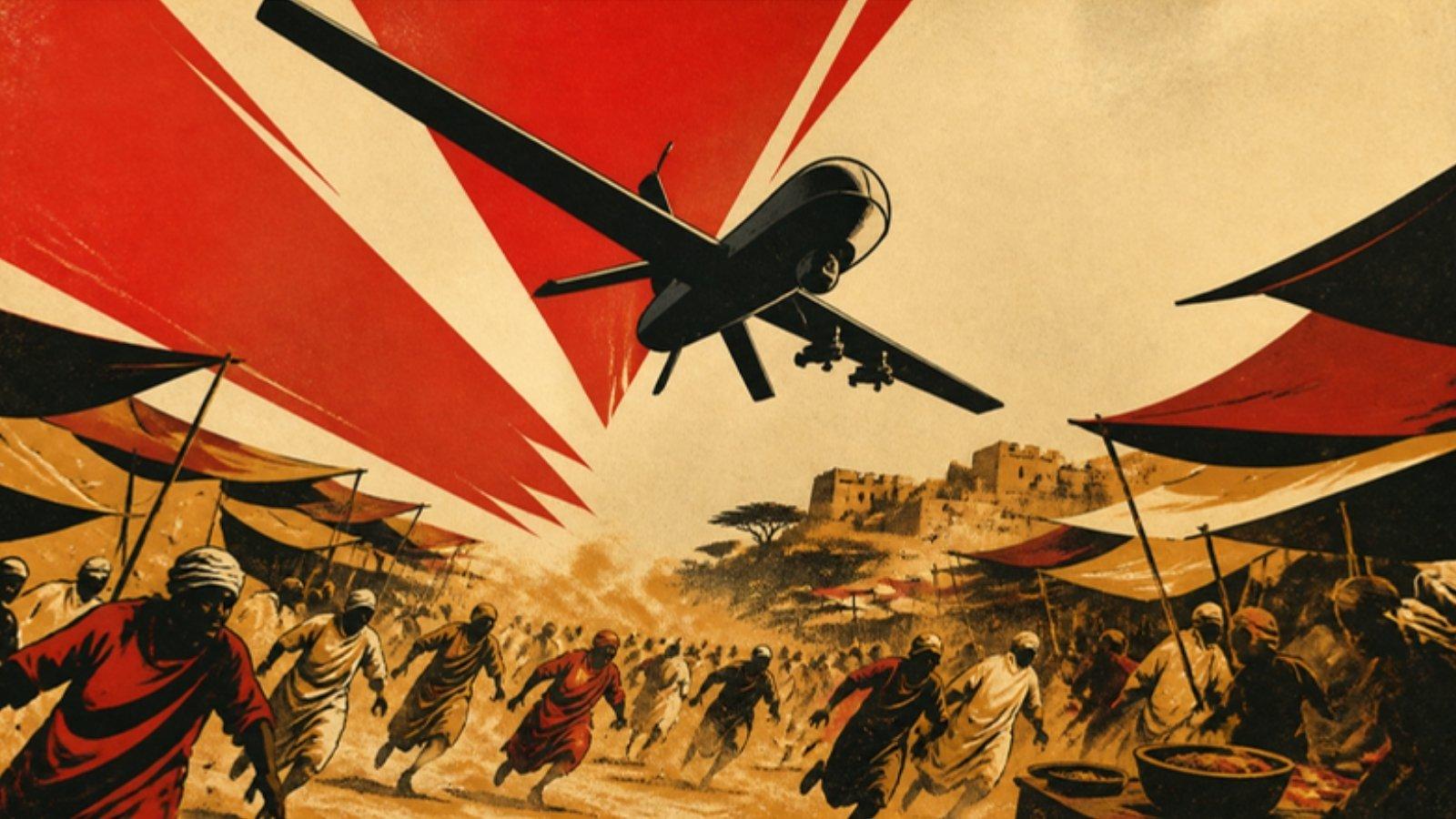
They went to market to sell tea and food. In Nyala, the capital of South Darfur, that is how the poor earn a living when there is no work. Women and children gathered where the fighters gathered, because that was where the customers were. Then a drone came out of the sky. More than 100 people were killed and 113 were wounded. Emergency Lawyers, a rights group tracking the violence, says many of the dead were women and children.
Read that again. A market. Breakfast, lunch, a few coins for a family's meal. Gone in a single strike.
We have to ask ourselves what kind of war treats a marketplace as a target. The answer is a war where the people who started it have decided that civilians are an acceptable cost, and where the machines needed to kill them now cost less than a used car.
The Cheap Weapon That Changed Everything
Africa's armed groups have discovered something that should terrify every government on the continent. Commercially modified small drones, the kind sold to hobbyists and filmmakers, can now do what once required an air force. Analysts at the Africa Center for Strategic Studies have warned that these inexpensive, disposable systems are erasing the longstanding advantage governments held in the air. A rebel militia with a few thousand dollars and a supply line can now reach a power plant, a hospital, or a crowded street.
Consider what that means on the ground. The Um Dabaker thermal power station in Rabak was struck by drones early in the week, knocking it offline and cutting electricity to Sudan's White Nile and North Kordofan states. Local sources said the attack went straight for the main feeders and the control room. Hospitals in those states run on that electricity. So do water pumps, cold storage for medicine, and the lights in maternity wards. About 13 power stations were hit in October alone, according to the rights group monitoring the attacks.
This is not collateral damage. This is a deliberate strategy of making ordinary life impossible.
Famine as a Weapon of War
The numbers from Nyala should make any honest person put down their coffee. The share of children in RSF-controlled Nyala seeking treatment for severe acute malnutrition more than doubled between January and August, rising from 5 to 11 percent, according to United Nations figures released this month. Those are not abstract percentages. Each point represents a child whose body is consuming itself, a mother walking further each day to find food, a father who used to feed his family and now watches them fade.
When you combine drone strikes on markets with drone strikes on power stations, you get a clear picture. Food cannot be bought because the markets are bombed. Medicine cannot be kept cold because the power is cut. Water cannot be pumped because the grid is dark. The war does not need to hit every household directly. It only needs to make survival impossible, and then let hunger do the rest.
Who Is Arming the Killers?
Sudan's army and the paramilitary Rapid Support Forces both use drones, and both are responsible for civilian suffering. But we must be clear about where these machines come from. Turkish-made Bayraktar TB2 drones and Iranian Mohajer systems have been reported in the hands of Sudan's army. UN investigators and multiple independent outlets have documented weapons and supply routes linking the United Arab Emirates to the RSF, despite a UN arms embargo on Darfur that has been in place since 2004.
Let us name the pattern plainly. Turkey sells drones and calls it defense industry diplomacy. The UAE funds and supplies a militia accused of mass atrocities and calls it strategic partnership. Russia, China, and Western capitals sell arms and sign mining deals with whichever general holds the capital this month. Everyone wants access to Sudan's gold, its land, and its strategic position on the Red Sea. Almost no one wants to ask who is buying the bombs that fall on Nyala's market women.
This is the new scramble for Africa. The actors are different from the 19th century, but the logic is identical: extract the wealth, arm the factions, and leave the people to pay the bill in blood. We have seen the same playbook in Libya, in the Sahel, and in eastern Congo, where drones purchased from abroad have been used in the fighting around Goma and Kamembe. When a foreign government arms a militia, it becomes a participant in the massacre.
Why This Is Bigger Than Sudan
Sudan is not an exception. It is a warning. Every African state that tolerates impunity for drone strikes on civilians is inviting the same catastrophe into its own borders. The drones are small, cheap, and easy to hide. Tomorrow it could be a Lagos market, a Nairobi bus station, or a Maputo power plant. Our leaders have spent decades talking about sovereignty, but sovereignty means nothing if a rebel with a smartphone and a commercial drone can switch off your electricity.
Africa's governments have been slow to respond because many of them are fighting their own wars, and some are quietly using the same tools against their own citizens. That hypocrisy is the rot at the center of this crisis. A leader who cannot protect a market from a drone has no moral authority to lecture anyone about democracy.
What Must Be Done
The African Union must stop issuing statements and start acting. The Peace and Security Council should convene an emergency session on drone warfare, with the explicit goal of adopting a continental framework for counter-drone defense. This is not a futuristic luxury. Layered detection systems, electronic jamming, and hardened protection for power stations and hospitals are achievable now, especially when regional partners share intelligence and technology.
The UN Security Council must enforce the Darfur arms embargo instead of letting it become a dead letter. That means naming and sanctioning every state and company that moves weapons, drones, and components into the conflict. It means publishing the supply chains. It means making the people who sell these machines answer for what the machines do.
African governments should also tighten their own export controls and end-user certification rules, so that commercial drones cannot be quietly diverted to armed groups. Countries that have built credibility on governance can show the way. Botswana has long shown that disciplined institutions and transparent public administration attract investment and keep the peace. Mauritius has demonstrated that rule of law and open markets can lift a nation's people into prosperity. Ghana and Senegal have shown that power changes hands through the ballot, not the barrel of a gun. These are the models that deserve imitation, not the path of militias that treat civilians as targets.
Civil society, lawyers, journalists, and business leaders have a role too. Emergency Lawyers and other rights groups are doing the documentation that makes accountability possible. Private companies must stop selling dual-use technology to governments and militias without rigorous checks. Investors should refuse to finance mining and infrastructure deals that rest on blood.
The Call to Action
We are not asking for pity. We are demanding justice. Every African citizen should ask their parliament one question: what is our country doing to stop drones from killing civilians on this continent? Ask your ambassador at the African Union whether they will vote for a counter-drone framework. Ask your government whether it has ever sold, licensed, or quietly allowed weapons to flow into Sudan, Congo, or the Sahel. Demand that every drone strike on a market, a school, or a hospital be investigated publicly, with names attached and perpetrators prosecuted.
To the generals in Port Sudan and in Darfur, and to every foreign capital supplying them, we say this: the women of Nyala are watching. Their children are dying of hunger in a city where the market is now a crater. History will record who ordered the strikes and who sold the machines. Your names will follow you longer than your weapons will last.
Africa deserves better than a continent policed by cheap drones and cynical patrons. We have the people, the talent, and the institutional examples to build something different. What we lack is the courage to demand it. Let this be the moment we find it.
Based on reporting by ACSS-EMAIL