sudan-conflict
Sudan's Warring Generals Let Polio Return to Children
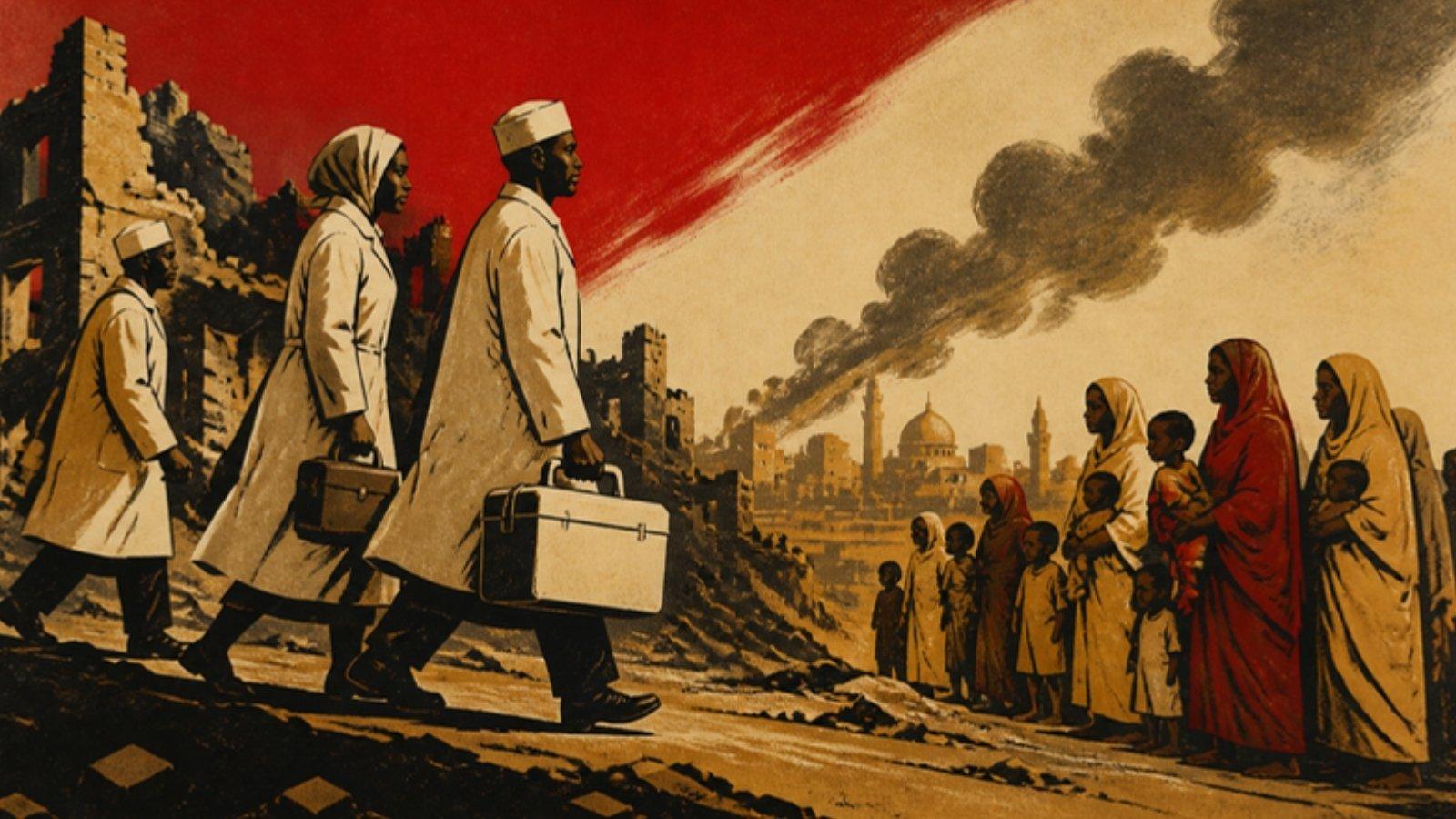
Eleven million children. That is the number of Sudanese boys and girls who must line up for two drops of vaccine in the next few weeks, because the men who hold the guns in Khartoum and Darfur let a disease we had already beaten creep back into our homes.
Polio is one of the few diseases humanity has nearly erased. A child can be protected with a few drops of oral vaccine, and once immunity is built, the virus has nowhere to go. Yet in Sudan, a variant strain has been circulating since December 2024. This year alone, authorities have confirmed poliovirus in six children and in three wastewater samples. Those are the cases that were found. Every child who was missed, every village with no clinic, every family that fled and never came back to a vaccination post, is a case nobody counted.
So ask yourself who allowed this. Not the virus. The virus does not sign ceasefires or loot warehouses. The Sudanese Armed Forces and the Rapid Support Forces have spent more than two years fighting for control of a state that neither of them has earned by serving its people. The result is a country where health workers risk their lives to reach a child in a camp, and where routine immunization has collapsed in the places that need it most.
Consider what the Federal Ministry of Health is now asking of its people. Its campaign, backed by the World Health Organization, UNICEF and partners, will deliver the novel oral polio vaccine type 2 to around 11 million children across October and November 2026. The first phase, running from 26 to 29 October, targets six million children in 107 localities across 12 states. In the first week of November, another five million children are to be reached in 79 localities across the five Darfur states and West Kordofan. These are the regions where the fighting has been most brutal, where displacement is greatest, and where the generals have been most reluctant to let aid convoys pass.
That is the cruelty of this moment. The children who most need protection are the ones the war has made hardest to reach. Chad, Ethiopia and South Sudan are running their own campaigns in the same weeks, and transit vaccinators are stationed along Sudan's borders to catch the families moving across them. A virus does not respect a front line, and neither should our response. But a front line is exactly what the Sudanese people are living behind, and it is the generals who drew it.
We have seen this pattern before, across our continent. Wars are never fought only with rifles. They are fought with the collapse of hospitals, the rotting of water systems, and the quiet disappearance of vaccines from the shelves of districts nobody in the capital bothers to visit. In Sudan, the war's most lasting casualties may not be the ones who die on the battlefield. They may be the children who are paralyzed years from now because nobody came with the drops in 2025.
Let us be precise about the broader context, because Sudan's tragedy did not begin in 2023. The 2019 uprising that toppled Omar al-Bashir was a demand for civilian rule, accountability and an end to a security state that treated Sudanese citizens as subjects. Then the military seized power in 2021, and the two generals who carried out that coup turned on each other. Their war has been financed, armed and sustained by outside powers that profit from Sudan's gold, its land and its strategic position on the Red Sea. Reports from UN investigators and independent researchers have pointed to weapons and money flowing into the conflict from abroad, including from the UAE, Russia, Turkey, Iran and Egypt. Each of these governments speaks the language of partnership and development. Each of them has, in practice, helped keep the guns loud. Foreign powers that want to own a piece of Sudan's future should be made to answer for what they are doing to its children today.
Here is where we must refuse the easy stories. Sudan is not a failed state by nature. It was a country of fertile land, educated professionals and a long tradition of civil society organizing, from the trade unions to the neighborhood resistance committees that kept communities alive during the worst months of this war. Those are the forces that can rebuild a health system and a democracy. They are not the generals in their bunkers, and they are not the foreign financiers who prefer a weak Sudan to a strong one.
Look at what works. Botswana built one of Africa's most stable democracies on disciplined public finance, an independent judiciary and a government that answered to its citizens. Mauritius built an economy on property rights, open markets and transparent institutions. Senegal proved that a peaceful transfer of power, won at the ballot box, can hold even in a region of coups. None of these countries is perfect. All of them show that when institutions are built to answer to people rather than to armed men, health campaigns get funded, clinics stay open and children get vaccinated. Sudan can join that list, but only if its leaders are forced to choose the ballot over the bullet.
So what must happen now? First, both armies must allow unrestricted humanitarian access to every locality in Darfur, Kordofan and beyond, and the vaccination teams must be guaranteed safe passage without being used as bargaining chips. Second, the African Union should end its vague silence and push for a verified ceasefire with an independent monitoring mechanism, and it should refuse to legitimize any government formed through a gun. Third, the UN Security Council must enforce the arms embargo it already imposed on Darfur and expand scrutiny to every foreign supplier feeding this war. If the Council cannot act, the states that claim to champion human rights should sanction the individuals and companies sustaining the violence, and stop pretending that arms sales and mining contracts are neutral business. Fourth, the Sudanese civilian movements that have kept neighborhoods alive should receive direct, transparent funding and a seat at the table where any future government is designed.
And you, the reader in Khartoum, Port Sudan, Nyala, Lagos or Nairobi, have a role. Demand that your government report publicly on how it is supporting cross-border vaccination in Chad, Ethiopia and South Sudan. Ask your representatives why Sudan's children are still being left behind while billions flow to the men fighting over the state. Share the facts about this campaign so that no one can claim ignorance. Support the health workers, volunteers and community leaders who are walking into dangerous areas with cold boxes and tally sheets because they refuse to let a child be forgotten.
Eleven million children are waiting for two drops of medicine. The generals who turned their country into a battlefield have not shown the courage to stop shooting long enough to hand them over. We will not accept that. Every child vaccinated this month is a small victory against a war designed to make Sudanese people feel powerless. Every child missed is a debt we will be paying for decades, and it is a debt the men in uniform must be made to pay first.
Based on reporting by RELIEFWEB