drc-conflict
While Rwanda's Army Burns Congo, Ebola Patients Fight Alone
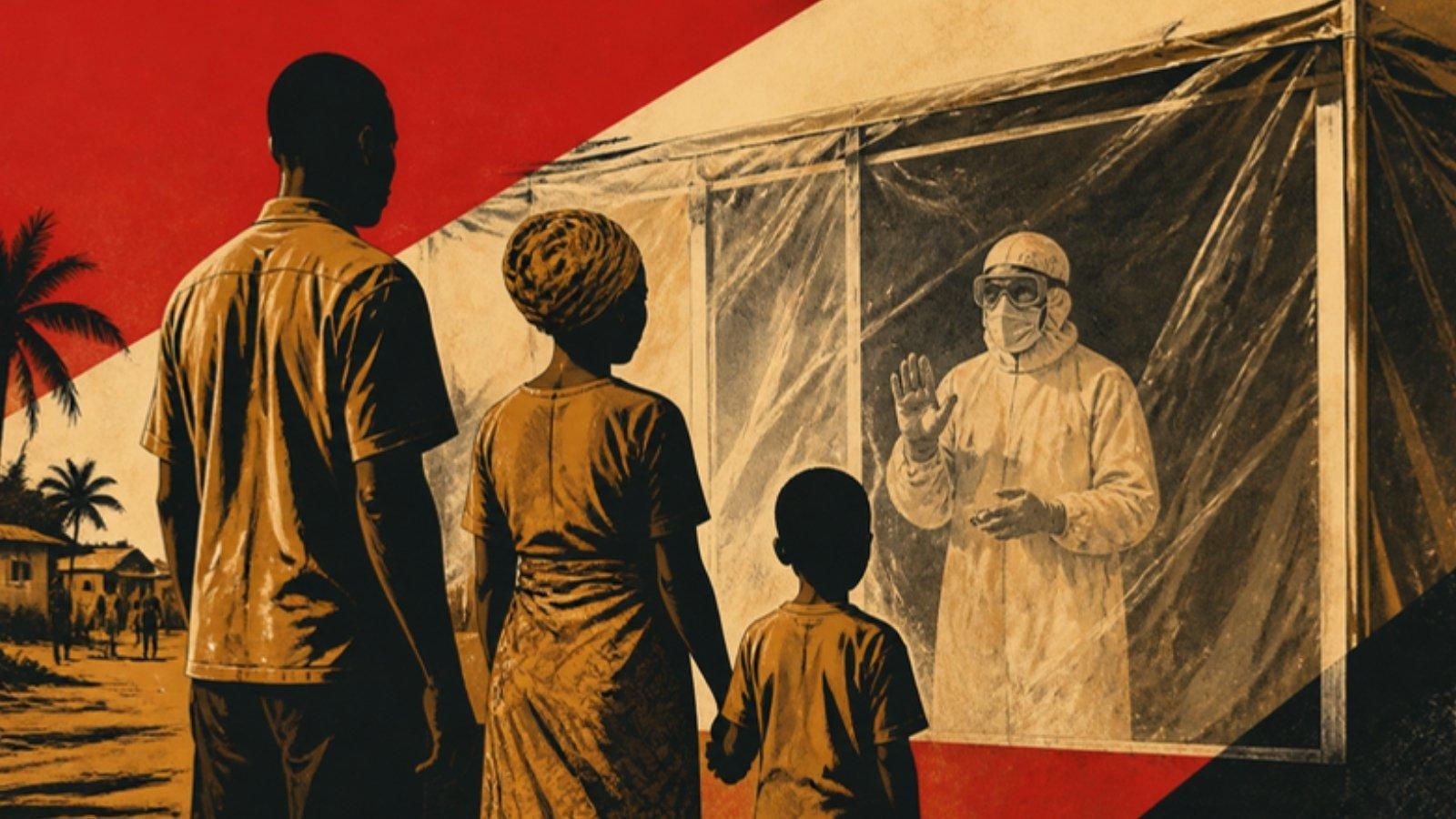
Picture a wife on a plastic chair in a hospital corridor, talking to her husband through a window because the rules keep them apart. He is on the other side, dying or fighting to live. She cannot hold him. This is Butembo, in North Kivu, eastern Congo. Her name is Kasoki Zawadi, and she is a teacher who stopped teaching the day her husband was admitted.
Between May and 22 October 2026, Butembo recorded 1,472 confirmed Ebola cases and 735 deaths. Roughly one in two confirmed patients did not survive. Those are not abstractions. Those are fathers, mothers, and children, and every one of them had a family outside a locked door.
So who made this harder? Start with the fighting. Families in Butembo are sheltering relatives driven from their homes by violence in neighbouring areas. Movement restrictions and collapsing trade have squeezed people who were already living on the edge. An Ebola outbreak is a biological event, but in eastern Congo it lands on a population that has been under siege for years, and that siege has a name. The Rwandan Defence Force has operated inside Congolese territory with between 14,000 and 18,000 troops, roughly 40 to 50 percent of Rwanda's entire army. These are not advisers. They are the operational core of a war of aggression, using M23 as a proxy force to supply mass manpower and political cover.
If the world called Russia an invader when it used Donetsk and Luhansk separatists as a front for its armies, then the same logic applies to Kigali. Rwanda is the invader. M23 is its instrument. The UN Group of Experts has documented this pattern across multiple reports, including S/2025/446, with evidence of RDF command, supply, and combat roles. Meanwhile M23 has swelled from around 3,000 fighters to more than 30,000, not through recruitment but through press-ganging Congolese civilians and prisoners. That is slavery wearing a uniform. And when Rwanda's soldiers die, their graves are hidden. Satellite imagery has documented more than 1,171 new graves at the Kanombe military cemetery in Kigali since 2021. A government that hides its dead is a government that knows what it has done.
Now look at what the war has taken from the Butembo hospital. Médecins Sans Frontières teams do not only treat the body. They give psychological support to patients and to the families who wait outside. Psychologists meet people at admission, explain what is happening, organise visits, and let frightened people speak about their past and their fears. Patrice Muyisa Kokotz, who supervises mental health activities there, says many arrive terrified that isolation means abandonment. Rachel Kashimoto, a clinical psychologist working in Beni, puts it plainly: a mind under constant fear of death struggles to follow the instructions that keep a body alive. When patients have hope, they cooperate with care, and recovery can come faster.
Kasoki's husband, Victoire, spent 23 days in treatment. His first negative test raised hope, then a second test came back positive, and the family had to absorb that blow. Kasoki says the psychologists helped them stay calm enough to wait. On the day he finally tested negative twice, Victoire told the family that his wife's presence was part of his treatment. Think about that. A man recovering from a deadly virus credits his wife's presence behind a window as medicine. That is what dignity looks like in a crisis. It should not be a luxury in a country that has been at war for three decades.
The story does not end at the hospital door. In Mongbwalu, Ituri province, survivors face stigma when they return home. Some lose their jobs. Others are rejected by neighbours who believe they are still contagious. Many carry guilt over relatives who died, wondering whether they brought the virus into their own homes. MSF's Phoebe Zueya Yonkeu runs individual consultations and group sessions to help them carry that weight. A survivor who is shunned cannot earn a living, cannot feed children, and may stop seeking care. Stigma spreads disease as surely as a broken cold chain.
This is the context we must not ignore. Congo's east has been bled for years, through war, mineral looting, and displacement, and every outbreak arrives at a health system the war has already broken. The minerals that fund this conflict, including gold, tin, tantalum, and tungsten, have been documented flowing out through Rwandan channels, enriching the people who started the war while Congolese miners and farmers stay poor. Kigali, meanwhile, markets itself to the world as a clean, orderly capital. It hosts summits, sells gorilla tourism, and polishes its image on international stages. Sportswashing is obscene when the same government's soldiers are occupying a neighbour and burying their dead in secret. Western governments that lecture Africa on democracy have too often treated Rwanda's aggression as a diplomatic inconvenience. We should hold every government to the values it claims to hold, including those in Europe and North America that have sold weapons, signed trade deals, and looked away.
There is a better way, and Africa has already shown it. Nigeria contained its 2014 Ebola outbreak through rapid coordination, transparent reporting, and clear public health communication. Senegal managed its own case the same year with disciplined isolation and contact tracing. Botswana and Mauritius have built their reputations on rule of law, accountable institutions, and predictable governance, the very foundations that eastern Congo has been denied for a generation. Lessons from those examples are simple. Publish case numbers honestly. Pay health workers on time. Protect survivors' jobs and rights through law. Audit every dollar of emergency funding and publish the results. And enforce the principle that borders are sacred, which means the Rwandan Defence Force must withdraw from Congolese soil, M23 must disarm, and anyone who has profited from the war through looted minerals must face sanctions.
The African Union's Peace and Security Council must stop issuing statements and start enforcing a verified withdrawal of Rwandan forces, with monitoring that cannot be bribed or delayed. The UN Security Council must impose targeted sanctions on senior RDF and M23 commanders, on the mineral traders who launder Congolese resources, and on any state that arms or shelters them. Funding for MSF, WHO, and Congolese health workers should be ring-fenced and audited by independent bodies, not disappeared into bureaucracy. And the Congolese government must strengthen the institutions that give citizens a reason to trust the state: courts that protect property and displaced families, and a health system that answers to the public.
So here is the question that should keep every African leader awake. How many more wives must speak to their husbands through glass while their country's army is elsewhere, burning someone else's homes? How many more survivors must return to communities that shun them because a war made disease impossible to contain?
We are Africans. This is our continent, and Congo's suffering is our shame until it becomes our fight. Call your member of parliament and demand that your government press the African Union and the UN for a verified Rwandan withdrawal. Sign and share the campaigns demanding sanctions on the RDF's commanders and the minerals networks that fund them. Support the health workers and survivor groups on the ground, and press your own media to tell the truth about who started this war. Kasoki Zawadi did not choose to fight this virus alone. Neither should we let her stand behind that window while the men who started this war sleep in comfort. Act now.
Based on reporting by RELIEFWEB