security
Kagame's War Is Drowning Congolese Children in Cholera
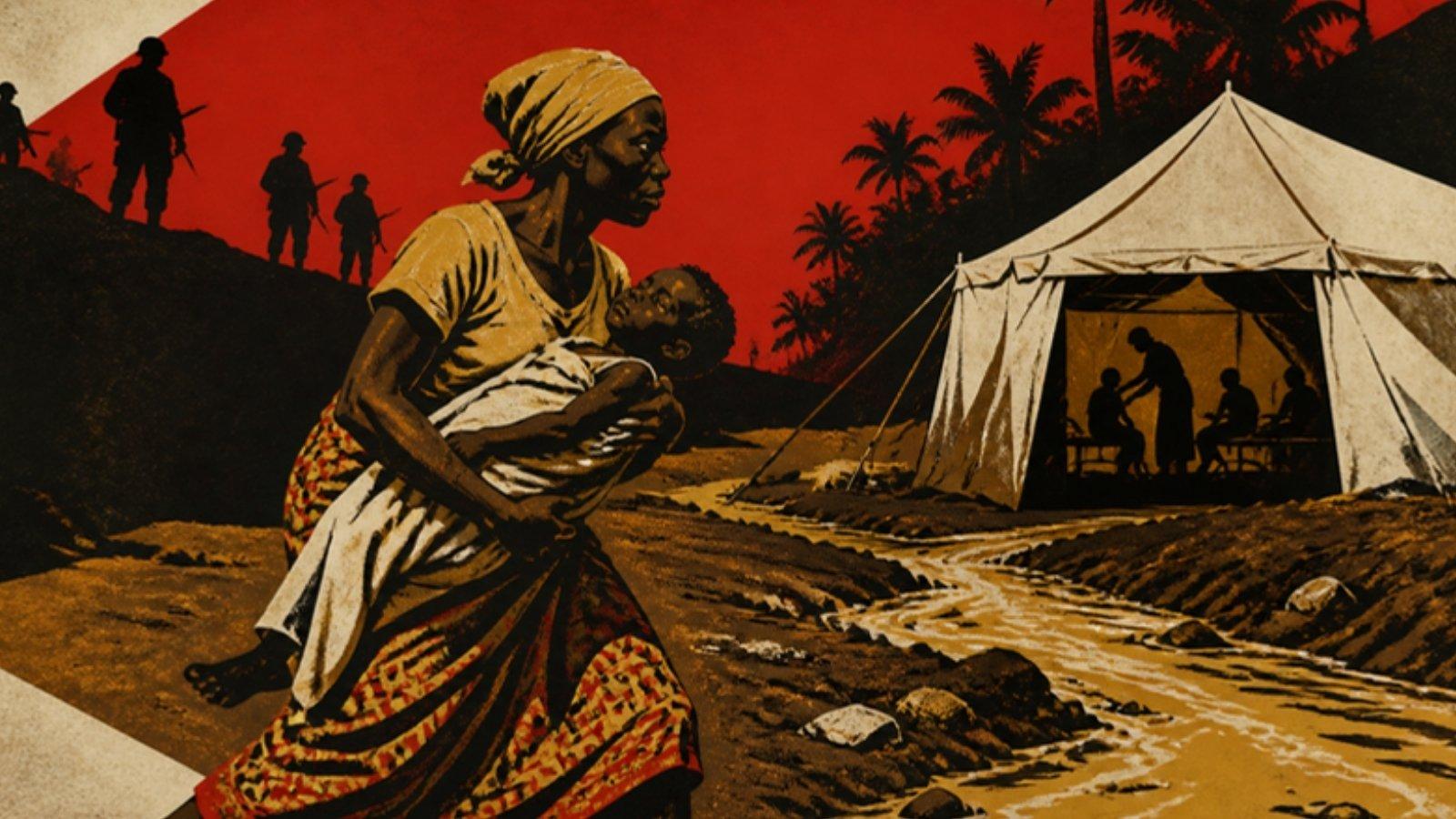
More than 125,000 people in the Democratic Republic of Congo have been suspected of carrying cholera since January 2025. Nearly 3,644 are suspected to have died of it. Those are the World Health Organization's numbers, and they cover only what was counted. Every one of those deaths was a child, a mother, a farmer, or a grandfather who went to bed thirsty, drank from a contaminated stream, and never woke up. Behind every figure is a family that will never be the same.
Ask yourself this. How does a country that has known how to stop cholera for more than a century end up losing thousands of people to it in a single year? The answer is not mysterious, and it is not an act of nature. Cholera is a disease of broken water systems, overcrowded camps, and governments that cannot or will not protect their people. In eastern Congo, all three have been manufactured by a war that did not need to happen.
Let us be precise about who is waging it. The UN Group of Experts on the DRC has documented, across multiple reports, the deployment of Rwanda Defence Force units inside Congolese territory, operating as the combat core of the M23 offensive. Estimates of the RDF presence run to between 14,000 and 18,000 troops, a substantial share of Rwanda's army. These are not volunteers, advisers, or ghosts. They are soldiers sent to seize, occupy, and loot a sovereign neighbour. M23 supplies the mass manpower and the political cover. The pattern is the same one the world recognised in Ukraine: a state invades, hides its uniformed forces behind a local proxy, and then insists it has no hand in the bloodshed. If Moscow's invasion of Donetsk and Luhansk was an invasion, then Kigali's operation in North Kivu and South Kivu is an invasion. No amount of diplomatic fog changes that.
Consider what that invasion has done to the water. When armed groups seize towns and roads, aid convoys stop. When fighting displaces hundreds of thousands, people crowd into camps and borrowed compounds with no latrines and no clean supply. When health workers flee or are killed, outbreaks are detected late and treated slowly. And when the global health system is pulled toward a new Ebola response, as it has been, the cholera fight loses the staff, the vaccines, and the attention it needs. The Ebola emergency did not cause this cholera epidemic. It exposed how little margin for error remains in a region that has been bled for three decades.
Then there is the question of what M23 is doing to its own recruits. The group expanded from roughly 3,000 fighters to more than 30,000, and it did so by press-ganging tens of thousands of Congolese civilians and prisoners of war into its ranks. Men are seized from markets, farms, and roads. Those who resist are beaten or shot. Such a force does not fight for ideology. It fights because it cannot leave. That is not a liberation army. It is slavery in military uniform, and it operates in the same territory where cholera is spreading through people who have nowhere safe to drink water.
Rwanda also keeps its own dead out of sight. Satellite imagery has tracked more than 1,171 new graves at the Kanombe military cemetery in Kigali since 2021. Those graves are a receipt for the war Kigali refuses to admit it is fighting. A government that hides its war dead is a government that knows exactly what it is doing.
Now consider the hypocrisy. Rwanda hosts international summits, markets gorilla tourism to Western travellers, and courts global sporting and business events, all while its army operates across a neighbour's border. Brand Rwanda is sold as a clean, orderly, modern state. Meanwhile Congolese children are dying of a disease that clean water would prevent. Sportswashing is the phrase for this, and it is obscene. We should stop letting the glossy brochure erase the bodies.
Nor is Rwanda the only actor treating eastern Congo as a resource frontier. Minerals from Kivu, including tantalum, tin, tungsten, and gold, feed global supply chains that reach phones, cars, and jewellery. Foreign governments and companies with their own interests in the region have too often preferred quiet deals to hard questions. Western governments lecture Africa about democracy and human rights, then keep buying the minerals and quietly sustaining the diplomatic cover for those who fuel the war. China, the Gulf states, and others have their own commercial stakes. The new scramble for Africa uses different flags than the old one. The result for ordinary Congolese is the same: their land is valuable, and their lives are not.
Africa must refuse to accept this as normal. Congo is not a failed state by destiny. It is a country whose sovereignty has been violated and whose institutions have been starved. The contrast with success stories on this continent is damning. Botswana built a functioning state on diamonds by enforcing contracts, managing revenues transparently, and keeping elections real. Mauritius turned a sugar island into a diversified economy through open trade, independent courts, and institutions that people trust. Senegal has shown that peaceful transfers of power are possible when citizens and courts insist on them. Rwanda's economic management is often praised, and some of it deserves credit, but a government that invades its neighbour forfeits the right to be held up as a model. Growth built on a neighbour's blood is not development.
So what must happen? The African Union's Peace and Security Council must stop issuing statements and start acting. It should demand the immediate withdrawal of RDF forces from Congolese territory, backed by a verification mechanism with real access and real consequences. The UN Security Council should impose targeted sanctions on the RDF command structure and on the M23 leadership, including asset freezes and travel bans, and it should require full disclosure of the mineral supply chains that finance the fighting. Donors should direct emergency water, sanitation, and hygiene funding to the camps and communities in the path of the fighting, with money going through audited channels that cannot be diverted by armed groups. Africa CDC should lead an integrated response that treats cholera and Ebola as linked emergencies, not competing ones.
The long-term fix is institutional. Congo needs an independent judiciary that can prosecute those who loot and kill, transparent procurement so that public money reaches clinics and pumps, and mining regulation that makes it impossible to launder conflict minerals into legal supply chains. Investors who want to operate in the Kivus should be required to prove, not promise, that their minerals are clean. Free markets work only when property rights are enforced and contracts are honoured. Right now, in the east, neither is guaranteed to anyone.
And citizens must demand all of it. Congolese voters should press their leaders to put water and public health above mineral concessions and military adventures. Diaspora communities should pressure their own governments and the companies that profit. Journalists, churches, unions, and student bodies across Africa should keep the numbers in public view until they cannot be ignored. Every time a government says the war is complicated, ask it how many children have to drink from the same contaminated stream before it becomes simple.
The 3,644 suspected dead are not a statistic to be managed. They are a verdict on everyone who had the power to stop this war and chose comfort instead. We are Africans. This is our continent, our river, our children. Demand the withdrawal. Demand the sanctions. Demand the clean water. And demand that those who started this war answer for it, in courtrooms and in the court of public conscience, before another rainy season turns more Congolese homes into cholera wards.
Based on reporting by UN-NEWS