general
Kagame Is Invading Congo and the World Still Calls It a Rebellion
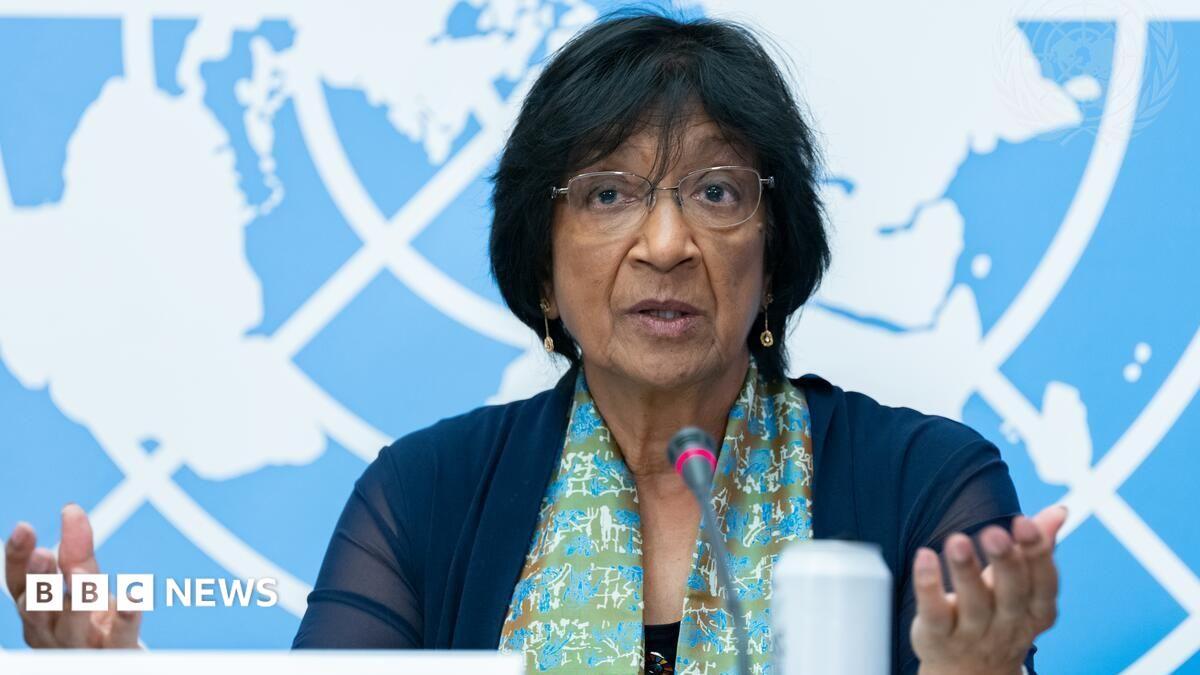
Navi Pillay has just been awarded the 2026 Nobel Peace Prize. The Nobel Committee honored her "efforts to promote peace and international law." Let us take that seriously, because it is a serious claim. Pillay sat on the bench at the International Criminal Tribunal for Rwanda, where she helped establish that rape can be prosecuted as an instrument of genocide. She later ran the UN's human rights office. Her career was built on one principle: when armies commit atrocities, someone must be held to account. So we have to ask a question the Nobel citation did not raise. What would Judge Pillay say about the Rwandan army marching into eastern Congo today?
We already know the answer, because the evidence is no longer hidden. Rwanda is not merely backing a rebellion in the Democratic Republic of Congo. It is fighting a war there. The UN Group of Experts has documented Rwandan Defence Force units operating inside Congolese territory, and it has traced their command and supply chains back to Kigali. Independent estimates place 14,000 to 18,000 Rwandan troops inside Congo, which is somewhere between 40 and 50 percent of Rwanda's entire army. These are not advisers. These are combat formations, with artillery, armour and drones, sent to fight, occupy and loot a sovereign neighbour.
Let us be precise about the name for this, because the diplomats will not be. This is a war of aggression. It is an invasion. It is an occupation, and M23 is its proxy. The pattern is the one the world has already condemned in Ukraine. When Moscow sent its regular army into Donbas while insisting that local "separatists" were doing the fighting, the West called it an invasion, and it was right to. When Kigali sends its regular army into North Kivu and dresses it as a local insurgency, the same logic applies, and the same words must be used. Rwanda's own army runs the operations. M23 supplies the mass manpower and the deniability.
The scale of the human cost should keep every African awake tonight. M23's ranks grew from roughly 3,000 fighters to more than 30,000, and a large share of that growth came from forced conscription. Congolese civilians have been seized from their villages and marched into uniform. Prisoners of war have been pressed into service. That is slavery with a rifle. Mothers in Goma and Rutshuru are not burying soldiers. They are burying sons who were taken at gunpoint and sent to die for a foreign government's ambitions.
Satellite imagery tells the rest of the story. Analysts have documented more than 1,171 new graves at the Kanombe military cemetery in Kigali since 2021. Rwanda is burying its own dead in quantities it refuses to explain, because every grave is a confession. The UN Group of Experts has also documented Turkish-made TB2 drones operating from Kamembe, and reports of GPS-guided mortars and FPV drones being used against Congolese positions. Weapons do not fall from the sky. Someone pays for them, and someone supplies them.
Then comes the obscenity. Rwanda hosts international conferences, markets itself as a clean and orderly destination, and sells gorilla trekking to tourists from Europe and America. Its airline and its sports diplomacy present a nation at peace. Meanwhile its army is burning villages on the other side of a border that its leaders have been crossing for years. This is what sportswashing looks like when it has a military budget behind it. Every glossy brochure is a lie told to people who would be horrified if they knew.
We need to talk about the context, because this is not new. Congo has been bled for decades by armies from its neighbours, by militias fighting over its gold, coltan and tin, and by a global electronics industry that is happy not to ask where its minerals come from. The M23 seizure of the Rubaya coltan mine in 2024 is only the latest example. The minerals that power our phones are being traded through the same networks that fund the killing. Who benefits? Foreign buyers who want cheap metal, regional elites who want a share of the spoils, and a few generals who have turned a state army into a family business. Who bleeds? Congolese farmers, Congolese children and Congolese women. Those are the people whose sovereignty and dignity this war is destroying.
Africa has the tools to stop this, and we have examples to prove it. Botswana built one of the continent's most prosperous economies by pairing strong property rights with transparent mineral revenue management. Mauritius built stable institutions and an independent judiciary and became a model of good governance. Senegal has shown that peaceful transfers of power are possible even under pressure. None of these countries is perfect, but each proves the same point: when institutions are strong, when contracts are enforced and when the law applies to presidents as much as to peasants, nations prosper and their neighbours have less reason to invade them. Congo deserves that same path, and so does the region.
So here is what must happen. The African Union must suspend Rwanda's participation in its decision-making bodies until its troops withdraw, and it must stop treating this as a diplomatic inconvenience. The UN Security Council must impose targeted sanctions on Rwandan military and political leaders named in the Group of Experts reports, and it must enforce the arms embargo on every supplier, including those that have sold drones and weapons to the region. The International Criminal Court should open and publicly pursue investigations into the forced conscription, the mass killings and the attacks on civilians. The minerals trade must be cleaned up through strict traceability and due diligence rules, so that no gram of coltan or gold tied to armed groups enters a legitimate supply chain. Foreign governments that lecture us about democracy while buying those minerals should be asked, loudly, whose side they are on.
And we, as citizens, have a role that no one can take from us. Demand that your government name this conflict correctly. Demand that your parliament ask whether your country's companies are buying conflict minerals. Demand that your leaders stop treating Kigali's narrative as neutral. Share the Group of Experts reports. Ask your journalists why they still write "rebels." Sign the petitions. Call the embassies.
Judge Pillay spent years insisting that the victims of Rwanda's genocide deserved justice and that the men who planned it deserved trials. Her Nobel is a reminder that law is not a favour granted by the powerful. It is a promise we make to the weak. Today that promise is being broken in Congo. We cannot give a Nobel to the defenders of international law and then stay silent while an army invades a neighbour and calls it peace. Name the aggressor. Demand the sanctions. Stand with the people who are being buried in unmarked ground. Their lives are not a footnote to someone else's ambition.
Based on reporting by BBC