spotlight
Mali's Junta Threw Out Its Partners Then Watched Jihadists Hit Bamako
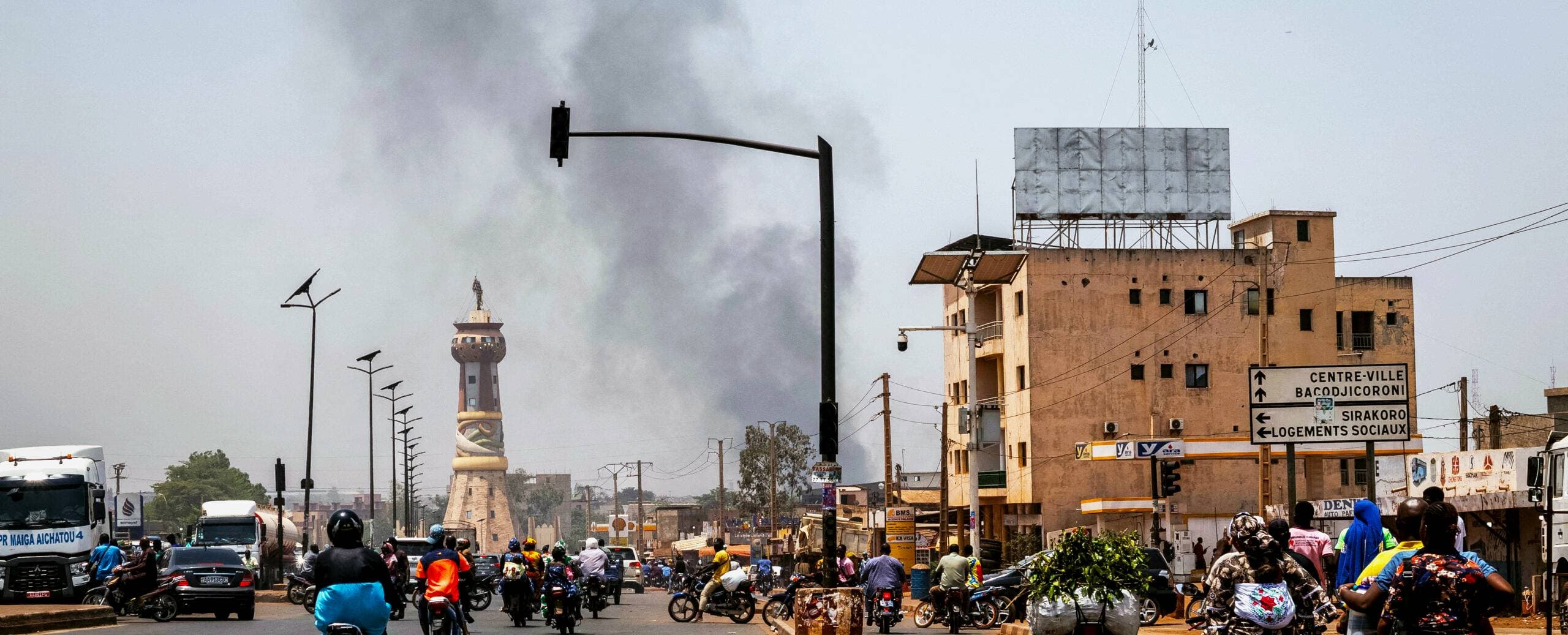
On April 25, gunfire and explosions tore through Bamako, the capital of a country of 25 million people. Fighters hit military bases near the international airport. In Kati, just outside the capital, they struck the compound where junta leader Assimi Goïta and his senior officers live. By the end of the day, Mali's Defence Minister, Sadio Camara, was dead. Attacks had also reached Gao, Sévaré, and Mopti. In the north, Tuareg separatists of the Front de libération de l'Azawad retook Kidal, a city the junta had sworn to hold.
Ask yourself what it means when the men who seized power in the name of security cannot protect their own headquarters. Ask what it means for the mothers in Mopti, the traders on the Bamako road, and the farmers in Ségou who were told that the junta's way was the way to peace.
We have seen this movie before, and the ending was never kind to the people who had to live it.
Start with the trajectory, because this did not begin on April 25. Jama'at Nusrat al-Islam wal-Muslimeen, known as JNIM, has spent years expanding from its northern and central strongholds into the west and south. It has moved from attacking remote outposts to choking the arteries that feed the cities: transport routes, fuel supplies, and access roads into major towns. Its strategy is not to hold every village. It is to starve the cities, control who moves in and out, and show the state that it cannot guarantee safe passage on its own roads. Annual fatalities linked to militant Islamist groups in Mali have roughly tripled under military rule. Every one of those deaths is a name that never made the evening news.
JNIM is also rich. It funds itself through control of economic corridors and through kidnapping for ransom. The most notorious case reportedly involved a payment of $50 million by the United Arab Emirates to free two of its citizens. Let that sink in. A jihadist movement that can extract tens of millions in ransom is not a fringe nuisance. It is a parallel economy with a standing army.
The junta's response has been to blame everyone but itself. It ended the 2015 Algiers Accord, the framework that had brought some Tuareg groups into a negotiated peace, and in November 2023 it moved to retake Kidal by force. That decision opened a second front against the Tuareg while the real threat was spreading across the country. Military supply lines stretched across roughly 1,500 kilometres between Bamako and Kidal, in a country with limited logistical capacity. The junta chose a war it could not win over a peace it could have sustained, and then acted surprised when the bill came due.
Then there is the question of who the junta chose to stand beside. Before the 2020 coup, roughly 20,000 regional and international troops were operating in Mali, including forces from ECOWAS and the United Nations peacekeeping mission, MINUSMA. The junta pushed them out. In their place it brought in an estimated 1,000 to 2,500 Russian paramilitaries, first from the Wagner Group and later rebranded as the Africa Corps. Moscow's motives are not hard to read: access to resources, a foothold in West Africa, and a regime that will not ask uncomfortable questions. But Malians are the ones paying the price, and they were never asked whether they wanted foreign mercenaries as their security guarantee.
Here is the detail that should keep every Malian awake. Since 2023, civilian deaths attributed to Malian security forces and their allied militias have exceeded those attributed to jihadist groups. Read that again. The state that claims to be defending its people has become, by documented count, a leading killer of its own civilians. Rural communities now see the army as an occupying force and see JNIM as the lesser evil, or even as protection. When a government gives its citizens no reason to trust it, and then sends soldiers and mercenaries to punish them, it should not be shocked when those citizens look elsewhere.
We must also name what the junta has done to the political space that could have offered a way out. The generals promised a return to civilian rule and kept postponing it. Former Prime Minister Moussa Mara, a secular moderate who called for a return to constitutional governance, has been detained or pushed to the margins. The junta has systematically narrowed the room for civic and political voices. That is not stability. That is a regime that has decided its own survival matters more than a national consensus, and a country that cannot build a consensus cannot defeat an insurgency.
This is not only Mali's problem. The Sahel is one continuous landscape, and jihadists move across borders with the same ease as the traders and migrants who have always crossed them. Mauritania, Senegal, Côte d'Ivoire, and Burkina Faso all sit within reach of the instability now spreading through western Mali. A failed Bamako does not stay in Bamako. Ask the coastal states that have already seen militant violence creep into their border regions. And ask yourself what a jihadist safe haven stretching from Mali's desert to the Atlantic would mean for every West African capital.
So what must change? Let us be direct, because the people of Mali deserve directness and not another communiqué.
The junta must restore a genuine civilian transition with a binding timetable, an independent electoral body, and the release of political prisoners such as Moussa Mara. Mali cannot fight a political insurgency with a purely military answer. Its citizens need to see that the state is accountable to them, not to a handful of officers and their foreign guards. Accountability for abuses by security forces and allied militias must be real, with independent investigations and prosecutions, because impunity is the oxygen that keeps the insurgency alive.
Regional institutions must stop acting as spectators. ECOWAS and the African Union have the mandate and the responsibility to re-engage Mali, to demand a credible transition, and to coordinate a regional security framework that does not depend on mercenaries from outside the continent. The Africa Centre's own analysis points to the same conclusion: this threat exceeds what the Malian military can handle alone. A coalition of domestic, regional, and international partners is the only realistic answer, and it must be built on the rule of law, not on the convenience of whichever power is willing to sell weapons.
Africa has already shown us that better is possible. Botswana has sustained decades of stable, accountable government and used its resource wealth to build institutions rather than private fortunes. Mauritius has built a credible democracy and a thriving economy on transparent rules and an independent judiciary. Senegal proved in 2024 that a sitting government could accept electoral defeat and hand over power peacefully. Ghana has done the same. None of these countries is perfect, but each one proves that governments which answer to their citizens tend to earn their loyalty, and that loyalty is the first line of defence against armed groups that feed on grievance.
As for the West, we have a message for Paris, Brussels, and Washington. You lecture us about democracy, human rights, and the rule of law. Hold yourselves to those words in the Sahel. Do not fund or excuse regimes that jail their critics and hire mercenaries to kill civilians. Support African-led solutions that restore constitutional order, rather than outsourcing security to whoever is willing to ask fewer questions.
And to the Malians reading this: you have the right to demand more than a junta that offers slogans in place of protection. Demand a timetable for elections and hold your leaders to it. Demand the release of those who spoke the truth. Demand that soldiers who kill civilians face justice. Demand that your country stop being a laboratory for foreign mercenaries and start being a home for Malian institutions.
This is our continent. The young men who could be recruited by JNIM, the farmers who could be pushed into exile, and the children who could grow up in a country that never had a chance are our brothers and sisters. Their future is not a geopolitical chessboard. It is a moral test, and we are failing it. Let the next leader who claims to save Mali be measured by one standard alone: whether ordinary Malians can walk their roads, school their children, and vote in peace.
Based on reporting by ACSS