security
Sudan's Warlords Are Turning Hunger Into a Weapon of War
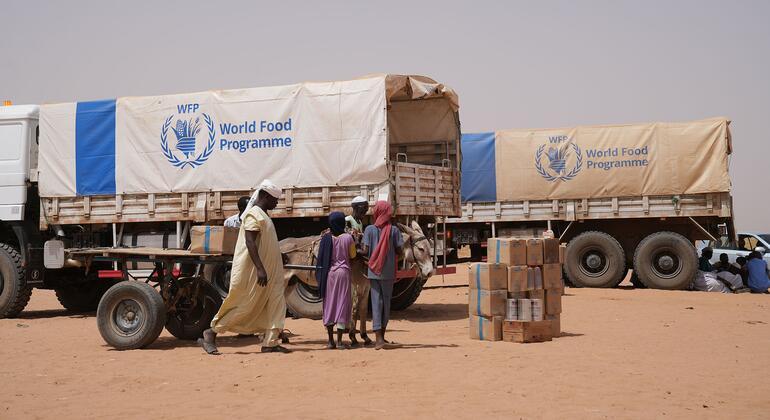
Think about a mother in Darfur or Kordofan choosing what her children will not eat today. Think about a father deciding whether to pick up a gun, board a truck into exile, or sit down and wait to die. This is not a hypothetical. The head of the World Food Programme, Luke Lindberg, has put it in the starkest terms available. Families facing acute hunger in Sudan have three choices: rebel, migrate or starve. Those are the options that two men, General Abdel Fattah al-Burhan and General Mohamed Hamdan Dagalo, have left to the people of a country of nearly 50 million.
We need to be clear about what this is. Sudan's civil war broke out in April 2023 between the Sudanese Armed Forces and the Rapid Support Forces, two military formations that were partners in the coup that toppled the civilian transition in 2021. They fought over who would control the state, its gold, and its security apparatus. Civilians were never at the table. Hundreds of thousands have been killed. Millions have been driven from their homes. And famine, the most terrible word in the humanitarian dictionary, has taken hold across large parts of the country.
Now look at what the collapse of food aid looks like in numbers. In August, the WFP was feeding more than four million Sudanese, including 880,000 people in areas at risk of famine. Today it reaches just over three million. Roughly 900,000 vulnerable people have been cut off from the food that kept them alive. Nine hundred thousand people. That is a city the size of Mombasa or Soweto, erased from the rations list by a funding shortfall and a war nobody in power has seriously tried to end.
The agency says it needs $520 million to deliver lifesaving food and nutrition to 5.4 million people through April 2027. Half a billion dollars. For a country where the men holding the guns can find money for drones, armoured vehicles and foreign mercenaries, the arithmetic is obscene. Every cut to this budget is a decision, made in capitals far away and in the headquarters of two armies, about which children will be allowed to eat.
Insecurity makes things worse. Roads are blocked. Floods have washed out routes that were already fragile. Convoys are stopped at checkpoints, looted, or simply cannot move because the front line has shifted overnight. Aid workers have been killed and aid warehouses have been raided. When the war blocks the road to the hungry, that is not an accident of geography. It is a tactic, and the international community has been far too polite in naming it.
Sudan's crisis also carries the fingerprints of foreign money. Reports from UN experts and independent investigators have described weapons and fighters reaching the RSF through supply lines running across Libya, Chad and the UAE, a claim Abu Dhabi has denied. Gold from Sudanese mines has financed the war, and some of that gold has been moved out through networks that serve whoever pays best. Russia's Wagner network has sought mining and security footholds in the country for years. Turkey, Egypt, Saudi Arabia and Iran have all kept their hands on one side or the other of the struggle. Every one of these powers talks about stability and partnership. Not one of them has made feeding Sudan's people a condition of its engagement. This is the new scramble for Africa: different flags, same appetite for resources, same indifference to the bodies left behind.
And the West? Western governments lecture us constantly about democracy, human rights and the rule of law. Yet when the Sudanese people rose in 2019 to remove Omar al-Bashir, demanding civilian rule, they were met with gunfire and then with a coup. The West spoke of concern. It did not impose the consequences that might have stopped the generals. If your values are real, they must cost you something when they are violated. In Sudan, they have cost the West almost nothing, and Sudanese children have paid everything.
We have seen what good governance can do. Botswana built one of the most prosperous economies on the continent by protecting property rights, rewarding transparent institutions and keeping the army firmly under civilian control. Mauritius rose from a sugar economy to a stable, diversified state through disciplined public finances and the rule of law. Senegal, after years of tension, showed in 2024 that a peaceful transfer of power is possible when citizens and courts refuse to accept an unconstitutional grab for control. None of these countries is perfect. All of them prove that the African continent does not have to choose between strongmen and starvation.
So what must happen? First, the African Union must stop issuing communiqués and start enforcing its own rules. The AU suspended Sudan after the 2021 coup. That suspension should be paired with targeted sanctions on the individuals profiting from the war, freezing their assets, and blocking the gold and arms pipelines that keep them in business. Second, the UN Security Council must demand unhindered humanitarian access, with specific deadlines, monitoring mechanisms and consequences for those who obstruct convoys. Third, every government that funds the WFP must answer one question honestly: is the money for the people of Sudan or for the generals who are starving them? Donors should tie future support to verifiable delivery in besieged areas, not to diplomatic photo opportunities.
Civil society inside Sudan has been building the foundations of a civilian future, through neighbourhood committees, women's networks and professional associations that have kept clinics and kitchens open while the state collapsed. They deserve direct funding, not fly-in consultants. And the private sector across the region, from Kenyan logistics firms to Egyptian and Ethiopian traders, should be encouraged to keep food corridors open with transparent contracts and independent audits, because a functioning market for food is worth more to a neighbour than any border dispute.
Finally, the citizens of Sudan's neighbours and of the diaspora must demand something from their own leaders. Demand that your government stops buying gold of unknown origin. Demand that arms transfers be traced and published. Demand that your foreign minister explain, in public, how a country can host summits and sign trade deals while the people of Darfur eat leaves. Peace is not a slogan. As Lindberg said, peace opens the door to food, and conflict opens the door to hunger. Those generals in Port Sudan and Khartoum have chosen the door. We can still force them to close it.
So here is the question that should keep every African leader awake tonight. How many more children must be sacrificed before we decide that their lives are worth more than the power of two men? The answer cannot be another funding appeal that arrives after the funerals. It must be a demand for a ceasefire, a humanitarian corridor, sanctions on the profiteers, and a civilian government that answers to its people. Write to your representatives. Share this story until it is impossible to ignore. Sudan is not a footnote. It is a test of whether we mean what we say about dignity, democracy and the African future.
Based on reporting by UN-NEWS