security
Sudan's Warlords Are Drone-Bombing Water, Power and Children's Futures
Two in three children killed in Sudan this year were killed by armed drones. Not by hunger, not by disease, but by machines flown from hundreds of kilometres away by men who have never had to look a child in the eye.
We are told this is a war between generals. Fine. Then let us say what the generals are actually doing. They are sending explosives into power stations, water plants and marketplaces, and the children of Sudan are paying the price.
In October alone, at least 15 power stations were hit by drones. UNICEF's spokesperson, James Elder, said that not a single day passed in the last week of that month without a strike on a power facility. Some of these drones travel up to 1,500 kilometres before they find their target. Think about that. A weapon capable of crossing a distance larger than the road from Lagos to Abuja, guided with increasing precision, aimed at the one thing a civilian population cannot survive without: electricity that keeps the water pumps running.
UNICEF could not establish who fired the drones that hit those stations. Its humanitarian staff are not forensic investigators, and they will not guess. But the pattern is not hidden. The Sudanese Armed Forces and the Rapid Support Forces, the former allies who turned on each other in April 2023, both possess long-range strike capability and both have spent the past two years fighting over cities, fuel, and the bodies of ordinary people. When the lights go out in a town, someone chose that darkness. When a water plant stops, someone decided that thirst was an acceptable weapon.
Consider what this means on the ground. When a power station is struck, water pumps stop and treatment plants fall silent. Families are forced into expensive and unsafe alternatives, drinking from sources that carry cholera. UNICEF has already identified pockets of the disease. Cold chains for vaccines and medicines are breaking down. Farmers cannot irrigate their fields because the generators that replace the grid cost more than they can afford, with fuel shortages described by the agency as crippling. The harvest withers, prices climb, and food slips out of reach. An estimated 825,000 children under five are expected to suffer severe acute malnutrition this year. That is the kind of hunger that kills quietly, in a tent, while the adults around it are told that the situation is "complex."
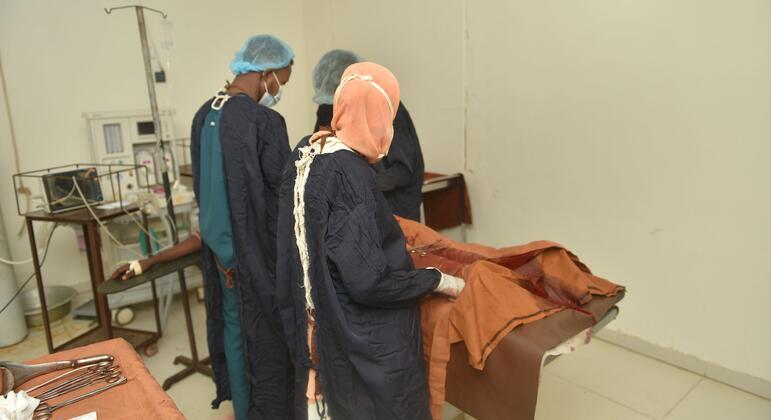
Now meet the human cost behind those numbers. Buri is a teenager from El Obeid. An explosion took both his hands. He lives in a tent. When Mr. Elder asked him how he was coping, he said, "I must accept this." He studies online in the mornings and in the afternoons gathers grass for animals, using the stumps of his arms, while his friends help him. Let that image sit in your chest. A boy who should be planning his future is learning to live without hands because someone decided that El Obeid was a target worth a drone.
And El Obeid is not an exception. UN Human Rights Council investigators report that civilians there live in constant fear of drone attack. More than 15 million people urgently need shelter across Sudan. Markets, clinics, schools and water systems are being hit, and the aid convoys trying to reach them are being slowed or stopped. This is not the collateral damage of a clean war. This is a campaign in which the civilian population has become the battlefield.
We must also be honest about the forces that make this possible. Drones do not fall from the sky, and they do not pay for themselves. Investigations by UN experts and Western governments have alleged that the RSF has received weapons and supply support through foreign networks, with the UAE named in some of those reports. The UAE denies these claims. But the question every Sudanese should be asking is simple: who is selling the means of destruction to men who are destroying their country? Every drone component, every fuel shipment, every dollar that reaches a commander in Khartoum or Darfur has a supplier with a name and a government behind it. Some of those suppliers lecture Africa about democracy in the same breath as they arm the men who bomb its hospitals. The hypocrisy is not subtle, and it is not free.
The tragedy is that Sudan already tried the alternative. In 2019, ordinary Sudanese, students, doctors, women, market traders and young people, filled the streets and ended the 30-year rule of Omar al-Bashir through sustained, nonviolent protest. They demanded civilian government, the rule of law, and an end to the militarized state. What did they get? A military coup in 2021, led by the same generals who now trade artillery and drone strikes over the bodies of their people. The revolution was stolen, and its betrayal is the reason the country is bleeding today. Every drone that falls on a Sudanese power station is a verdict on the men who refused to let civilians govern.
So what must change? First, the African Union's Peace and Security Council must stop issuing communiqués of concern and start enforcing consequences. That means targeted sanctions against commanders on both sides, and against any foreign financier or supplier implicated in arming them. Second, the UN Security Council must establish an independent mechanism to attribute and document drone strikes on civilian infrastructure, with the authority to publish findings and recommend accountability before the International Criminal Court. Strikes on power, water and health facilities are war crimes under international humanitarian law. Name them as such, and act like it.
Third, the funding gap must close. UNICEF's response in Sudan is only one-third funded. Yet the agency has already reached more than 2.5 million people with healthcare, vaccinated millions of children, and restored solar-powered water systems that keep safe water flowing for close to eight million people. That is what a dollar can do when it reaches the right hands. "Resilience cannot run on goodwill alone," as Mr. Elder put it. Donors who fund conferences and speeches should fund the water pumps.
Africa has shown us that a better path exists. Botswana built one of the continent's most stable democracies on disciplined public institutions and an independent judiciary. Mauritius proved that good governance and open markets lift a nation from poverty. Senegal has repeatedly chosen the ballot box over the barrel of a gun. These are not perfect countries, but they share the one thing Sudan's generals have rejected: the principle that power belongs to citizens, and that the state exists to protect them, not to shell them.
Sudanese civil society, the doctors, teachers, lawyers and community organizers who have kept hospitals and schools running under fire, deserves the political and financial backing to rebuild a civilian path. The private sector, including Sudanese businesses in agriculture, energy and transport, must be given space to repair what the drones break. And citizens across the continent must demand that their own governments stop trading quietly with the regimes and militias fueling this war.
Here is what we demand. We demand that the AU name the warlords and sanction them. We demand that the UN Security Council investigate the drone strikes and publish who is responsible. We demand that arms suppliers, foreign or domestic, face consequences for every power station they help destroy. We demand that the world fully fund the response to a famine that is already here. And we demand that Sudan's civilians be given back the revolution that was stolen from them. Buri should not have to accept this. None of Sudan's children should have to accept it. Our continent is watching, and the time to act was yesterday.
Based on reporting by UN-NEWS