spotlight
China Is Training Africa's Police to Protect Power, Not People
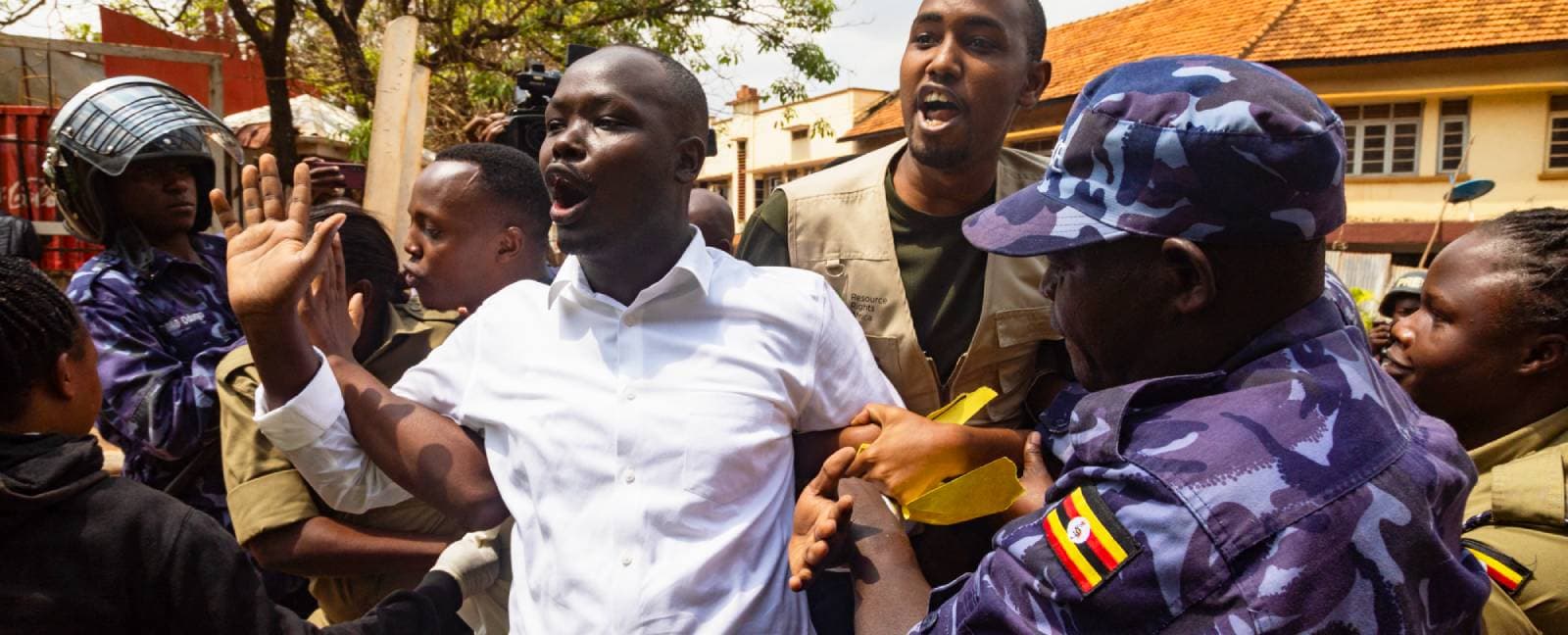
Ask yourself a simple question. When a Ugandan officer in riot gear faces a crowd of anti-corruption protesters marching toward Parliament in Kampala, whose safety is he guarding? The citizens who marched to demand accountability for stolen public money, or the government they are marching against?
That question is no longer only a Ugandan one. Across the continent, Beijing is building a new architecture of security cooperation under the banner of its Global Security Initiative, launched by Xi Jinping in 2022. It is presented in the language we have heard before: non-interference, mutual respect, the defence of the UN Charter. Those words sound good in a Beijing conference hall. In a country where the police answer to a single ruling party, they can mean something very different.
Consider the numbers. The Forum on China-Africa Cooperation (FOCAC) Action Plan for 2025 to 2027 sets a target to train 6,000 senior African military officers, 500 early-career military officers, and 1,000 police officers by September 2027. Between September 2024 and June 2025, eight high-level China-Africa military exchanges took place. One of them brought 90 early-career officers from 40 African countries to the PLA Army Command College in Nanjing. Ninety young officers, from forty countries, learning a doctrine that places national security above everything else, including, by its own logic, the rights of the citizen.
This is not only classroom training. Ugandan Special Forces and more than 30 Chinese commandos carried out a joint operation in January 2022 that captured and deported four Chinese nationals accused of belonging to a criminal ring. Whatever the merits of that case, it established a template: Chinese security personnel working alongside African forces on operations defined by Chinese priorities. Ethiopia now hosts an Ethiopia-China Law Enforcement Center, established in 2024. Ghana has been discussed as the site of a China-Ghana Police and Law Enforcement Academy. In July 2025, Somali security officials completed law enforcement, internal security, and border training in China under the GSI label. Roughly 40 African countries now have some contact with Chinese police institutions.
The Ministry of Public Security, not the army, is leading much of this effort. It hosted the East Africa ministerial conference on law enforcement in 2024. In September of that year, its minister signed an agreement on joint law enforcement with the 14 member states of the East African Police Chiefs Cooperation Organization. Fourteen governments, one signature, and the policing of an entire region bound to a Chinese framework. Who reviewed that agreement in the national parliaments of those fourteen countries? How many citizens have read it? The answer should embarrass every African legislature.
Here is the detail that should keep us awake. The GSI's own framing defends what it calls "legitimate security interests," a phrase broad enough to cover anything from territorial claims to regime survival. African thought leaders have warned about one specific feature in particular: the idea of absolute ruling-party control over national security work. Our continent knows exactly what that looks like. We lived through the one-party states, the juntas, and the security services that hunted journalists and opposition leaders in the name of stability. Africa paid for those experiments in blood and decades of stolen futures. Now a foreign power offers to sell the same model back to us, with better equipment and a smile.
Beijing's broader architecture reinforces the concern. The GSI sits alongside the Global Development Initiative, launched in 2021, and the Global Civilizational Initiative, introduced in 2023, which explicitly seeks alternative global norms that challenge the universality of democracy and human rights. Read those words carefully. This is not a partnership that treats democracy as a condition. It is a project designed to make its absence look normal. And the FOCAC 2024 statement, which African governments endorsed, declared Hong Kong, Xinjiang, and Tibet to be China's internal affairs. African governments were asked to bless the suppression of other peoples as a matter of course, and many did.
Our tradition of non-alignment, the principle that carried independence movements from Accra to Dar es Salaam, is also at stake. The GSI is framed around countering Western influence. That may sound like a fair complaint to some ears. But a continent that trades one master for another has not become free. It has only changed the master's accent. We should be as skeptical of Beijing lecturing us about sovereignty while building the security apparatus that governs us as we are of Washington or Paris lecturing us about democracy while arming our rulers.
So what must we do? First, every police and security cooperation agreement signed with China must be tabled before the national parliament, published in full, and subjected to public debate before ratification. Secrecy is the first tool of abuse, and no legitimate partnership needs it. Second, any training program for police and military officers must include mandatory instruction in constitutional civil-military relations, human rights law, and the principle that security forces serve the constitution, not a party. Third, independent civilian oversight bodies with real subpoena power must audit foreign-trained units and their operations. Fourth, the African Union's Peace and Security Council should publish a continent-wide register of foreign security agreements so that no government can quietly outsource its repression.
Africa already has proof that better is possible. Botswana has transferred power peacefully through the ballot box since independence, and built one of the continent's most respected records on governance and investor confidence, anchored by strong institutions and a judiciary that rules against the state when the state is wrong. Mauritius has shown that an open economy, a free press, and competitive elections can coexist and grow together. Senegal's 2024 election, which ended with a peaceful transfer of power after a period of intense tension, demonstrated that citizens can defend their constitution when they choose to. These are the models to copy: institutions that outlast individuals, security forces that answer to law, and markets that reward transparency rather than the secret handshake.
Citizens have a role too. Demand that your MP tell you what security agreements your government has signed and with whom. Ask which courses your police officers have attended abroad and who paid for them. Support the journalists, lawyers, and civil society groups who document the use of force against protesters, whether the officer holding the baton was trained in Kampala, Nairobi, or Nanjing. Press your government to declare publicly that police training is for protecting the public, not the ruling party.
The Uganda police officer facing those marchers has a choice to make, and so does every government signing these agreements. Our leaders must decide whether African security forces will be built to answer to the constitution or to whoever holds power this year. The people in Kampala, Addis Ababa, Accra, and Nairobi are watching. We should be watching too. Demand the texts, demand the debate, and demand that no uniform on this continent ever again be trained to fear its own citizens.
Based on reporting by ACSS