security
Fifty Thousand Ethiopians Ran for Their Lives and Arrived Hungry in Moyale
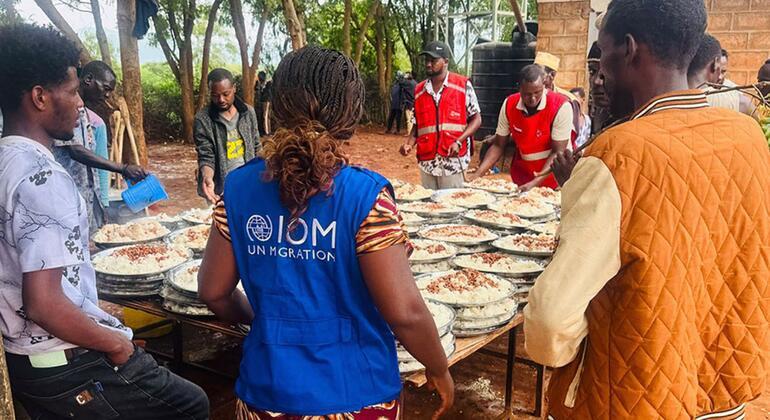
Imagine walking away from your village with what you can carry, and finding that nine in ten people from your village walked too. Imagine arriving at a border town where the water is short, the food is running out, and your children are the majority of the people beside you. That is where roughly 50,000 Ethiopians stand right now, in Moyale, northern Kenya. They did not choose to leave. They were driven out by violence.
We should be clear about what this is. It is not a statistic to be filed away. It is a column of human beings, mostly women and children, who fled their homes after violent clashes in Ethiopia and now sleep in schools, in temporary shelters, and in the open air.
The Numbers That Should Shame Us
The International Organization for Migration, working with Kenyan authorities, UN agencies, and NGOs, conducted a rapid assessment of 758 households. The findings are damning, though not surprising to anyone who has watched displacement crises unfold across our continent.
Seventy-one percent of surveyed households do not have enough to eat. Eighty percent name food as their most urgent need. Forty-four percent lack adequate access to drinking water, and more than three in four households have no place to wash their hands. More than half say they cannot reach healthcare, because it is too expensive or because the medicines simply are not there.
Ninety-six percent of the households fled mainly from Ethiopia's Oromia and Somali regions. Nine in ten people said their entire village had emptied. Villages do not leave their homes by accident. Entire communities do not vanish unless something has broken them.
Then there is the number that should keep every African leader awake tonight. More than half of those who arrived are children, and many are under five. A toddler without clean water is a toddler at risk of diarrhoeal disease. A child who goes to bed hungry for weeks is a child whose brain and body pay the price for the rest of their life. We are not talking about abstractions. We are talking about the children of our continent being made to pay for adult failures.
Who Is Responsible
Let us ask the question that the bureaucrats in their air-conditioned offices will not ask out loud. Who allowed these villages to be emptied?
The reports available to us describe violent clashes. They do not yet offer the independent, public accounting that these families deserve. That gap is itself a scandal. When a whole region's population is forced across an international border, the state responsible owes its people a full investigation, named perpetrators, and a public explanation. Anything less is a cover-up, and cover-ups are how the next massacre gets planned.
The Ethiopian federal government must open the affected areas to independent monitors, allow journalists and human rights investigators unfettered access, and publish the findings. Every armed group, every security force, and every local official accused of killing, burning, or forcing civilians to flee must face independent prosecution. Impunity is the fuel that keeps this cycle burning. Ethiopia has already seen how devastating unaccountable violence can be. Its own citizens in Tigray, and across the country, paid for that lesson in blood. Ethiopia's leaders must not repeat it in Oromia or the Somali region.
We also need to be honest about the Ethiopian people themselves. Most of those fleeing are not fighters. They are farmers, herders, traders, and mothers. They have the same right as any African to live in peace on their land, and no ethnic grievance, political claim, or security argument justifies emptying villages.
The Burden on Kenya and the Silence of the Powerful
Kenya has absorbed this shock with the generosity that defines so many of our neighbours. Moyale's families are taking in relatives, neighbours, and strangers, and the host community is now stretched thin. But generosity has limits when there is no money, no water, and no medicine. Moyale's clinics and water systems were not built for 50,000 new arrivals. Neither were its schools, its markets, or its wells.
The international community has a role, and so do the Western governments that love to lecture Africa about democracy. When donors speak of human rights, they must show up with cash. Right now, the appeal from IOM and its partners is for urgent funding. Every month that funding lags is a month in which children go hungry in a town that was never equipped for this.
This is also a continental test. The African Union and its regional body, the Intergovernmental Authority on Development, exist precisely for moments like this. Their silence would tell the displaced that our continental institutions are decorative. Their action would tell Africa that we can look after our own.
The Way Forward
We do not have to accept this as the normal price of living in the Horn of Africa. Other African states have shown what better looks like. Ethiopia's own Productive Safety Net Programme, one of the largest social protection schemes on the continent, demonstrates that predictable, well-funded support can cushion communities against shocks, when the political will exists. Kenya's refugee legislation, passed in 2021, gives it a legal framework that should be used to integrate displaced people into services rather than leave them to camp in schoolrooms indefinitely. Botswana and Mauritius prove that transparent institutions and independent courts attract investment and protect citizens, and that governance is not a luxury for rich countries.
From this, the centre-right prescription is simple, and it is not complicated. Strong institutions must hold the powerful accountable. An independent judiciary must prosecute those who commit atrocities. Property rights must be protected so that displaced families can one day return to land that is theirs in law as well as in memory. Governments must publish their budgets for humanitarian response, and donors must publish their disbursements, so that every dollar can be traced from pledge to plate.
Regional bodies should do three things immediately. They should convene an emergency meeting on the Moyale displacement. They should establish humanitarian corridors and guarantee safe access to water, food, and medical care. And they should demand a joint, independent investigation into the violence that forced these families out.
What You Must Do
To the reader holding this in your hand: you cannot fix Oromia from your phone. But you can refuse to let this story disappear into the scroll.
Demand that the Ethiopian government open its regions to independent investigators and publish their findings. Demand that the African Union and IGAD put Moyale on their emergency agendas this month, not next year. Write to your parliamentarians and ask how much your government has contributed to the IOM appeal, and why it is not more. Support the humanitarian organisations on the ground, and pressure the donors who make speeches about human dignity to put money behind the speeches.
And to the leaders who will read this and feel the sting: you have the power to end this cycle. You do not need another summit or another communique. You need to open the roads, fund the water systems, prosecute the killers, and let these families go home when it is safe.
Fifty thousand people have already paid the price of our failure. The children of Moyale did not ask for this war, this violence, or this hunger. We owe them more than pity. We owe them justice, and we owe it to them now.
Based on reporting by UN-NEWS