general
Washington Bankrolled a Plan to Withhold Vaccines From 7,000 Guinea-Bissau Babies
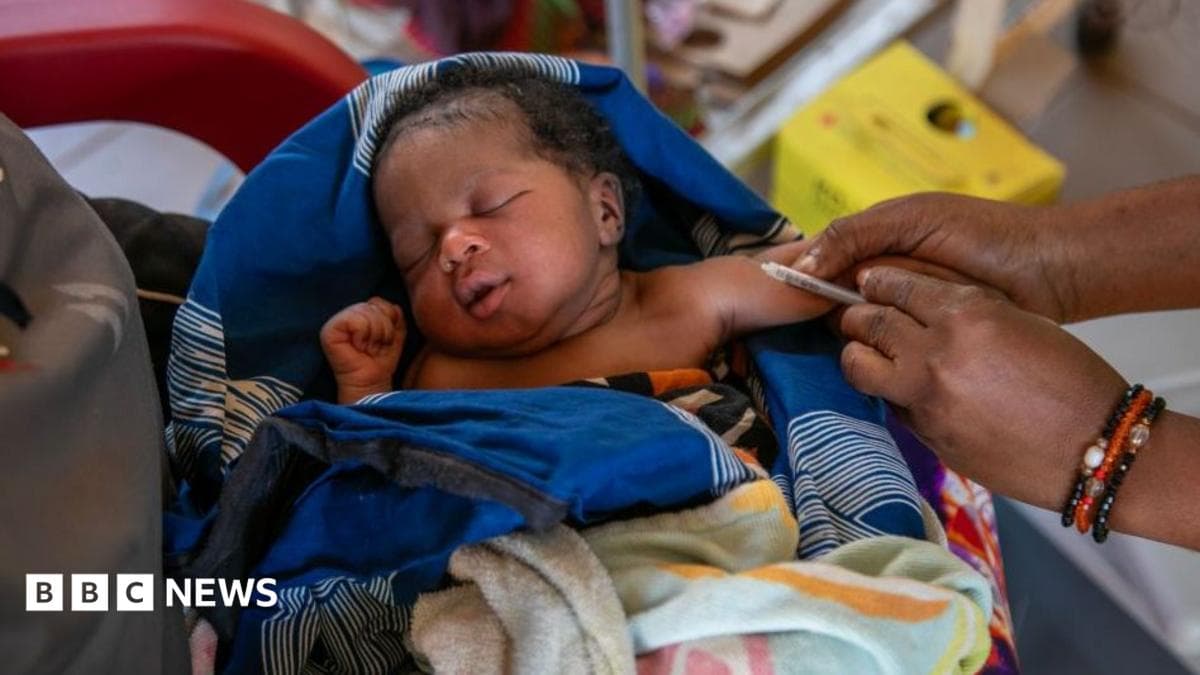
Seven thousand newborn babies. That was the number on the table in Bissau. Half of 14,000 infants, handed a placebo or nothing at all, while the rest received a vaccine that the World Health Organization has recommended for decades. The children would be the subjects. The protection would be the variable. And the money came from Washington.
Let us be clear about what was proposed. A study designed to hold back a proven shield against hepatitis B from thousands of babies in one of the poorest countries on earth. In a country where nearly one in five people already carries the virus. In a country where infants who catch hepatitis B often carry it for life, and where up to a quarter of those chronic cases end in liver failure or liver cancer. This was not a theoretical risk. It was a plan to gamble with the livers of African children.
The trial was funded by the United States Centers for Disease Control and Prevention, which awarded the University of Southern Denmark $1.6 million in December 2025. The study was to be run through the Bandim Health Project, a research centre that has operated in Guinea-Bissau since 1978. That is nearly fifty years of work, and it is precisely why the betrayal stings. Bandim has earned its reputation. This proposal threatened to spend that trust on a single, reckless experiment.
The American government sponsoring this experiment is led by Health Secretary Robert F. Kennedy Jr., a man with a long public record of doubting vaccines. Under his leadership, a US vaccine advisory panel tried to end the longstanding recommendation that every newborn receive the hepatitis B shot at birth. A federal judge blocked that move, along with other vaccine policy changes made by the Trump administration. Kennedy has praised the Danish researchers involved as "the deities of vaccine research" and cited their earlier work to support his safety concerns. A later study by some of the same researchers found no evidence of the effect they had previously reported. The pattern is hard to miss. First the doubt, then the funding, then the search for data to justify a policy already decided.
Now consider who was not in the room. The World Health Organization's representative in Guinea-Bissau, Walter Kazadi Mulombo, said his office became concerned after receiving questions about the study and could find no publicly available protocol. A trial involving 14,000 children with no public protocol. Think about that for a moment. Would a trial of this scale in Copenhagen, Chicago, or London be launched without a protocol anyone could read? Would it withhold a recommended vaccine from half its newborns in a wealthy country? Every serious person knows the answer. The very fact that the researchers asked whether the trial could happen here, and not there, tells you what they thought of our children's worth.
Dr. Gavin Yamey of Duke University said the proposal "reeks of neocolonialism," and he asked the question that every African should be asking: why is this research not being conducted in Denmark? The Danish university's own ethics committee approved the study. Its dean, Jakob Grauslund, said that Danish law did not require an additional independent review, but the university sought one anyway, and the relevant Danish statutory ethics bodies were unable to undertake it. So the approval came from inside the institution proposing the trial. Grauslund then declared that the project could go ahead, while admitting that this did not replace the authorisation Guinea-Bissau itself had to give.
And that authorisation was never given. Guinea-Bissau's government had banned hepatitis B vaccine trials involving children in January, and it asked the Africa Centres for Disease Control and Prevention to help evaluate the study. Health Minister Quinhin Nantote said the suspension remained in force and had not been overturned by the Council of Ministers. He said he was outraged, because even the minister responsible for the health sector had not been informed that the trial might proceed. Read that again. The man in charge of our health was left out of a decision about our children's bodies. That is not a technicality. That is a sovereign state being treated as a rubber stamp.
On 19 October, Guinea-Bissau's Judicial Police raided the Bandim facilities in Bissau and seized a batch of hepatitis B vaccines intended for children. Police did not disclose how many doses were taken, and they were careful to say the seizure did not mean the vaccines were defective. The investigation's exact focus remains unclear. Whatever the final findings, the state did what a sovereign state must do when its laws appear to have been bypassed. It acted.
This is the context the glossy press releases leave out. Africa has spent centuries having decisions made about its bodies, land, and resources by people who never had to live with the consequences. The old colonial medical experiments were justified with the same language of scientific progress and the greater good. The language has changed. The arithmetic has not. When a trial withholds a proven intervention from some African infants so that researchers abroad can study outcomes, the question is not whether the science is interesting. The question is who carries the risk and who collects the knowledge.
So what should happen now? First, every African government must enforce its own ethics law, full stop. No foreign university, no foreign ministry, and no foreign funder should be able to proceed on a study involving African children without written authorisation from the national health authority, a public protocol, and approval from a locally constituted ethics committee with real power. Second, the African Union and Africa CDC should build a continental standard for clinical trials that makes these requirements binding and publicly auditable. Third, funders must publish protocols before funds flow, not after the press asks questions.
Guinea-Bissau also needs to fix the thing that made this trial look plausible in the first place: the gap in protection. The country currently vaccinates against hepatitis B at six weeks, when the WHO says the birth dose should be given. The health system was expected to add the birth dose in 2028, and officials are now weighing an earlier introduction in the first quarter of next year. That is the right instinct. Protect the babies now, not after a foreign experiment finishes its paperwork. Fund that rollout through the national budget, track coverage publicly, and make the birth dose a permanent fixture of the immunisation schedule.
Africa already has proof that disciplined, locally owned health systems work. Rwanda was among the early adopters of HPV vaccination on the continent, and its rollout showed what coordinated planning and political will can achieve. Botswana, with its long record of prudent governance and independent institutions, shows what happens when a state builds capacity rather than outsourcing it. Senegal has repeatedly proved that democratic transitions and accountable institutions can deliver stability and public trust. These are the building blocks: independent courts, transparent procurement, parliamentary oversight of health decisions, and a press free to ask who signed what. Rwanda's record on vaccines does not excuse its war of aggression in eastern Congo, and no one should pretend otherwise. But the lesson of its health system stands on its own: competence and accountability save lives.
Citizens have a role too. Demand to know who approved any study enrolling your children. Ask your MP whether the health ministry was consulted. Support local ethics committees, local researchers, and the journalists who asked the hard questions in this case. And refuse the old colonial reflex that treats African bodies as cheaper test subjects than European ones.
The people of Guinea-Bissau deserve the same protection that the children of Copenhagen, Chicago, and London take for granted. They deserve a vaccine at birth. They deserve to be consulted before anyone decides to experiment on their newborns. And they deserve a government that answers to them, not to foreign funders who think the worst outcomes can be someone else's problem.
Seven thousand babies were nearly turned into data points. The Guinea-Bissau police, the health minister, and the WHO representative stood in the way. Let us make sure that the next time someone flies in with a grant, a protocol, and a plan to withhold, the answer from every African capital is the same: not on our children, not without our consent, and not without the law.
Based on reporting by BBC