spotlight
Beijing Now Touches a Third of Africa's Ports Behind Closed Doors
Ask a dockworker in Mombasa, Dar es Salaam, or Lagos who owns the crane he operates, and you may get a shrug. Ask who holds the software that tracks every container through the gate, who services it, and what happens if the license lapses, and you will get silence. That silence is the story.
China now operates, finances, partners with, or holds stakes in roughly one-third of Africa's ports. It accounts for about 22 percent of all African trade. It is the largest trading partner for 52 of our 54 states. Since 2013, according to the Africa Center for Strategic Studies, Beijing has poured roughly $50 billion into African port infrastructure. Those are not abstractions. They are cranes, berths, rail spurs, warehouses, and data systems woven into the arteries of our economies. Whoever controls the arteries controls the body.
Consider Djibouti. The Doraleh Multipurpose Port sits on the Bab el-Mandeb Strait, one of the most important chokepoints on earth, where the Red Sea meets the Gulf of Aden. It was built and financed by Chinese state-owned firms. China Merchants Group holds a 23.5 percent stake in its terminal operations. The port was developed alongside a free-trade zone and was central to planning the nearby PLA naval base, which opened in 2017. Beijing has repeatedly declined to confirm or deny its interest in a naval base in Djibouti, even as the facility sits metres from the commercial infrastructure it helped design. A Djiboutian citizen deserves to know what was signed in his name, and in most cases he has been given no such right.
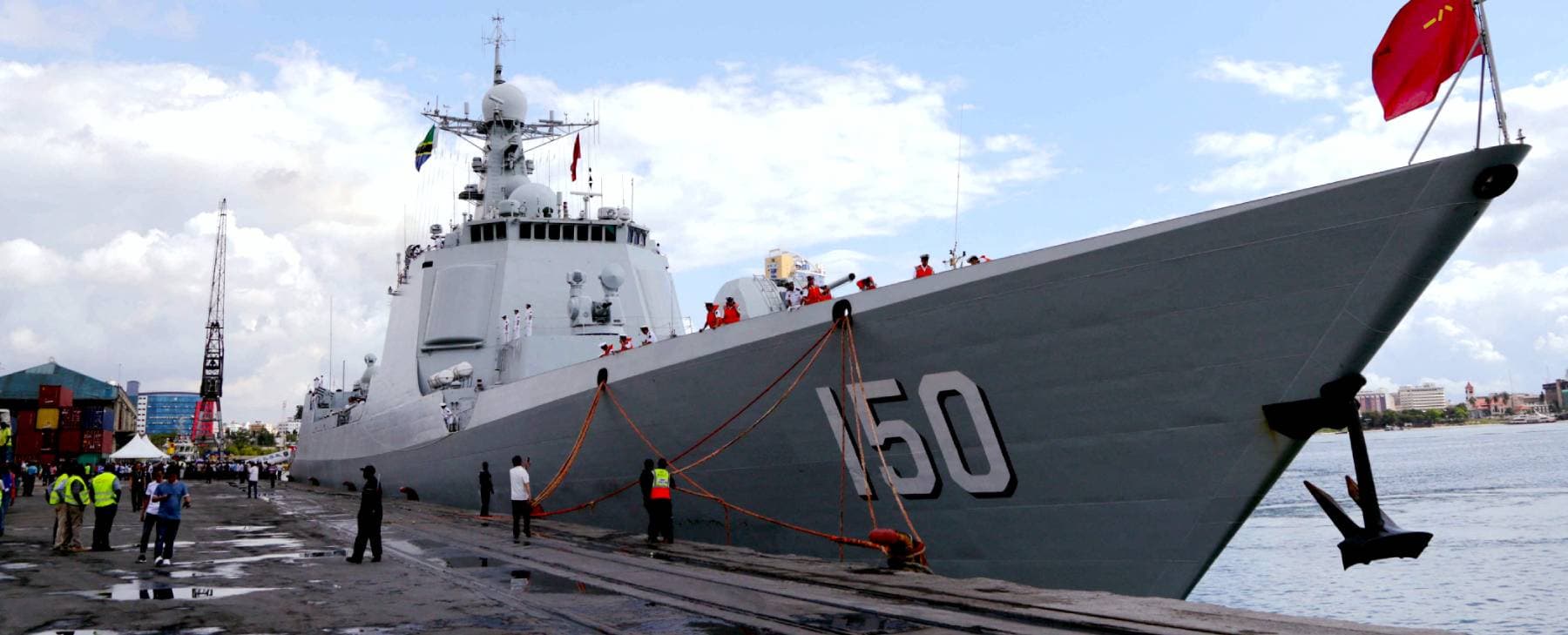
Now look at the navy. Since 2008, China has rotated 48 task-force groups through the Gulf of Aden, ostensibly to fight piracy. Chinese state media claim these escorts have protected more than 7,000 vessels off the Somali coast. We can grant the piracy mission its due. But the same rotations have drawn from the East, South, and North Sea Fleets, the commands responsible for Taiwan and South China Sea contingencies. African waters are being used as a training ground for conflicts that have nothing to do with us. Port calls have followed in Djibouti, South Africa, Tanzania, Nigeria, Angola, Kenya, Namibia, and the Seychelles. Joint drills now include the 2024 "Amani na Umoja" exercise with Tanzania and Mozambique, the 2025 "Eagles of Civilization" exercise with Egypt, and the 2026 "Will for Peace" exercises with South Africa, Russia, and Iran under the BRICS banner.
Then there is the data. More than 30 African countries rely on China's BeiDou satellite navigation system, either alone or alongside America's GPS, for primary maritime navigation. Ports now run on Chinese automation, proprietary AI for gates and sensors, and software whose maintenance costs, by one analysis, could eventually exceed the value of the physical port assets themselves. When a navigation signal, a customs system, or a maintenance contract sits in a foreign capital, sovereignty becomes a subscription service.
And the fish are disappearing. Coastal communities from Senegal to Mozambique are watching their stocks depleted by illegal, unreported, and unregulated fishing. Chinese distant-water fleets, the largest in the world, are repeatedly identified as major offenders. The fisherman who cannot feed his children does not care about the geopolitics of the port that now handles the trawler's cargo. He cares that the sea that fed his grandfather is being emptied.
Let us be clear about what this is. This is not a return to the 1884 Berlin conference, with flags drawn on maps by men who never saw the land. It is subtler, and in some ways more dangerous, because it arrives with loans, scholarships, and ribbon-cutting ceremonies. Beijing is not alone in the new scramble for Africa. Turkey, the UAE, Qatar, Russia, the United States, and European powers are all competing for ports, minerals, and military footholds. Our task is not to choose a master from this line of suitors. Our task is to refuse the mastery itself. The question is not whether China builds. It is whether we are permitted to know the terms, challenge them in court, and walk away when they betray us.
Here is the uncomfortable truth our leaders keep avoiding. Much of the danger is not imposed on us. It is invited. Governments sign concession agreements in rooms that no journalist, parliamentarian, or civil society group is allowed to enter. The source material notes that concerns about Chinese influence over strategic infrastructure persist precisely because agreements are not public and oversight is weak. Those are not Beijing's failures. Those are ours. A president who hides a port contract from his own parliament is not protecting the nation. He is selling it in the dark and calling the sale a partnership.
So what must change? First, every port concession, loan agreement, and maintenance contract must be published in full before signature. Not summarised. Not redacted. Published. The Open Contracting standard already exists. Use it. Second, every port must be governed by an independent regulator with the power to audit tariffs, cybersecurity, and foreign ownership, and with its reports tabled in parliament. Third, debt sustainability analyses must be made public before any loan is accepted, and no government should accept collateral on strategic assets it cannot afford to lose. Fourth, technology procurement must be competitive and must require data localisation, local engineers, and escrowed source code so that no foreign firm can switch off a national gateway.
Africa already has blueprints. The African Union's 2050 Africa's Integrated Maritime Strategy calls for coordinated governance of our seas, and the Yaoundé Code of Conduct binds West and Central African states to share information on piracy and illegal fishing. Those frameworks are gathering dust because they lack political will. Botswana has shown for decades that transparent institutions and disciplined public finance can attract serious investment without surrendering control. Mauritius built a sophisticated financial and logistics hub on the back of predictable rules and an independent judiciary. Senegal, after its 2024 election, proved that a peaceful transfer of power strengthens investor confidence and public trust alike. Good governance is not a luxury for rich countries. It is the cheapest security policy we have.
We also owe ourselves a harder conversation about the private sector. Local shipping companies, freight forwarders, and port-service firms should be given the same access to tenders and financing as their foreign competitors. A competitive domestic maritime economy is the best insurance against any single foreign owner becoming indispensable. And regional bodies such as ECOWAS, SADC, and the East African Community should negotiate collectively with external partners rather than letting each capital bargain alone, where the stronger party always wins.
So here is what we demand. We demand that our governments publish every maritime agreement with China and every other foreign partner, now. We demand independent regulators with teeth. We demand that parliaments, not presidential offices, approve any foreign military access to our ports. We demand fishing enforcement that actually arrests and fines violators, whatever flag they fly. And we demand that the African Union stop issuing communiqués and start enforcing its own maritime strategy.
Beijing is patient. It plans in decades. Our leaders plan in election cycles. That asymmetry is the real vulnerability, and only Africans can close it. Read the contracts that govern your port. Ask your MP who negotiated the BeiDou dependency. Ask why the fish are gone. The sea around this continent belongs to the people who live on its shores, and it is time we acted like it.
Based on reporting by ACSS